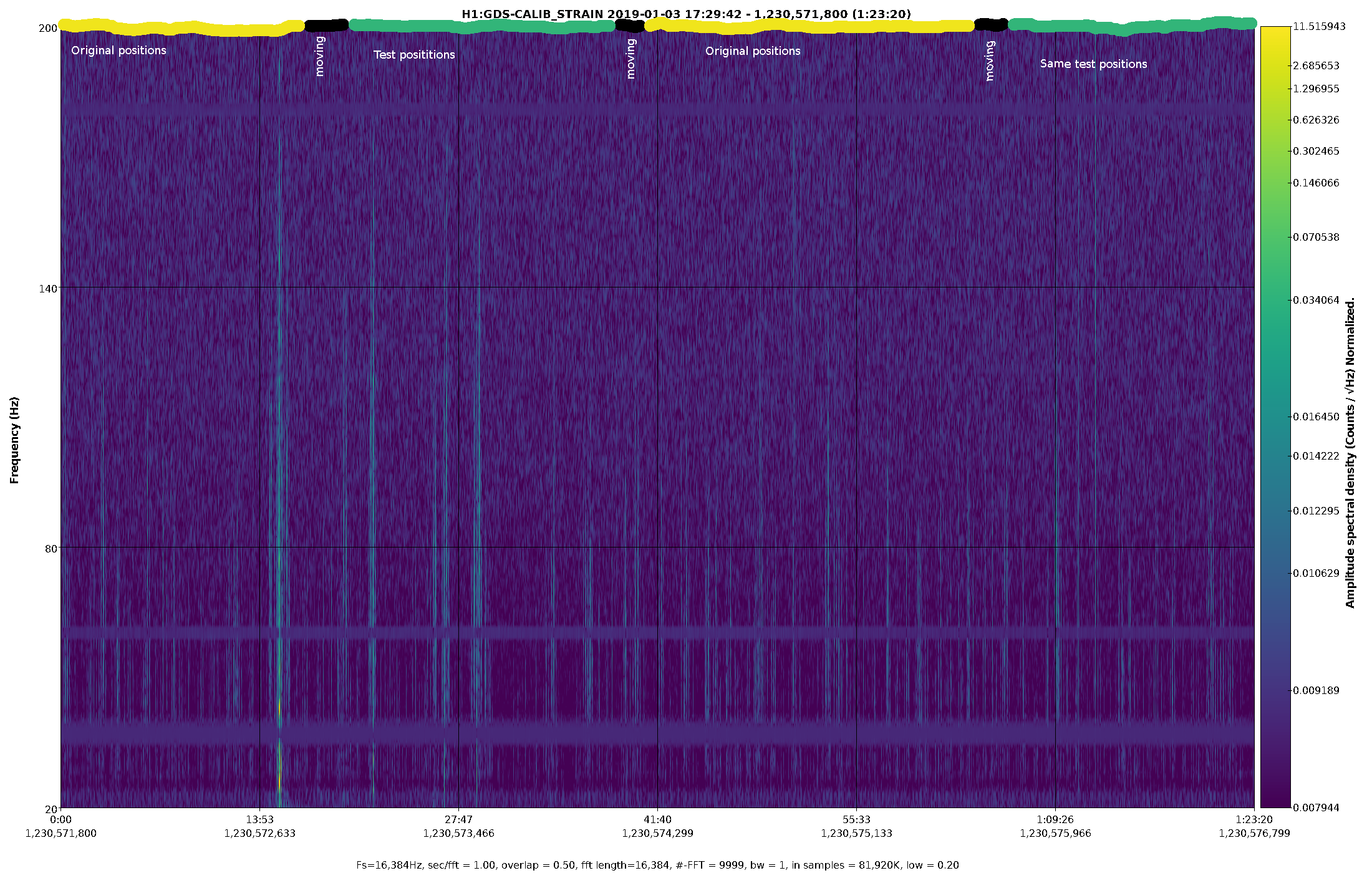
While we were locked (16.5 hours!), we noticed that especially with the large wind (and / or anthropogenic ground motion?) we were seeing big scatter shelves in the DARM spectrum.
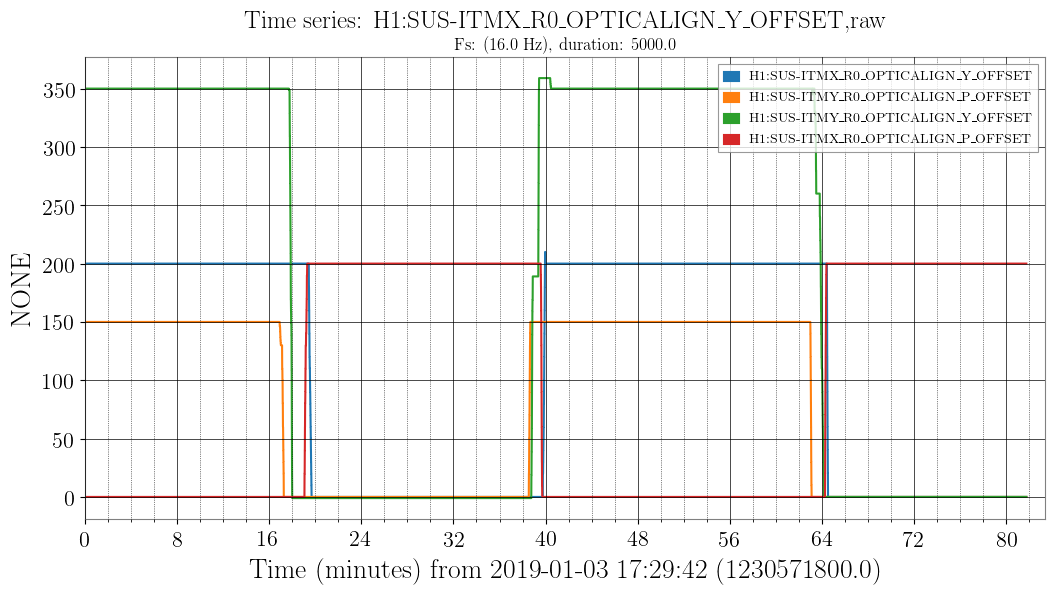
As a first pretty passive check, we moved the ITM compensation plates to see if a different position would give different scattering structure. The test positions (slider values shown in time series attachment) are perhaps slightly worse than the nominal, but it's pretty hard to say.
In the attached 5000 second spectrogram, I have drawn colored lines along the top of the x-axis to indicate the state of the CPs at various times. The plot includes 1000 seconds at the CPs' nominal positions (yellow line), a test position (turquoise line), again the original positions (yellow) and again the test positions (turquoise). During the times of the black lines the CPs are being moved. You can see that the first time we were in the test positions things were clearly worse, but that could perhaps have corresponded to some higher wind speeds (we've been getting sustained winds of more than 20 mph this morning). When we repeated the test back to the test positions, the scattering is maybe a teeny bit worse than the nominal positions, but it's really very marginal.
We moved on to some squeezing tests after this, so we haven't tried any more CP positions. For now, we're leaving them at their nominal positions.
If DetChar has time, it would be helpful to run the scattering identification tools on some of the data in the last ~5 hours, to help us identify what might be the cause of this scattering.