RX/RY motion is typically a limiting factor for ISI suspension point motion. This is because we are limited in lowering the blends by sensor noise, but it might be possible to make different compromises to reduce SRCL motion between 1 and 10 hz, possibly allowing lower SRCL loop gain to reduce SRCL to DARM coupling.
On the HAM ISI, the current RX/RY blends are designed to minimize the blend gain peaking below 1 hz and to avoid injecting rotational GS13 noise into the horizontal loops below .1 hz. This limits how quickly the CPS blends can roll off above 1 hz, thus limiting the absolute isolation. I've tried to come up with a blend to improve performance above 1 hz, but compromises need to be made to do that. In October, I tried running these blends for a couple of days on HAMs 4&5 RX/RY.
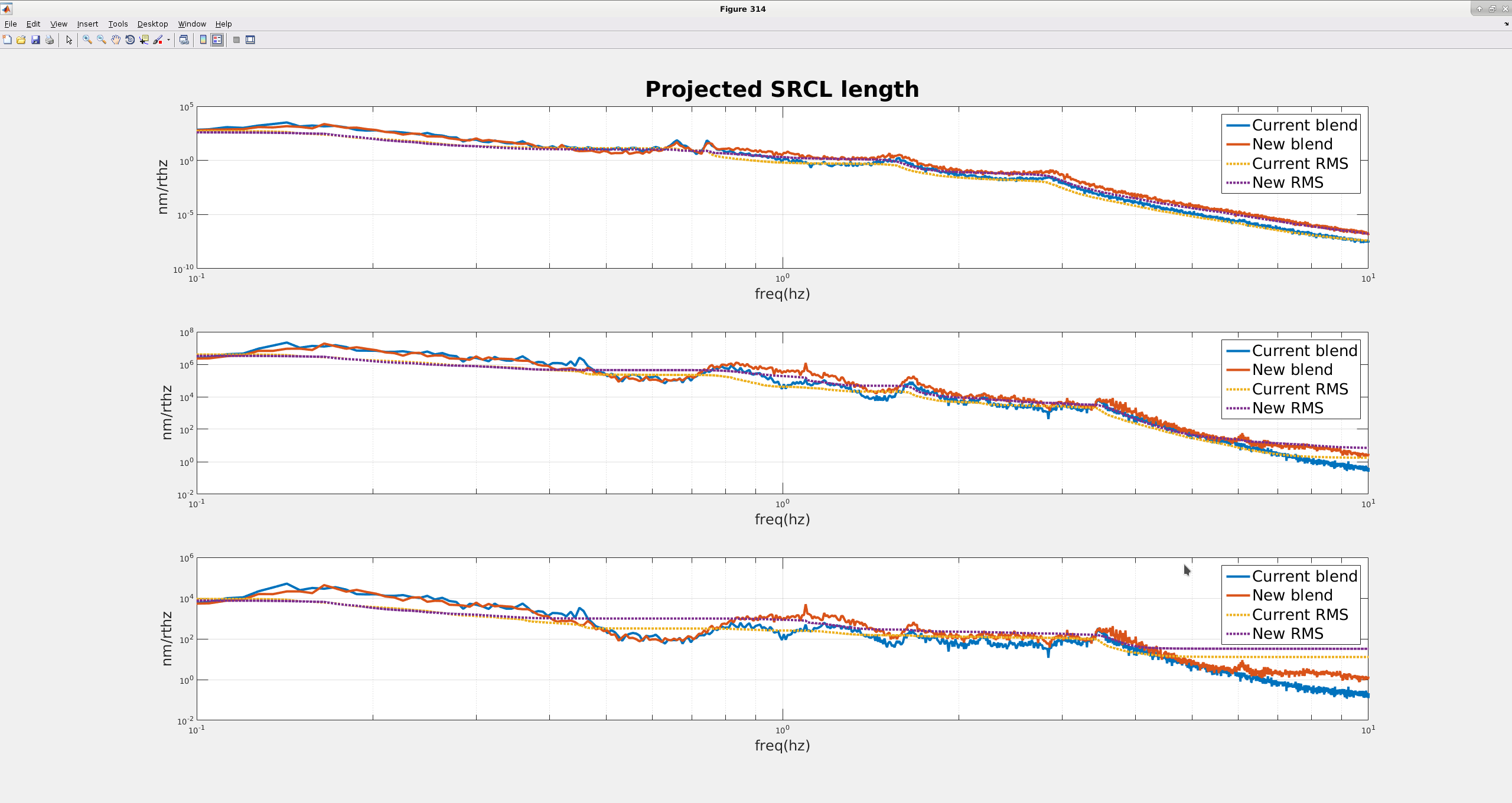
First attached plot shows some spectra comparing a lock on Oct 19 last year (with the "improved blends") to a lock a couple days later (with the low gain peaking blends). The top plot is a reconstruction of the SRCL cavity using the ISI gs13s, which I did by multiplying each optics OAF_SUSPOINT motion timeseries by the appropriate suspension model to estimate each optic's motion (using lsim in matlab), then adding the timeseries together using the coefficients from the OAF_SUSPOINT cavity calculations. The second plot compares CAL_CS_SRCL for the two locks, this is supposed to be um, but that is clearly wrong, the cavity can't be moving ~1m, so I'm not sure what the calibration is there. The third plot is the SRCL drive on SRM M3. All 3 plots show some improvement over above 1 hz with the more aggressive blends on HAMs 4&5 RX/RY.
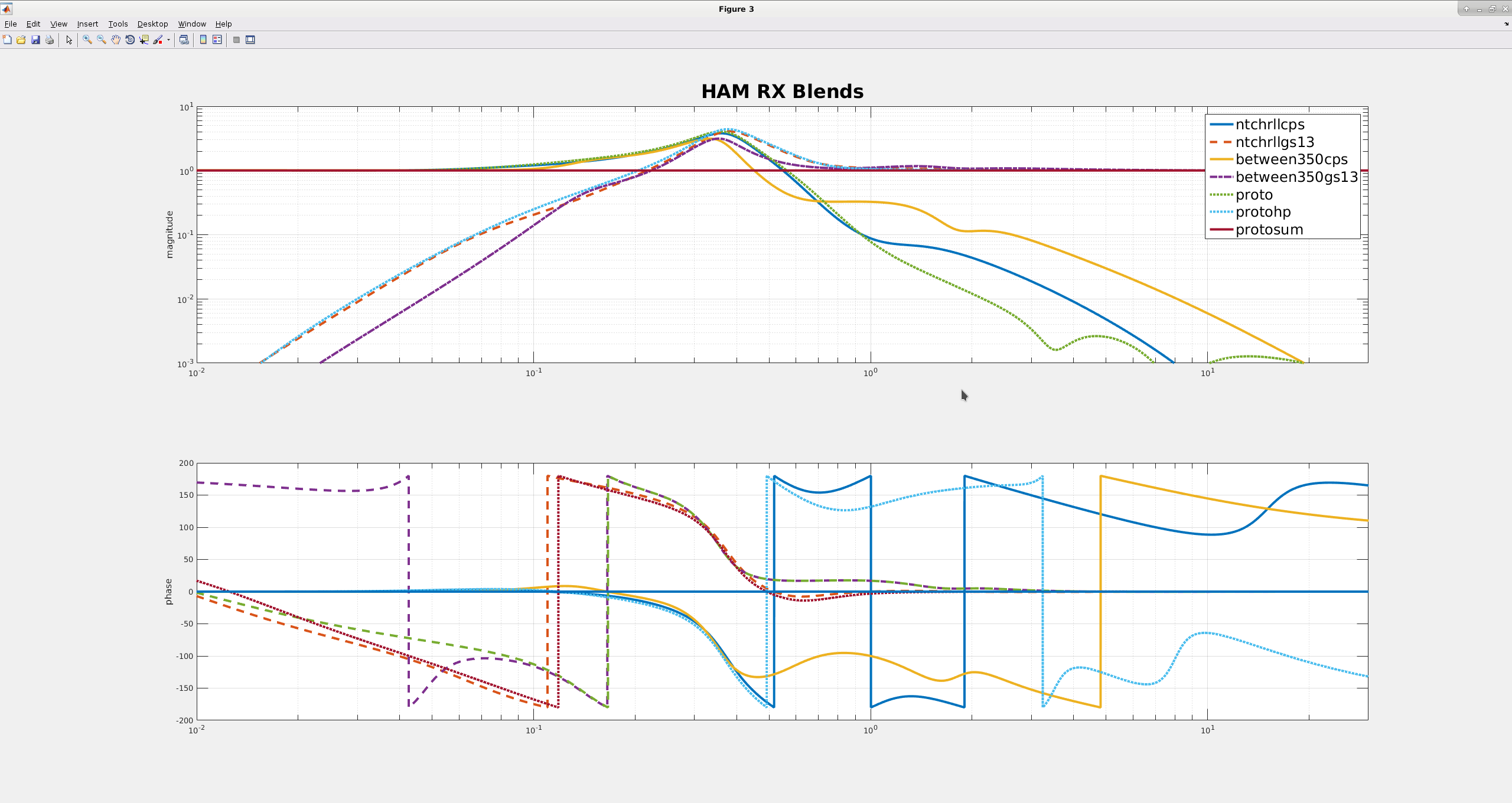
The second attached figure is a bode plot that compares are couple blends for the HAM ISIs. The first two lines (ntchrll...) are the blends that we use currently, which have low gain peaking, but are CPS noise limited, pretty much everywhere. The next two lines (between350...) are the more aggressive blends I tried in October. They inject more GS13 noise at low frequency into the horizontal loops, but didn't keep us from locking, so maybe it's okay. The last three lines are a more aggressive blend I would like to try, guided by the improvements I was able to get by changing blends. The low frequency stuff is pretty similar, the gain peaking is roughly the same, but I gave up above 10hz CPS roll-off to try to get as much improvement as possible between 1-10hz.