
A new h1calinj model has been installed on the h1oaf1 machine. This model will hold all front-end injection handling logic, including the injection EXC test points, under the channel prefix "H1:CAL-INJ_". The existing injection handling code in the h1calex model ("H1:CAL-PINJX_") has been left as is for now to facilitate transitioning and testing.
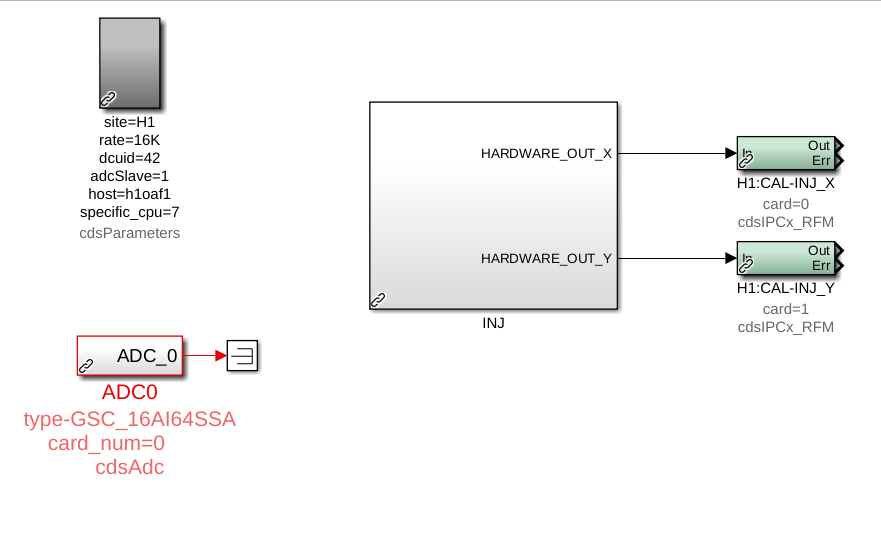
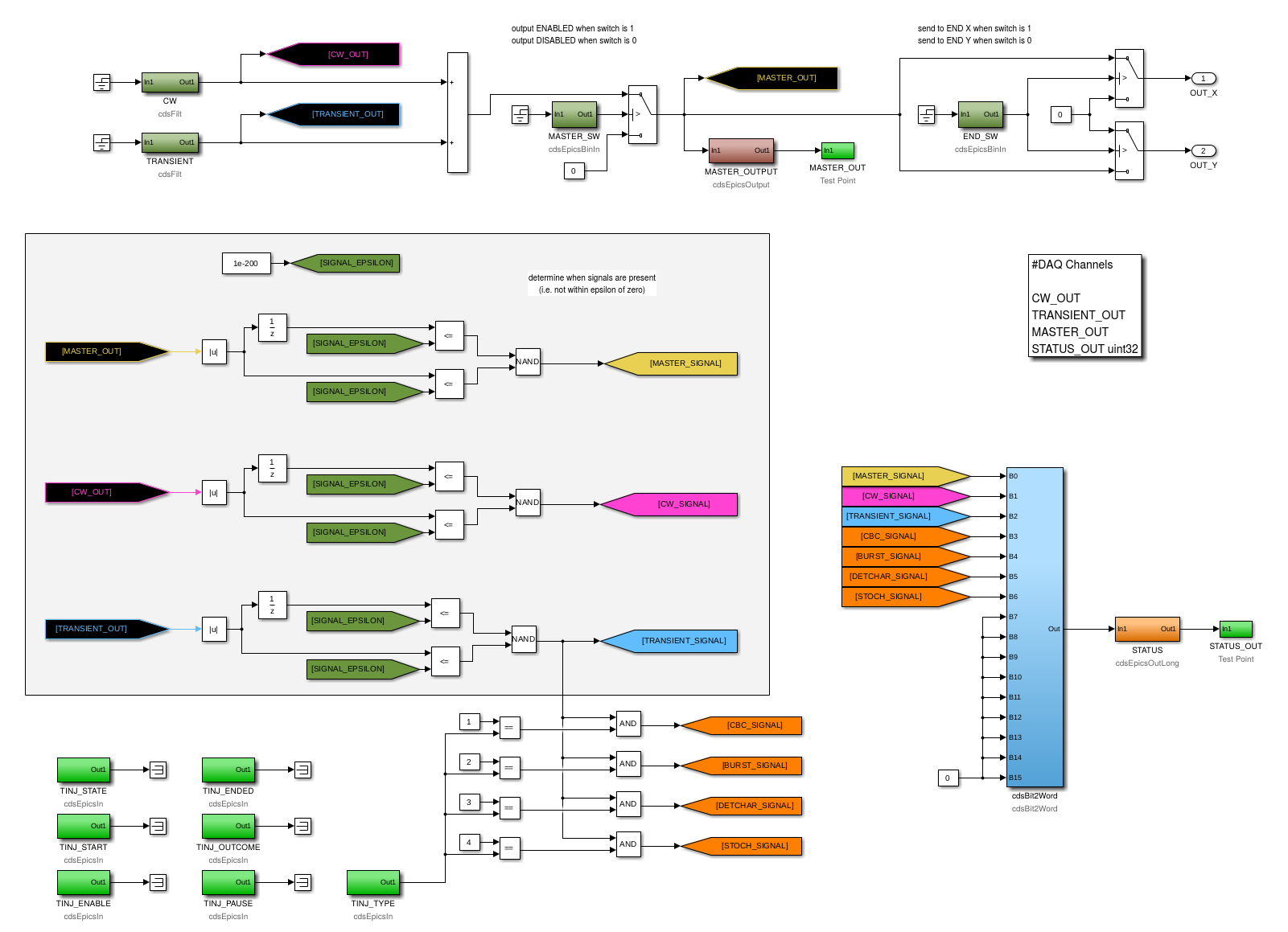
The first two attached images are of the top-level contents of the new h1calinj model, and of the contents of the "INJ" CAL_INJ_MASTER2 library part that contains all the core logic. The top of the latter shows the main injection signal flow. The two "CW" and "TRANSIENT" filter banks at the upper left hold the EXC inputs and calibration filters for the continuous-wave (CW) and transient (TRANSIENT) injection inputs respectively. The outputs of the two modules are summed and the overall "MASTER" output goes through an output switch ("MASTER_SW"), and then finally a switch ("END_SW") that determines which of calex or caley receives the injection signal ("H1:CAL-INJ_{X,Y}" via cdsIPCxRFM). Below the main signal path is logic to determine the presence of signals at various points in the injection path, and bundle that info into a single status word ("STATUS_OUT").
IPC receivers for the INJ_MASTER output sent from h1calinj (H1:CAL-INJ_{X,Y}) were added to the h1calex and h1caley models. EPICS and acquired test point monitors of the received signals were also added.
NOTE: a single 2**14 Hz, 61 us cycle delay will be added to the injection path because of the IPC needed to carry the signal from the vertex to the ends.
The new acquired fast channels are:
- H1:CAL-INJ_CW_OUT_DQ
- H1:CAL-INJ_TRANSIENT_OUT_DQ
- H1:CAL-INJ_MASTER_OUT_DQ
- H1:CAL-INJ_STATUS_OUT_DQ
- H1:CAL-INJ_X_OUT_DQ
- H1:CAL-INJ_Y_OUT_DQ
The STATUS channels (the H1:CAL-INJ_STATUS_OUT_DQ uint32 fast channel and the H1:CAL_INJ_STATUS slow channel) have the following bits:
- MASTER
- CW
- TRANSIENT
- CBC
- BURST
- DETCHAR
- STOCH
A value of zero (0) indicates no signal of the specified type is present, and a value of one (1) indicates the presence of the specified signal.
The h1calinj model also holds the "TINJ" EPICS status bits, nominally set by the INJ_TRANS guardian node. NOTE: the "H1:CAL-INJ_TINJ_" EPICS records were previously hosted by the ext_alert_ioc.py soft IOC running on the h1fescript0 machine. The records were removed from the soft IOC and the process was restarted.
The final image attached is a new MEDM screen CAL_INJ_CONTROL2. All functionality and status bits in the h1calinj model, and the monitors in h1calex and h1caley, are exposed.
As mentioned above, all the existing INJ infrastructure remains in place. We leave it up to the INJ group to update the INJ_TRANS guardian, the psinject process, downstream monitors, etc. We would like to schedule the removal of the old INJ infrastructure as soon as possible,
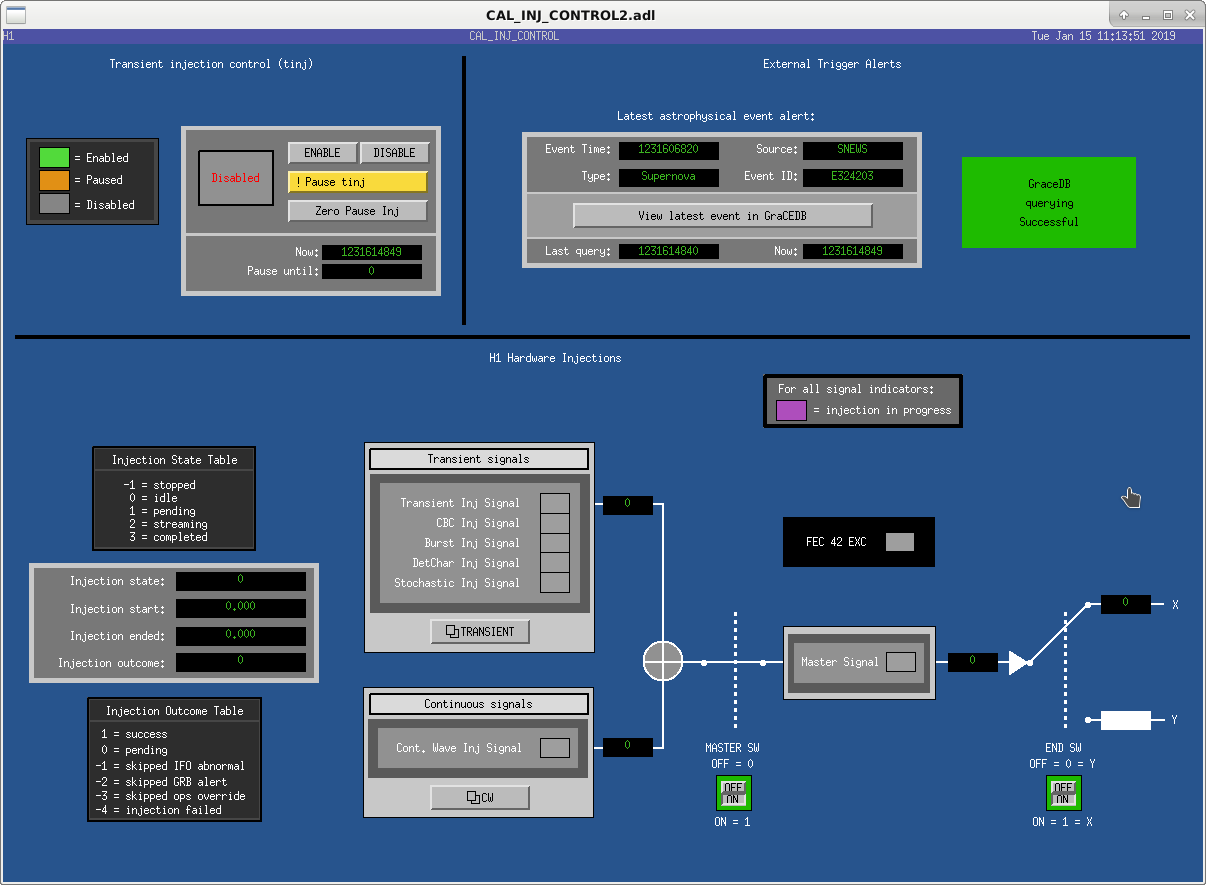
New MEDM screen is now accessible from the sitemap (cal-> hwinj ctrl). Old one is still there as "hwinj ctrl old".
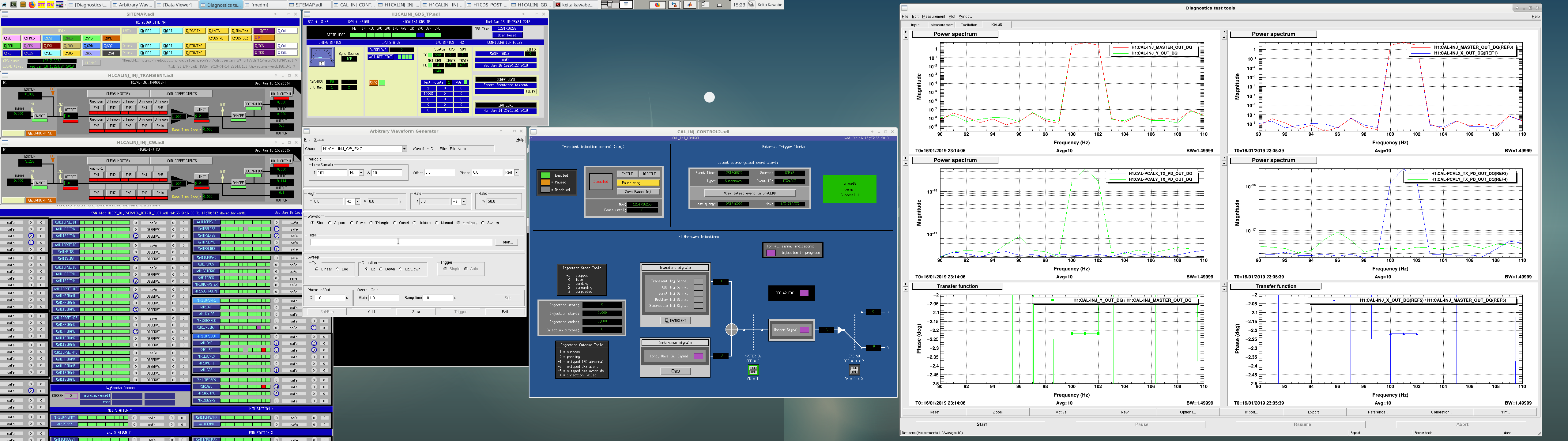
I briefly tested the new frontend.
- TRANSIENT INJ Signal bit of H1:CAL-INJ_STATUS responded correctly to excitation as well as an offset in H1:CAL-INJ_TRANSIENT filter module.
- CW INJ Signal bit of H1:CAL-INJ_STATUS responded correctly to excitation as well as an offset in H1:CAL-INJ_CW filter module.
- MASTER Signal bit of H1:CAL-INJ_STATUS responded correctly to excitation as well as an offset in either INJ_TRANSIENT or INJ_CW filter module.
- Excitation bit of H1:FEC-42_STATE_WORD only responded to excitations but not offsets (of course).
- H1:CAL-INJ_END_SW=1 or 0 correctly delivered the MASTER_OUT signal to h1calex or h1caley model (monitor points are H1:CAL-INJ_X_OUT and H1:CAL-INJ_Y_OUT).
- Time delay from MASTER_OUT to h1calex and h1caley was 61.035us, which is almost exactly 1/(2^14Hz). This was measured by injecting sine wave at 101Hz to CW and measuring the transfer function from MASTER_OUT to X_OUT or Y_OUT.
- H1:CAL-INJ_X_OUT or Y actually does go to PCAL laser power (done by looking at H1:CAL-PCALX_TX_PD_OUT or Y).
No surprise in the above. See the screen shot.
One surprise was that I had some problem loading filters to the new model using foton. Jamie and Rolf are working to figure it out.
(Jamie, Keita)
Existing filters in CAL-PINJX_TRANSIENT filter module were copied over to the new CAL-INJ_TRANSIENT filter and loaded successfully, and the settings represented by the attached screen were put in SDF as safe.
Transient injection group should test the new infrastructure as soon as possible. The new channel to inject is H1:CAL-INJ_TRANSIENT_EXC.
Note that, as of now, the filter is automatically loaded after the model restart as expected, but you cannot reload as far as the model keeps running. CDS group is still investigating, but in the mean time if you need to load the filter, contact the site (e.g. myself) and we'll schedule to restart the model.

I've opened FRS-12175 to cover the problem loading h1calinj's filter file.