craig.cahillane@LIGO.ORG - posted 03:29, Monday 21 January 2019 (46553)
Power Up Thermalization
I've looked at most of the power ports of the interferometer to try to get a feel for how IFO thermalization is affecting power levels.

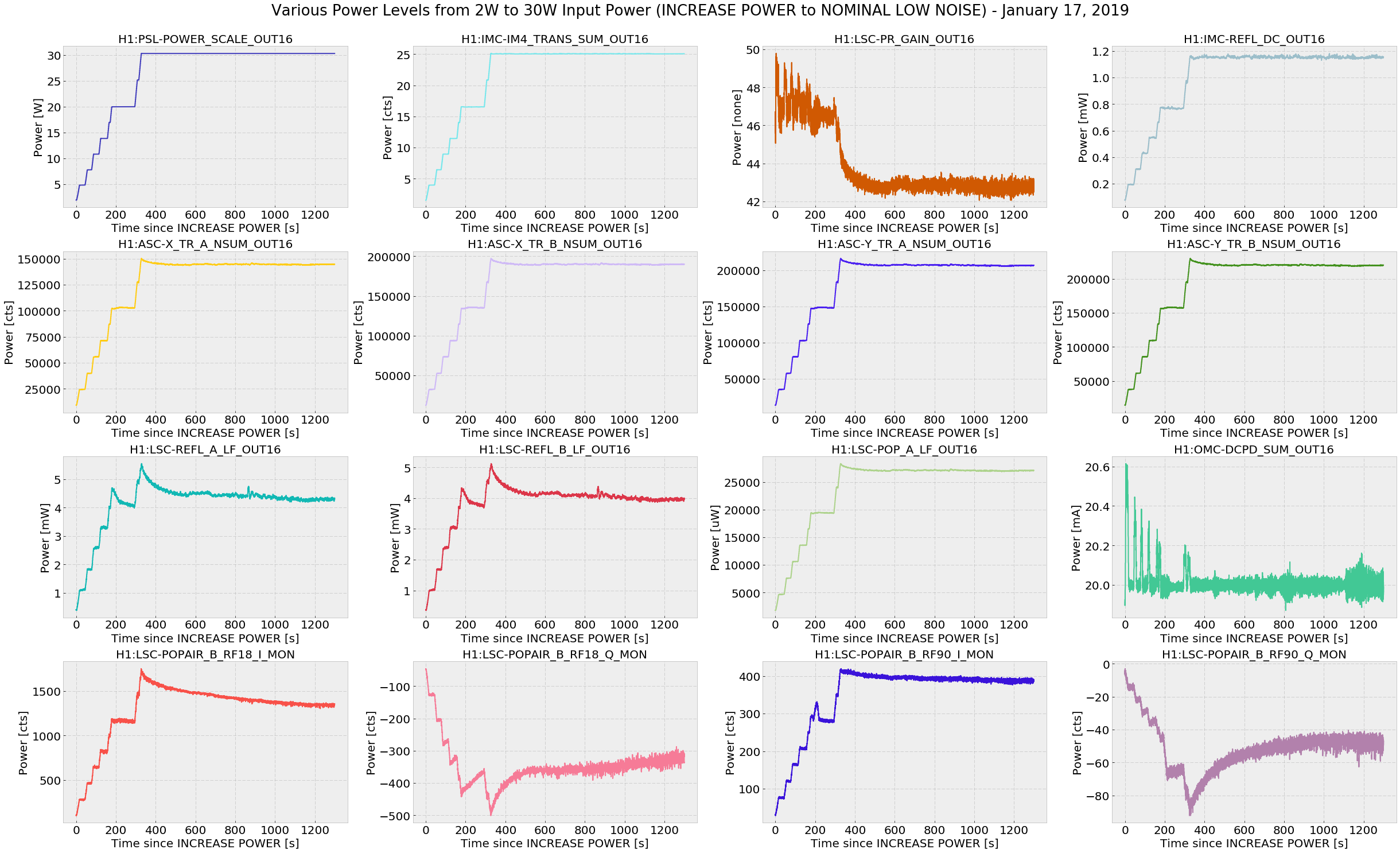
I looked at the time series of the PSL power, PR gain, Arms Transmission, REFL A/B LF, POP LF, and POP 18/90 I/Q from the beginning of a Jan 17 INCREASE POWER to NOMINAL LOW NOISE state transition.
- We reduced 45 modulation depth by 3 dB (from 27 to 24 dB on the 45 RFSET slider) at around 200 seconds at 20 W input power.
- We did NOT reduce RF 9 modulation depth.
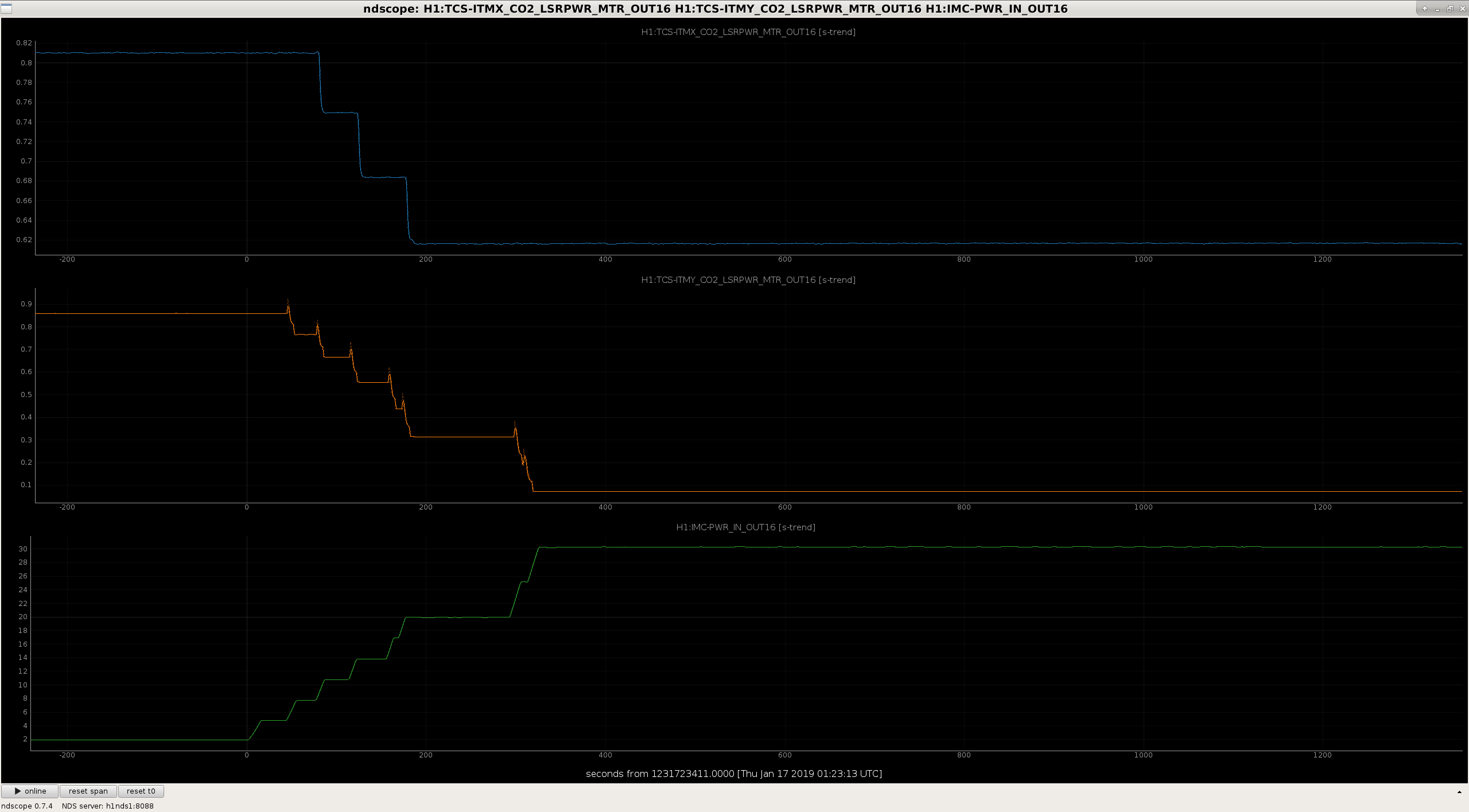
- Within the first 180 seconds, the TCS CO2 X moved from 0.81 to 0.62 W, and TCS CO2 Y moved from 0.86 to 0.07 W.

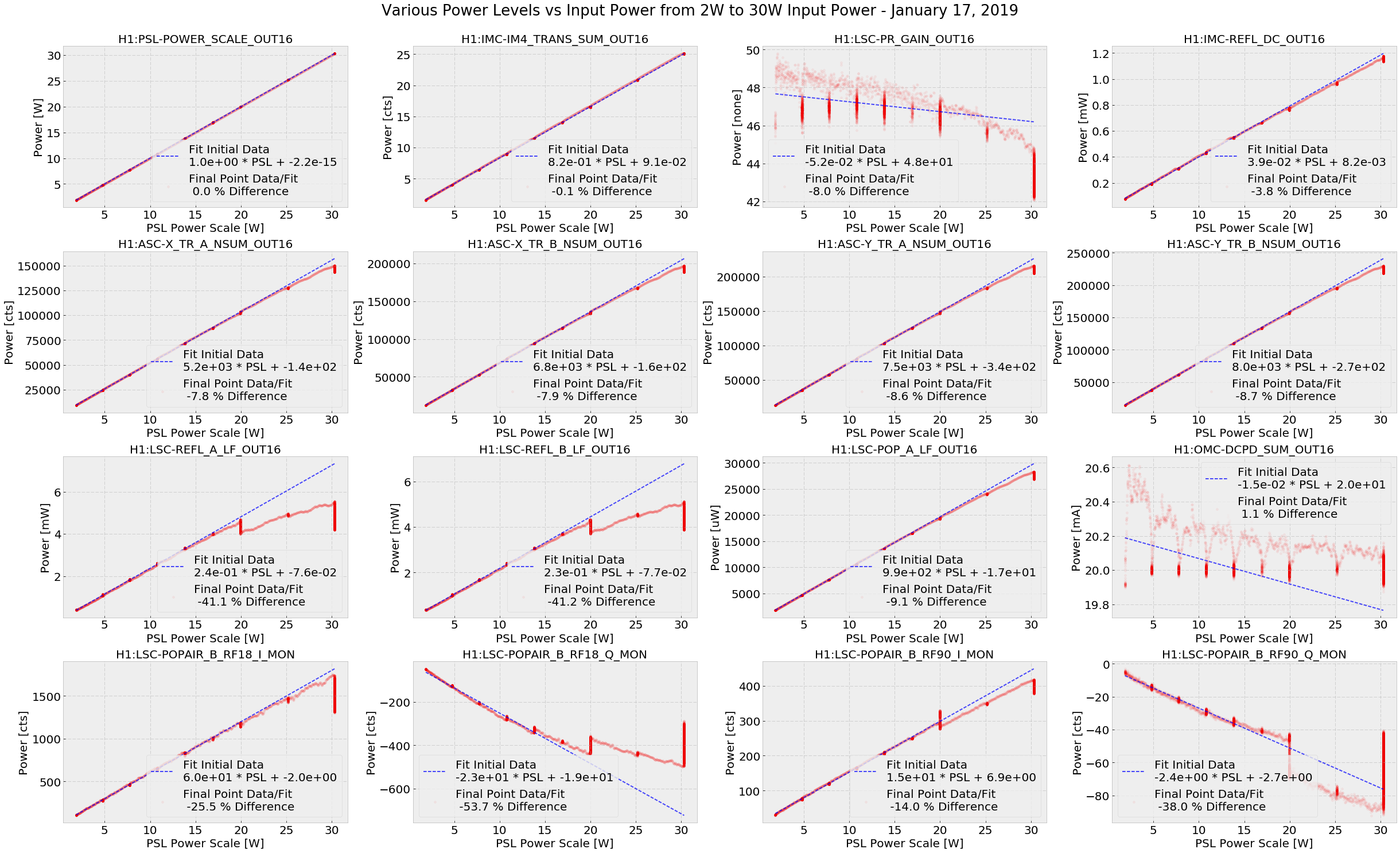
In attachment two, I fit a line to each of the early-stage power up numbers (from the first 150 seconds) to indicate what a linear response to power increases ought to look like.
When powering up from 2 to 30 W:
- The arm transmissions fall by 8%.
- POP LF falls by 9%.  This means most of our PRG thermalization losses in build-up come from increased arm losses.
- REFL LF lost 41%.  The REFL port is more complex because the CARM loop is trying to keep it as dark as possible in carrier, and PRCL is trying to keep 9 MHz on resonance as well.  REFL LF is probably mostly seeing the collapse of the 9 MHz sidebands, along with some 8% losses from the arms, and 15% losses from the 3 dB 45 MHz mod depth reduction.
- POP 18 lost 26%.
- POP 45 lost 14%.  7% comes from the modulation depth reduction.
Images attached to this report