Georgia, Sheila, Koji, Danny, Craig
BRUCO:
A BRUCO scan that Jonathan Richardson helped me to run can be seen here. Things of interest in the BRUCO scan are broad coherences with PRCL signals, angular noise polluting DARM up to 45 Hz, and coherence with the septum accelerometer at 90 Hz. There are also a lot of lines being picked up by BRUCO.


A2L decoupling:
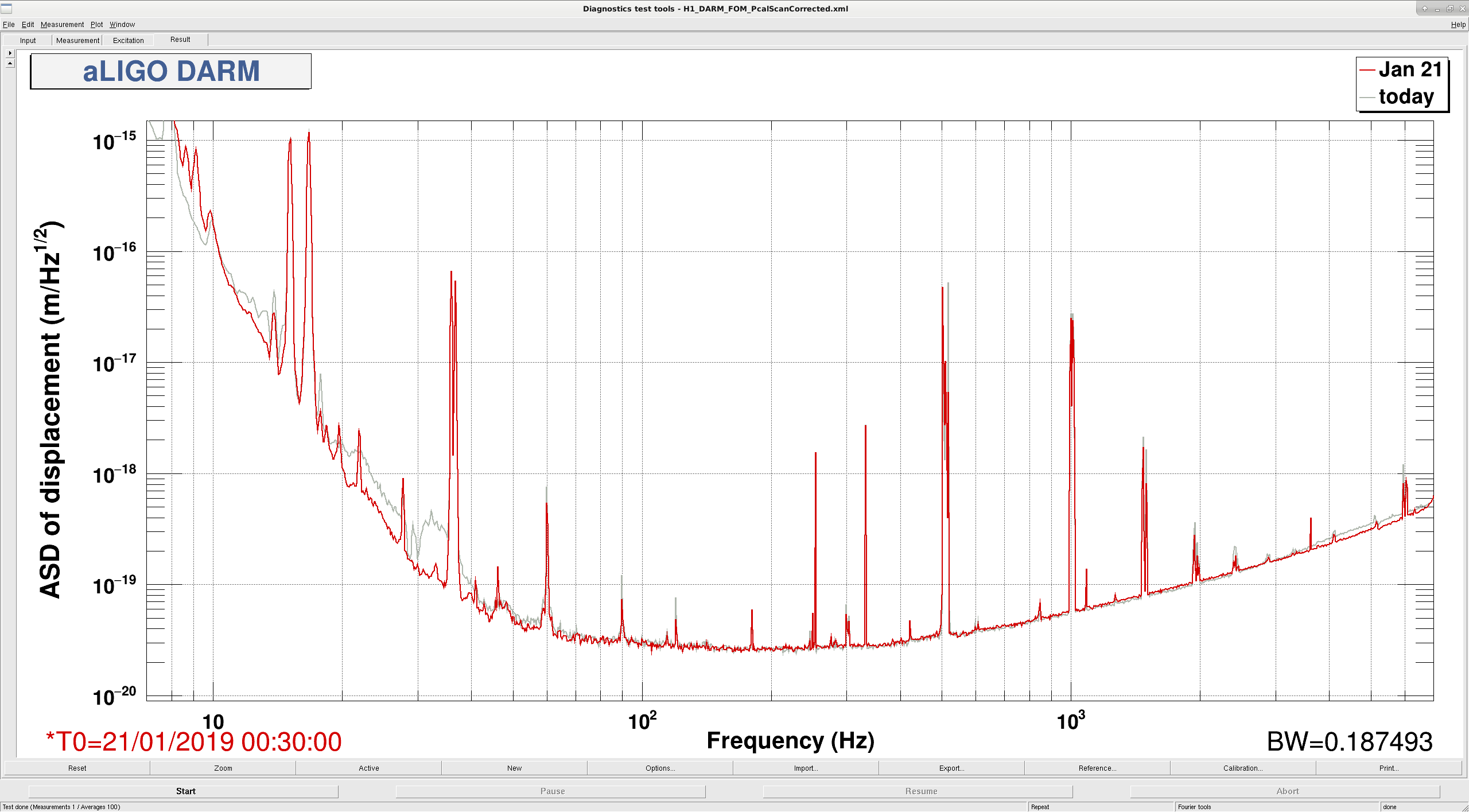
Today we had an increase in DHARD Y noise coupling to DARM, which degraded our sensitivity from 20-60 Hz.
The control signal spectrum for all the hard loops is the same as it was last week, it is just that the coupling to DARM has changed. We have not been running our A2L decoupling scripts since we switched to the spot position servos, since in principle they shoudl minimize the coupling of angular noise to DARM. We attempted to turn off the dither servos and run our old a2L scripts, but they both had errors that mean they aren't working. (Gabriele's script has a problem with nds connections, Hang's has a fitting problem). We manually adjusted the A2L gains for ITMX which not used for a dither servo, but this didn't improve the DARM noise.
I manually adjusted the ITMY Y2L gain using a 30Hz excitation and found that the value needed to minimize the coupling at 30Hz is rather different than the setting that the spot position servo has used. When we first started using the dither servos, the dither lines were all around 20 Hz, and the angular noise in DARM was well suppressed. Georgia has been moving the dither lines below the observation band, she finished moving the last three lines this last weekend 46554.
We are using a frequency independent angle to length decoupling. It may be that we need to use frequency dependent filters to have the dither lines at low frequencies and still have good decoupling at the frequencies we care about. Koji and I started to make a measurement of the frequency dependence of the decoupling but I broke the lock and we haven't relocked yet.
An additional problem that could be introduced by moving the dither lines to low frequencies is that the lines are not notched in the HARD ASC loops, so they go around the loops and are imposed on all the test masses, meaning that the spot centering loops will all be more cross coupled with these lower frequency dither lines, unless we can afford to notch them in the ASC loops.
SRCL FF to DARM plant changing:
Danny also made some measurements and did some fitting earlier to try to improve the SRCL FF. Danny Georgia and Craig have collected a number of different measurements for the feedforward fitting, but the differences between the measurements are large enough to prevent good feedforward. Danny has two different measurements of the SRCL FF actuation to DARM IN1 transfer function, and the phase of the two measurements was different by 10 degrees at 30Hz, probably because of the SRCL detuning causing an optical spring. (Edited after we realized with help from Gabriele that we weren't looking at the right references) If the optical spring is really wandering this much it will make it difficult for us to get SRCL subtraction better than 10% with a stable filter.
> Koji and I started to make a measurement of the frequency dependence of the decoupling but I broke the lock and we haven't relocked yet.
After Sheila left, I stayed with the IFO a while (~2:30AM) to see where the IFO start to gets instable. The IFO could not pass "LOW NOISE ESD ETMX". So I left it at "30W".