jeffrey.kissel@LIGO.ORG - posted 11:13, Thursday 24 January 2019 - last comment - 12:02, Thursday 24 January 2019(46621)
DAC Output Requests Are Confusing
J. Kissel
FRS Ticket 12201

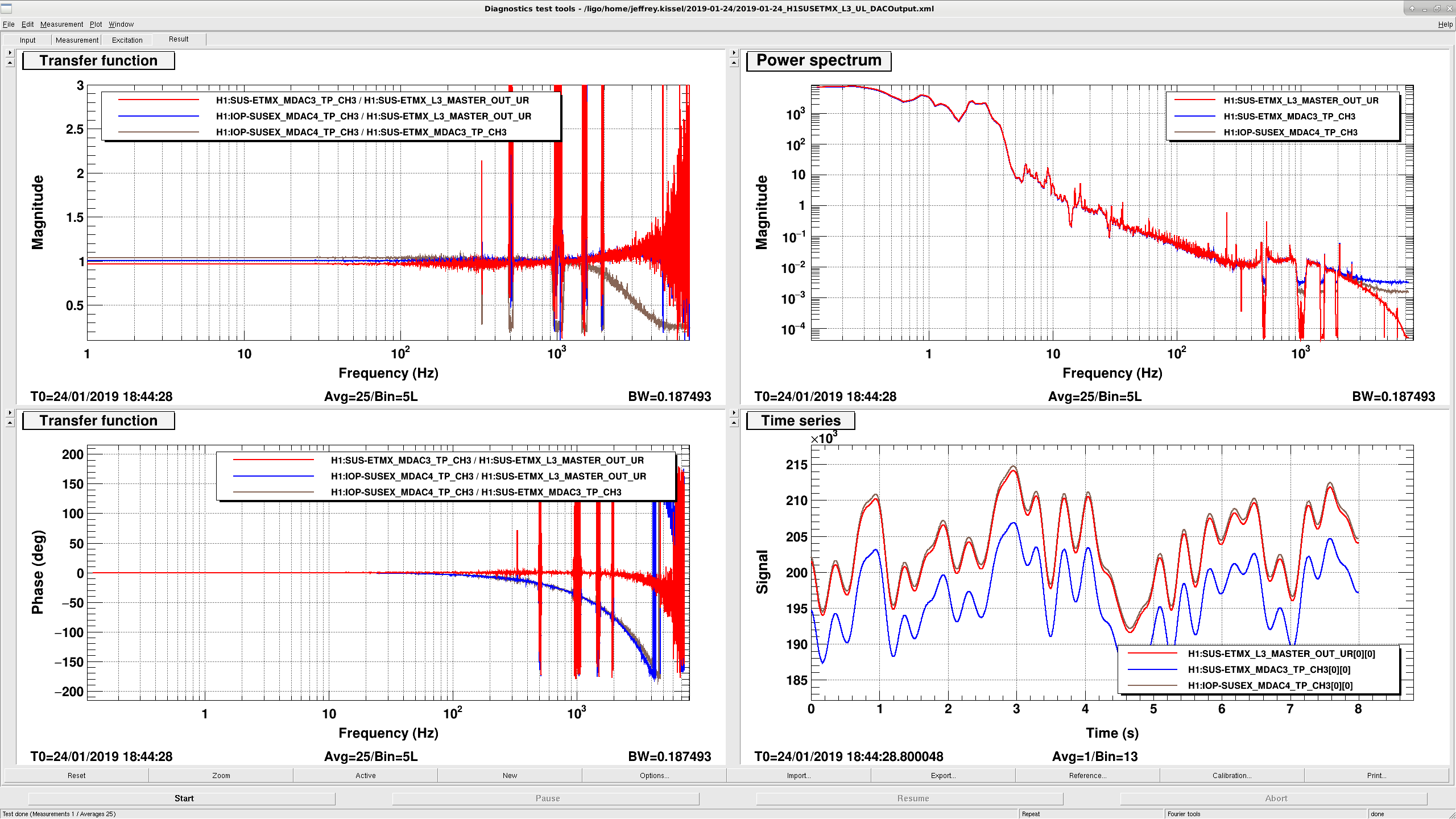
Inspired by the problem with charge measurements this morning (LHO:46619), I took a look at test points of the DAC output for SUS ETMX L3's UL ESD quadrant during a stable state of lock acquisition (specifically on ALS DIFF, and thus NOT saturating) in order to help understand at what point of requested digital counts that the DAC saturates. Attached are the results.

The DC values of the transfer functions are as follows:
Request  > USER Out      0.966245
Request  > IOP Out       1.00299
USER Out > IOP Out       1.03802

Why there's this gain divide-down then back-up between the Request, USER Out, and IOP, I don't know.
However, it does mean that when requesting, say 400000 ct out of the DAC, it'll actually send out 400000 * 1.00299 = 401196 ct out of the IOP.
That would also mean that a digital request of the theoretical maximum of the 20-bit DAC, 524288 ct, would actually try to send out 544221.42976, i.e. too much by ~19933. Thus the real saturation limit is 2^19 / 1.03802 = 505084 ct, i.e. 3.6% less than you'd expect.


I also attach the DTT template if one needs to repeat this test (note that only the request channels are stored in the frames, so the test must be done live).

Channel map for SUS ETMX L3's UL ESD quadrant:
Request    H1:SUS-ETMX_L3_MASTER_OUT_UR
USER Out   H1:SUS-ETMX_MDAC3_TP_CH3
IOP Out    H1:IOP-SUSEX_MDAC4_TP_CH3
Images attached to this report
Non-image files attached to this report

Comments related to this report
Just in case it was not clear, this gain dance on the way out to the DAC is the case for 18-bit DACs as well, and thus is likely not any issue with any particular DAC type, and instead a fundamental truth of the RCG code jumps between user request, the USER out, and the IOP out. See attached for the same study on ETMX's M0 F3 coil channel (this time locked on RF DARM, but there's no appreciable drive to the TOP mass besides the local damping loop output, some very slow ASC offloading, and a large [but removed from the FFT] DC offset).

Data captured with the same template, just in a new plot.
Template lives in
    /ligo/home/jeffrey.kissel/2019-01-24/2019-01-24_H1SUSETMX_L3_UL_DACOutput.xml
Images attached to this comment

Digital AI/AA filters with DC gain errors?