jeffrey.kissel@LIGO.ORG - posted 19:19, Thursday 24 January 2019 (46633)
2019-01-18 DARM Open Loop Gain Model vs. Measurement
J. Kissel

I've used the results from recent ETMX actuation function measurements (LHO:46605) and Sensing Function measurements (LHO:46632) to build a parameter set for the current (well, at least the 2019-01-18, last week Friday) interferometer's DARM loop:
    /ligo/svncommon/CalSVN/aligocalibration/trunk/Runs/O3/H1/params/modelparams_H1_20190118.py

The attached plot shows the result of comparing this loop model against the 2019-01-18 measurement. One can see a frequency-dependent ~5% wiggle in magnitude, and a phase discrepancy increasing with frequency up to 10 deg by 1 kHz.

Comments and (educated) guesses as to what's going on:
    - 10-40 Hz Magnitude: We don't have the actuation gains just right and/or the frequency-dependent ripples are a result of the similar ripples in the PUM and TST stages of the actuator measurements. As mentioned in LHO:46605,
"" We have not measured, and thus not well-compensated, any stage of SUS ETMX's driver electronics. We're still using the "off-the-shelf," "same compensation for each quadrant" compensation. ""
    Once we clean up these known systematic errors in the actuator (I'm schedule to take over EX next-week-Tuesday to gather the neccessary measurements), then we should be able to better estimate the gain of these two stages and I suspect we'll reduce the residuals in this frequency band.
    - 330 Hz Magnitude: We still have a massive notch in the DARM loop around 300 Hz for (a) the calibration line frequency, and (b) the beam splitter violin modes. It's not really important that we get this particular frequency right.
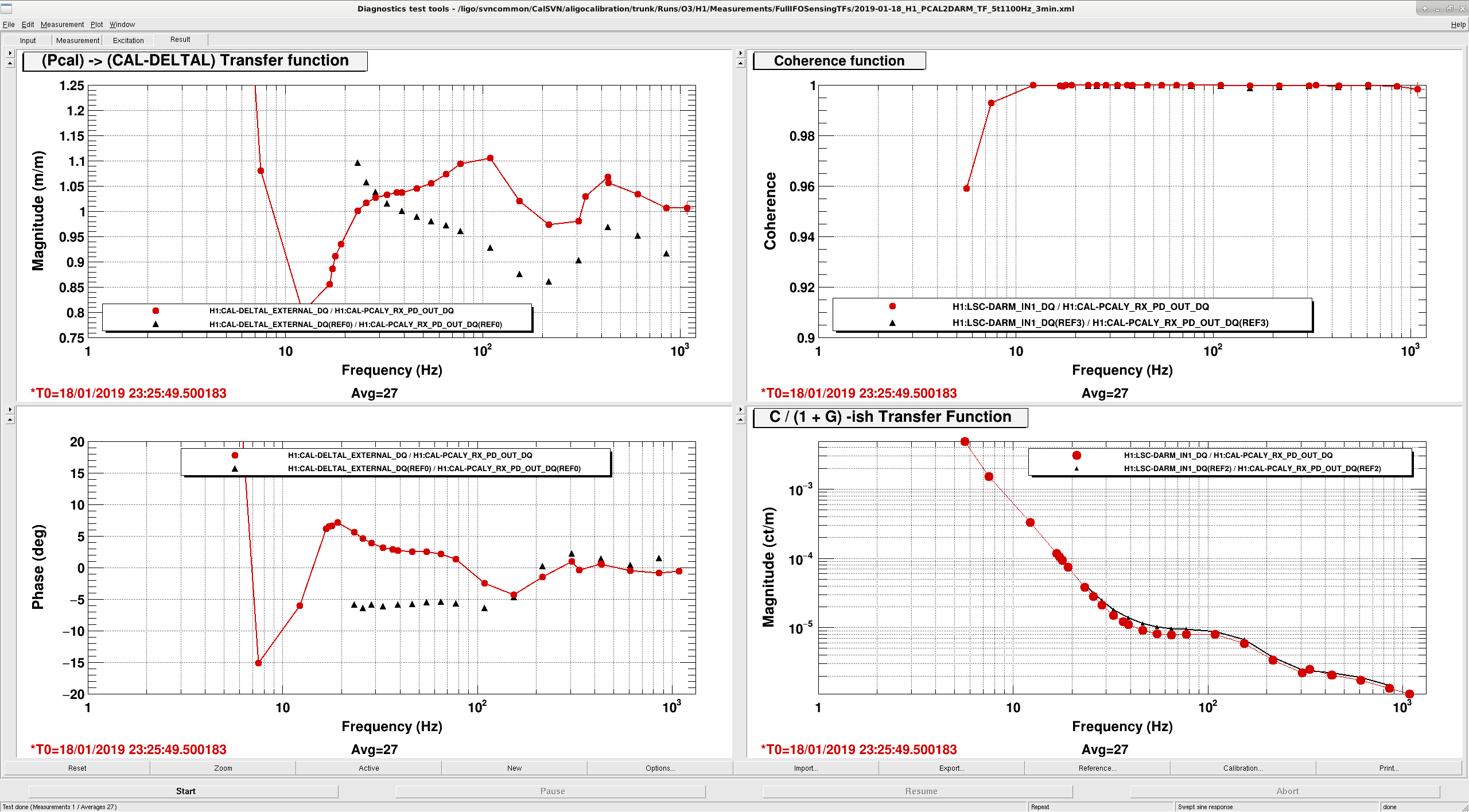
    - >500 Hz Magnitude and Phase: It's not clear to be yet what's going on here. At these frequencies, it's either the DARM loop filter or the Sensing Function accuracy, and the sensing function is accurately measured and fit to within 1% and 1 deg. Further, the high frequency data from the PCAL 2 DELTAL sweep (left panels of second attachment from LHO:46632 indicates that there's nothing wrong with the sensing function from 2018-12-05 (the post-ER13, 20W, split actuator model, as long as it's scaled to match the optical gain). I've, of course, checked that I've recreated the DARM loop filters correctly, but I can't find any issue as of yet.

As mentioned in the aLOG documenting the processing of the sensing function, and in addition to cleaning up the actuator, I'd really like to get a open loop gain TF with more densely populated frequency points to help understand what's going on at low frequencies. Hopefully the high frequency issue is just a bug in the analysis script somewhere, and I can clean that up once I sleep on it over night.
Non-image files attached to this report