Jenne, Sheila, Marie, Arnaud, Danny, Georgia, Craig
DHARD P investigation:
This morning we did a few things to investigate the problems we have been having with DHARD (see 46663 for links to relevant alogs). We haven't found the cause of the positive phase shift at 1 Hz, but we have found that a cross coupling with darm is reducing the gain of the DHARD loop.
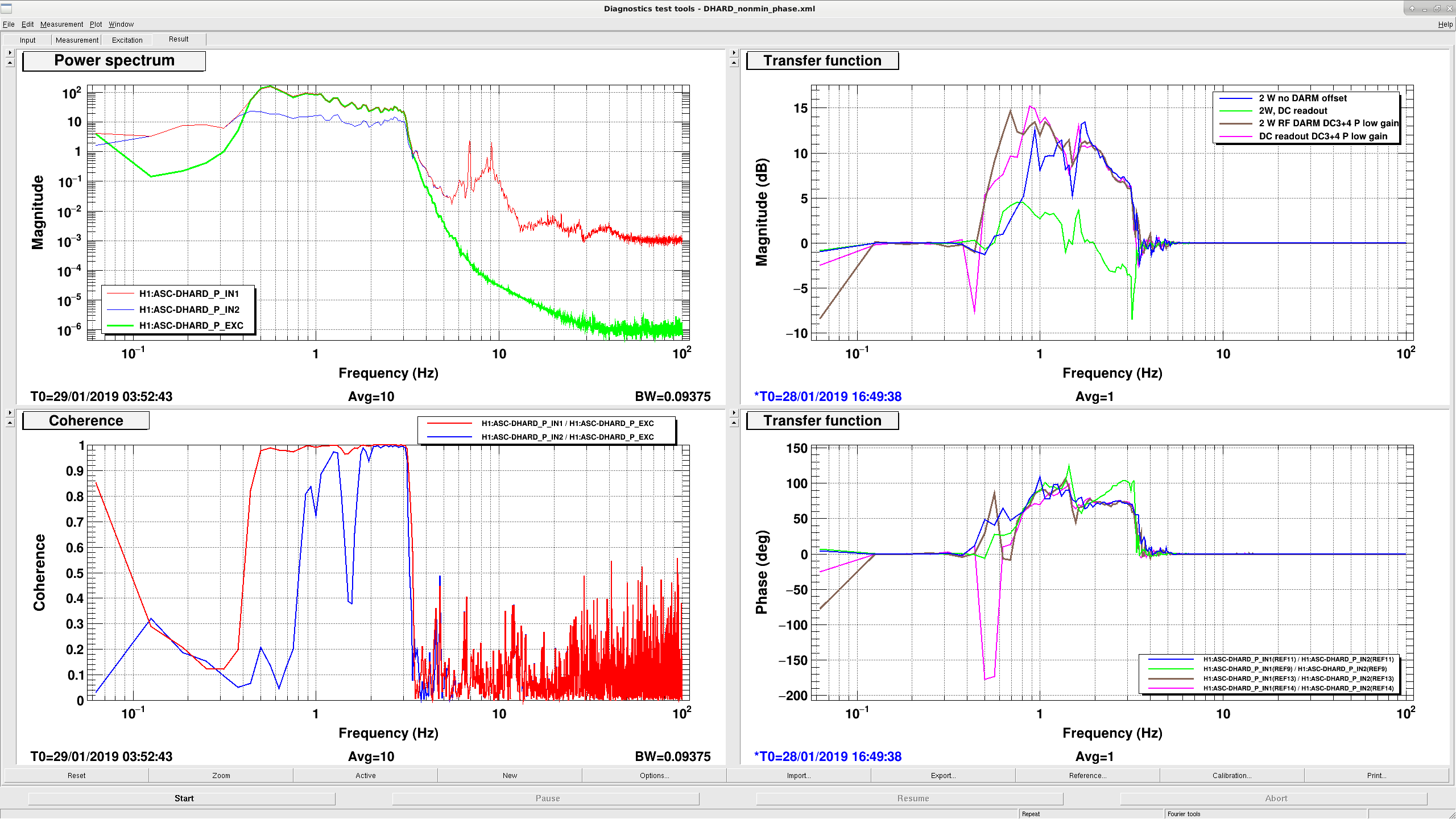
When I got here Jenne had the interferometer locked at 1.8W input power, and we made a series of DHARD P measurements at different configurations. We found that there is a change in the DHARD P gain when the DARM sensor is changed from AS45 to the DCPDs, this isn't due to the DARM offset but is actually a result of changing the DARM sensor (see attached screenshot). We tried changing the gain of CHARD P by 30dB, no impact. We also tried turning off the dither loops, and running the A2L decoupling script (more on that below), but this didn't change the DHARD transfer function.
At 2W input power we don't see the strange phase behavior at 1 Hz, but when we power up to 10W we do see it, locked on RF DARM or DC readout. (see attachment). However, on RF DARM the loop remains stable because we are not close to having a unity gain crossing at 1Hz.
DC centering:
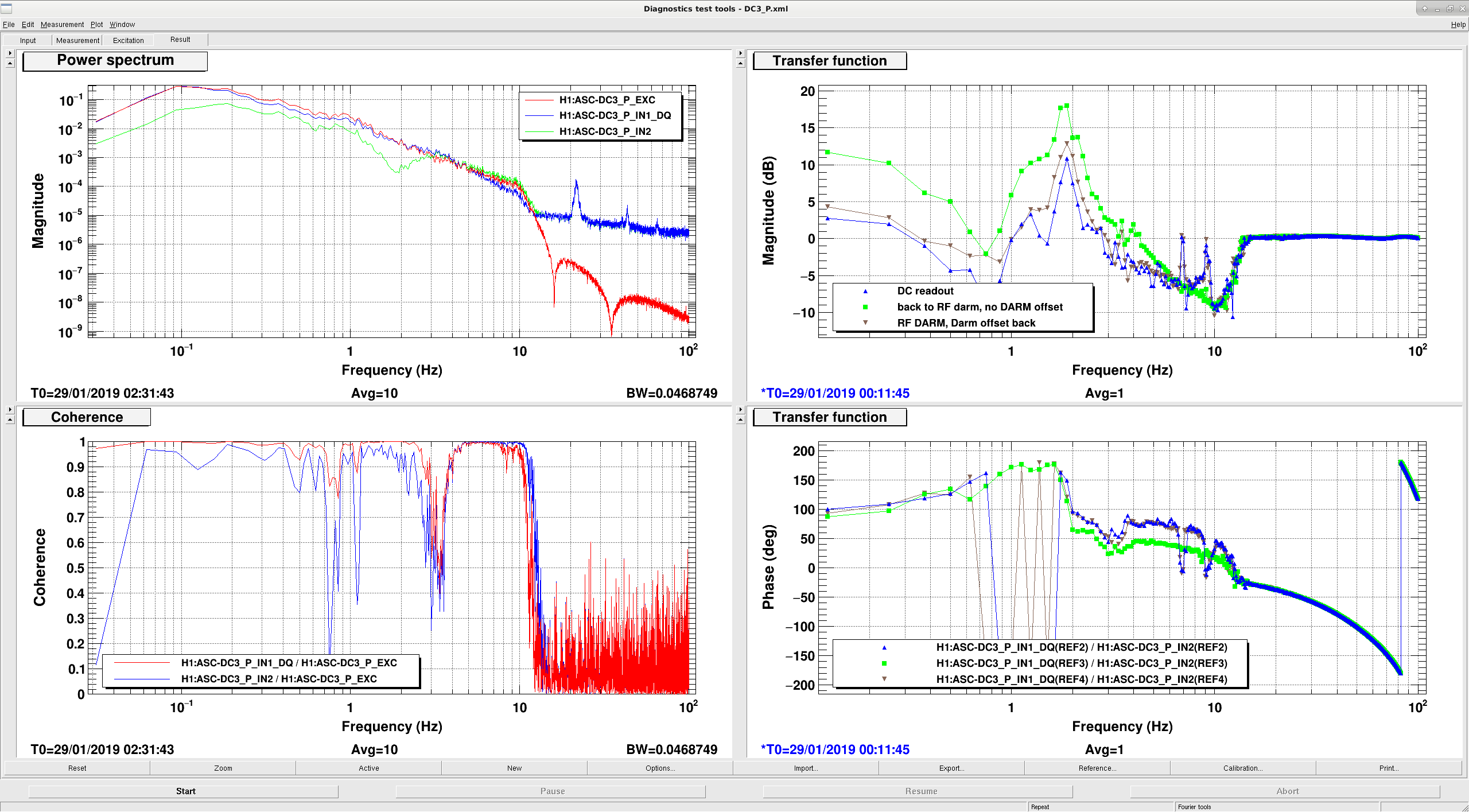
We also looked at the DC3_P centering loop, which centers onto AS_A the WFS used for DHARD. The gain of the centering loop depends on the DARM offset, as can be seen in our third attachment. We then measured the gain of the DHARD P loop for different centering loop configurations, and found that the centering loops are reducing the gain of the DHARD loop. This coupling from centering to DHARD depends on the DARM offset, since the DARM offset means that there is a signal in 45Q on all quadrants of the WFS head. We took a few minutes in DRMI to change the filters in the DC centering loops for pitch, so that our UGFs are now about 0.25 Hz. We haven't done this for the yaw loops yet, but we probably need to.
With the reduced gain in the centering loops, we were able to transition to DC readout and not see a change in the DHARD loop shape, shown in the third attached screenshot. We added a 0.8 Hz pole, a low pass at 1.5 Hz, and a -10dB filter to DC3+4 pitch, we ran these with a gain of -0.25 for the measurement where transitioning to DC readout didn't change the loop shape. We have now reverted to the old loops because we are not able to power up, but it seems that the problem with powering up is unrelated to the centering loop change since we still can't power up.
A2L script working again:
We had tried to run the A2L decoupling script on Friday, but ran into a problem with nds. Over the weekend Jonathan Hanks found a fix for us, which we can run this way:
PYTHONPATH=/ligo/home/jonathan.hanks/nds2-client-bugfix/lib/python2.7/site-packages
export PYTHONPATH
userapps/isc/h1/scripts/run_al_a2l.py
Suspension checks:
This morning Marie Arnaud and Jenne checked that all 4 of the PUM coils are moving the test masses on ITMX, ITMY and ETMY, which they are. Still have to check ETMX but seems fine regarding the measurements below.
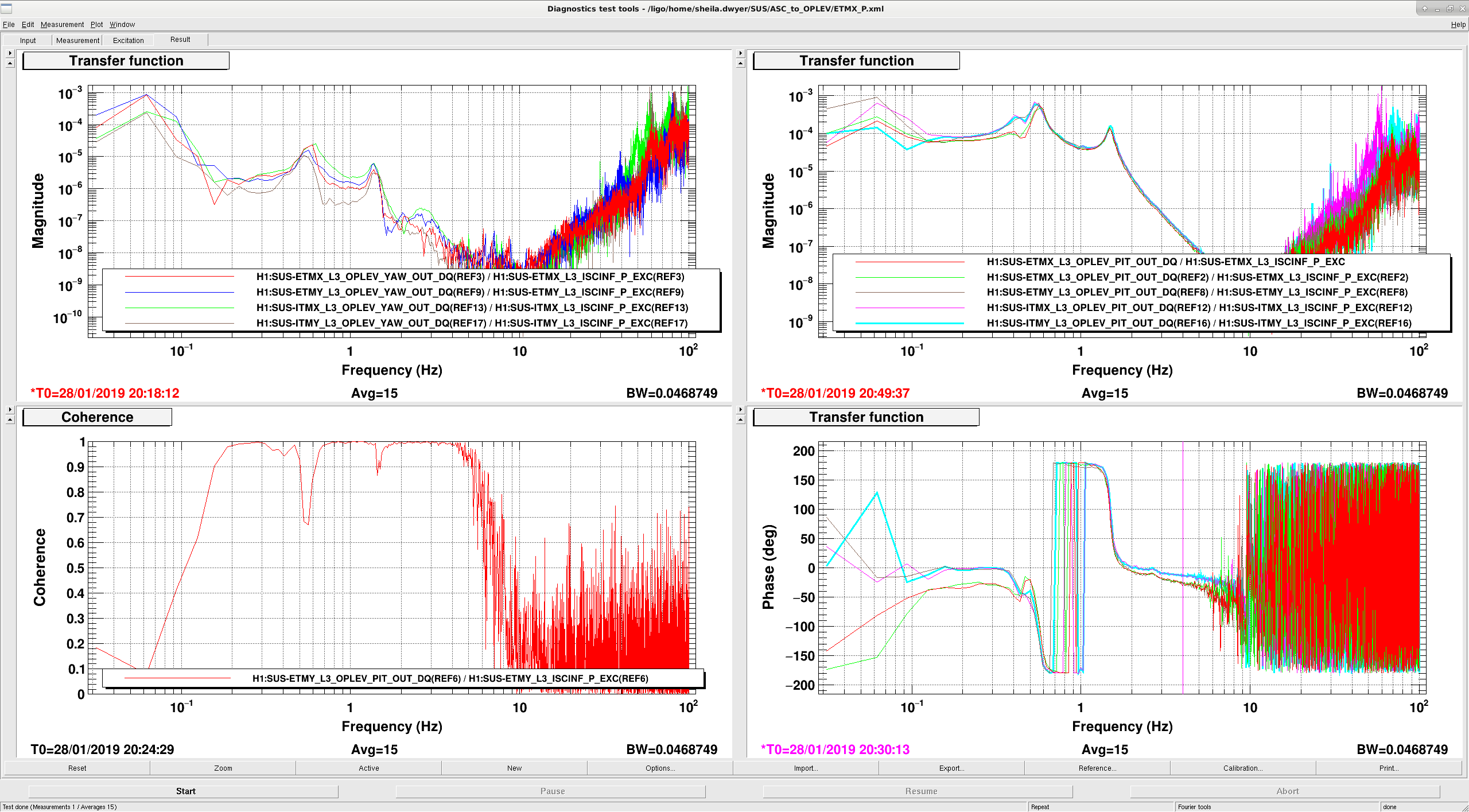
We also measured the transfer functions from the ASC input for pitch on each suspension to the optical lever, with the suspension set up to drive the PUM and the test mass as it is when we are locking. The second attached screenshot shows the measurements, they are mostly the same with no large P2Y coupling on any of the test masses. There is a difference in the measured phases between the ETMs and ITMs, which is 16 degrees at 4Hz. We looked for settings that are different between the ITMs and the ETMs: There is a bounce roll filter that is in the top mass offloading path for the ETMs but not the ITMs, and there is an additional (narrow) 28Hz notch in the ITMs compared to the ETMs. We tried retaking the measurements without these differences, they didn't matter for the measured TF as expected.The data is attached, Jenne is combining them offline.

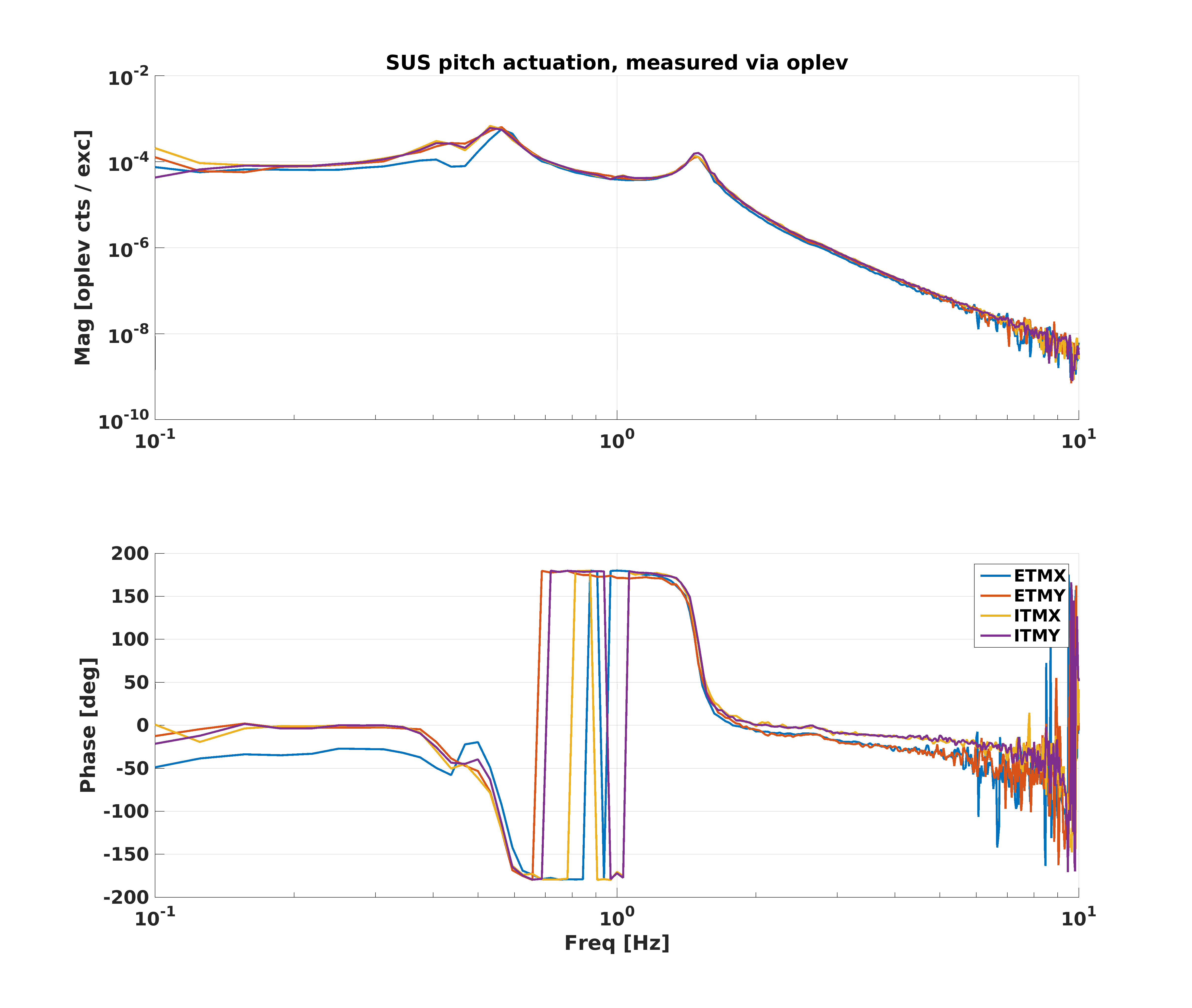
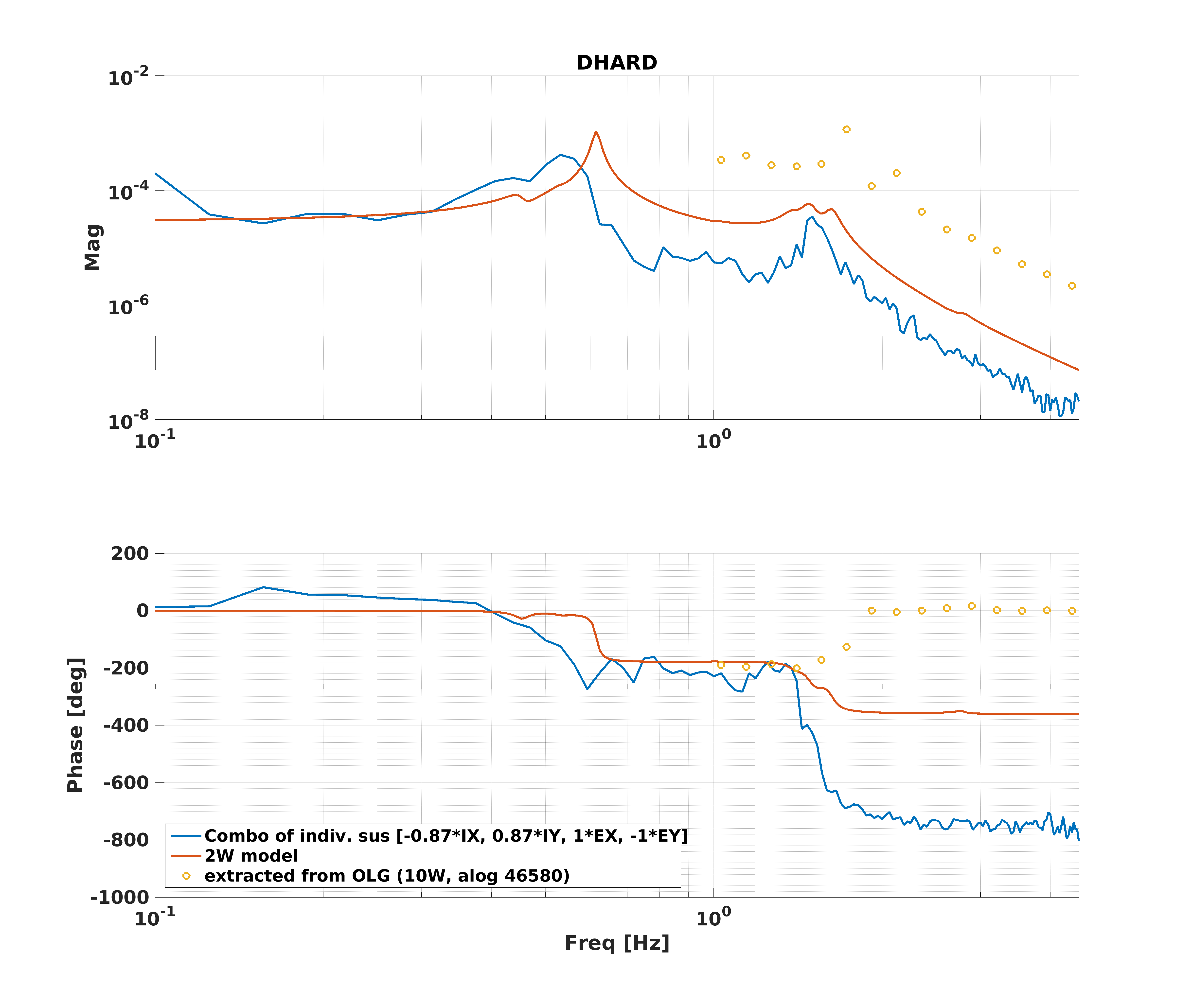
In the attached figures, I show the TFs measured this morning by actuating the suspension and watching the oplevs (SUSactuators), as well as what happens if I naively combine those 4 suspension measurements with our standard output matrix for DHARD (Standard_DHARD_outmtrx) to get the DHARD plant (magnitude is arbitrary here).
In this second figure, I compare the DHARD plant from combining the 4 individual TFs (which do not have radiation pressure effects, since the IFO was unlocked), the 2W DHARD modeled plant (which is basically identical to a 0W plant, since there is so little circulating power), and the DHARD plant extracted from an OLG measurement last week (alog 46580). I think that we need to revisit our relative suspension actuation strengths, so that they match up more precisely. I don't totally understand why the plant from the combination of individual suspensions seems to have extra phase lag above 1.5Hz, but it certainly shouldn't be like that. If I hand tweak the output matrix and look at the resulting DHARD plant from the combined suspensions, I can make all kinds of weird phases, or I can make them look sensible.
So, it seems like our actuation matrix is some combination of HARD and SOFT, common and differential, and this is contributing to the cross-coupling and weird phase. However, I'm not sure if this story hangs together though with Sheila's finding that the gain of the DC centering loop affects the DHARD OLG. Certainly it couldn't hurt to check that our HARD and SOFT actuations are as orthogonal as possible.