Conclusion:
If our goal is to keep the residual angular motion has a roughly constant rms, then we should try to reduce the ASC bandwidth as we power up, which would further allow us to lower the cutoff frequency to improve DARM.
Detail:
The closed-loop torque to angle transfer function can be written as
G_cl = S_rad / (1 + K*S_rad),
where S_rad is the L3 suspension torque to angle transfer function and K is the control filter.
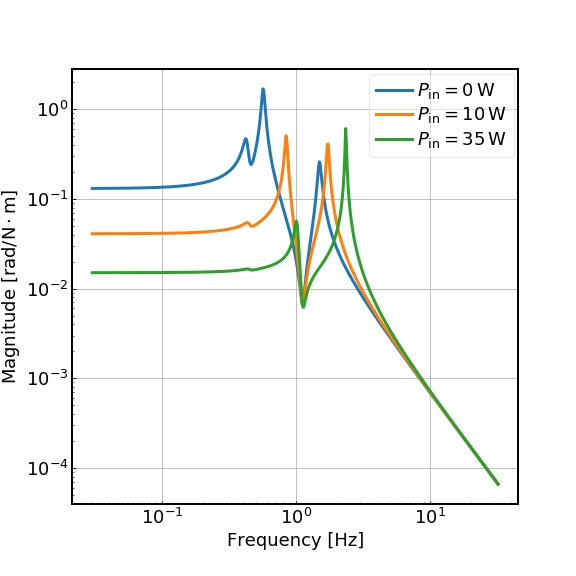
In the attached plot we show S_rad for the hard pitch mode at different input levels (to get arm power, we assumed G_p=42 and G_a=265). We can see that the DC level of S_rad decreases as we power up.
Now we focus on G_cl at around the microseismic frequency of ~ 0.2 Hz. It dominates the residual rms motion and it is below the sus resonances and the loop UGF. Consider two scenarios:
1). we keep the overall open-loop gain, (K*S_rad), roughly the same at different power levels. Then this means
G_cl ~ S_rad, which decreases as the power increases.
Since the raw seismic input in torque is independent of input power, as G_cl decreases with S_rad, we are clearly "wasting" control bandwidth by trying to keep (K*S_rad) the same. This cause us inject more sensing noise to the system then we need to. This is not optimal.
2). We should instead keep the loop suppression the same. Note that G_cl ~ S_rad/(K*S_rad) ~ 1/K at microseismic freq. As we power up, we should not increase the DC gain of K but just keep it roughly constant. This means the UGF of the CH/DH loops should decrease as S_rad decreases.