
After the intensity projection yesterday Daniel asked me to look at the ISS OLG.  Gabriele showed me how to take the analog ISS OLG measurements.

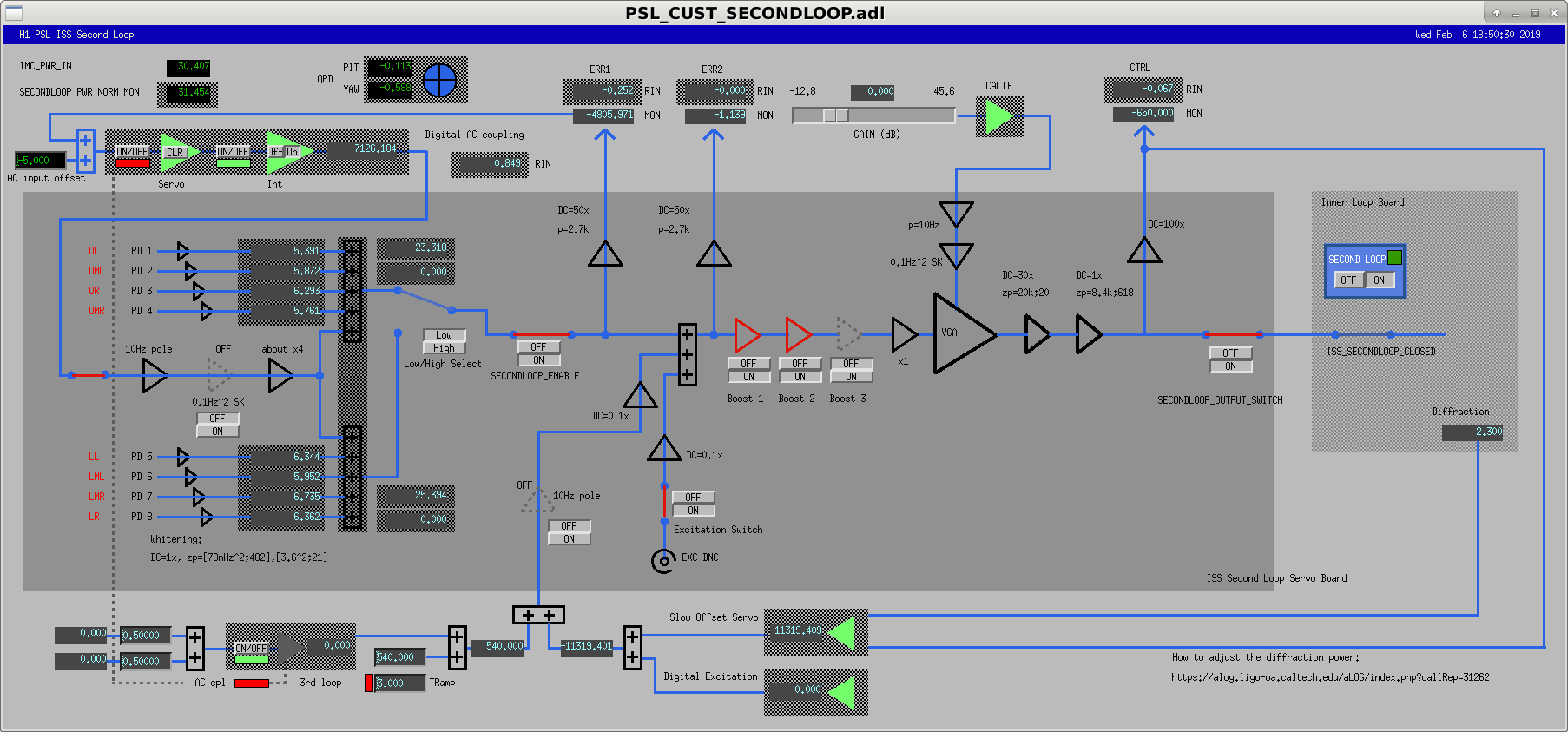
We seem to be marginally stable (7 degrees phase margin) with the ISS loop where we nominally sit (OLG in attachment one, ISS Secondloop nominal medm screen in attachment two).

Nominally, H1:PSL-ISS_SECONDLOOP_GAIN = 0 dB, and this is how I took the first measurement, the dark blue line in the plot.
I increased the ISS SECONDLOOP GAIN by 6 dB (light blue), and then another 6 dB (orange).  This gave us an additional 30 degrees of phase margin.  The gain seems to not want to increase more, so I didn't push it past +12 dB.

Looking at the ISS to DARM coherence at HF, it seems to be reduced from 0.5 to 0.2 now.  This is good, but still needs to be reduced further if we are going to reap the benefits of squeezing.


The ISS second loop UGF used to be higher than this, right in the middle of the phase bubble.
See for example 45185
Increasing this gain needs some more thought. We failed to Increase_Power due to an ISS instability.
For now, we've just decreased the VGA gain slider back to 0dB, and are able to lock.
Sheila, Gabriele and I tried increasing the VGA gain by 1dB and decreasing the slow offset feedforward path by 1dB (with the goal of slowly stepping toward the 12dB that Craig used last night), but even that 1dB step made the ISS diffracted power go crazy. We'll need to relook at this in an IMC-only configuration.
Since the low ISS second loop gain is a problem for high frequency noise, but not at all a problem for locking stability or low frequency sensitivity, we're leaving it as it used to be for now.