evan.goetz@LIGO.ORG - posted 14:04, Thursday 07 February 2019 - last comment - 14:23, Thursday 07 February 2019(46848)
Updated photon calibrator actuation function for CW hardware injections and inverse actuation filter
With the upgrades to the hardware injection system, it's a good time to revisit the photon calibrator actuation function and inverse actuation filtering for hardware injections. LHO aLOG 46846 showed that there is an approximate 47% increase in the gain of the excitation point of the photon calibrator.

The inverse actuation filter FM7 "cts/N" has been updated from an old value of gain(2.1537e+13) cts/N to the new value of gain(1.4677e+13) cts/N. This gain value was calculated from the DAC gain (20.0/2^18) x watts-per-OFS volts (0.13535 W/V) x newtons-per-watt (6.5980e-9 N/W) = 6.8134e-14 N/ct. The inverse of this is what is needed for the inverse actuation filter.

LHO aLOG 37764 describes the Pcal actuation path in the last bracketed term. For the hardware injection path into the Pcal, the new user model actually includes one more 16k clock cycle delay so that the hardware injection path sees the following:
                                                            V              W     N                 1      m     h
[ 61 usec delay x 61 usec delay x AI(D) x 61 usec delay x ----- x AI(a) x --- x --- x sus.norm x ----- x --- x --- ]
                                                           cts             V     W                f^2     N     m

Attached below is the actuation function used by the CW hardware injections that takes into account these updates for the excitation point gain and the extra clock cycle delay. I also saved it to
$CALSVN/trunk/Runs/O3/Common/Results/InverseActuationFilter/H1PCALXactuationfunction.txt.
In the past, I had saved this with an appended "_withDelay" to the filename. That seems unnecessary when computing the actuation function, so below is the export of the transfer function that reflects the above equation describing the Pcal actuation function from the hardware injection excitation point CAL-INJ_MASTER_OUT.

Finally, for transient injections that use the inverse actuation filter (described in further detail in LHO aLOG 27539), the uncompensated delay for the injections will be approximately 360 usec. The delay is a combination of the digital delays, as well as any residual phase effects from the approximated AI filtering and roll-off filters which would require time advances (not possible in Foton).
Non-image files attached to this report

Comments related to this report
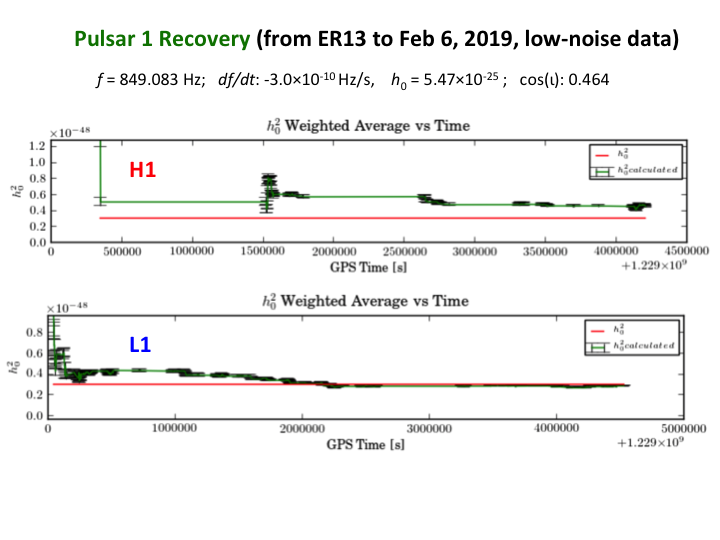
The need for the adjustment to the inverse actuation function used in CW injections is consistent with our recovery of too-large amplitudes in H1 data. Shown below is an example comparison of H1 and L1 recovered squared amplitudes from Jessica Leviton's monitoring program which runs daily on both observatory clusters. While the recovered central value for this loud injection agrees well with expectation in the L1 data, it has been converging to a value roughly 50% too high in the H1 data. Other loud injections show the same trend. (The underestimated vertical error bars shown on these plots should be ignored; the recovery program is under active development. The data points shown on each graph correspond to individual 30-minute low-noise SFTs for data collected when injections were running.)
Images attached to this comment