jenne.driggers@LIGO.ORG - posted 12:54, Monday 18 February 2019 (46978)
Dithering TMS and shaking EY chamber to check for scatter
- Dither TMSY in length
- H1:SUS-TMSY_M1_LOCK_L_EXC; f = 0.3; A = 500
- Definitely see the dither in power buildups, and also in yaw spot positions on TMSY QPDs. Not really visible in pitch. The yaw motion is coupling in to many ASC DOFs.
- Marginal amount of improvement by going -5 urad in yaw, but very marginal. (Looking at DARM BLRMS 3, 4, 5). No real change going +5 urad.
- Did, however, seem to reduce the coupling of yaw motion to other DOFs. Might just be that we're not falling off of the QPDs as much in this direction.
- Use PEM shaker at EY
- Kara set up a shaker injection, using the setup noted in alog 46524.
- awggui H1:PEM-EY_GDS_1_EXC, ellipBP, 4th order, 1-100 Hz, 10 sec ramp. Starting amplitude = 50 counts (Robert recommends 50k counts).
- Ramp up in amplitude to Robert's suggested 50k counts.
- TMSY moved in yaw -5 urad, and also +3 urad, both are slightly worse than nominal.
- TMSY moved in pitch. -5 urad made things slightly worse, +4 urad made things slightly better. Can't do much more than +4 without clipping on TMS QPD.
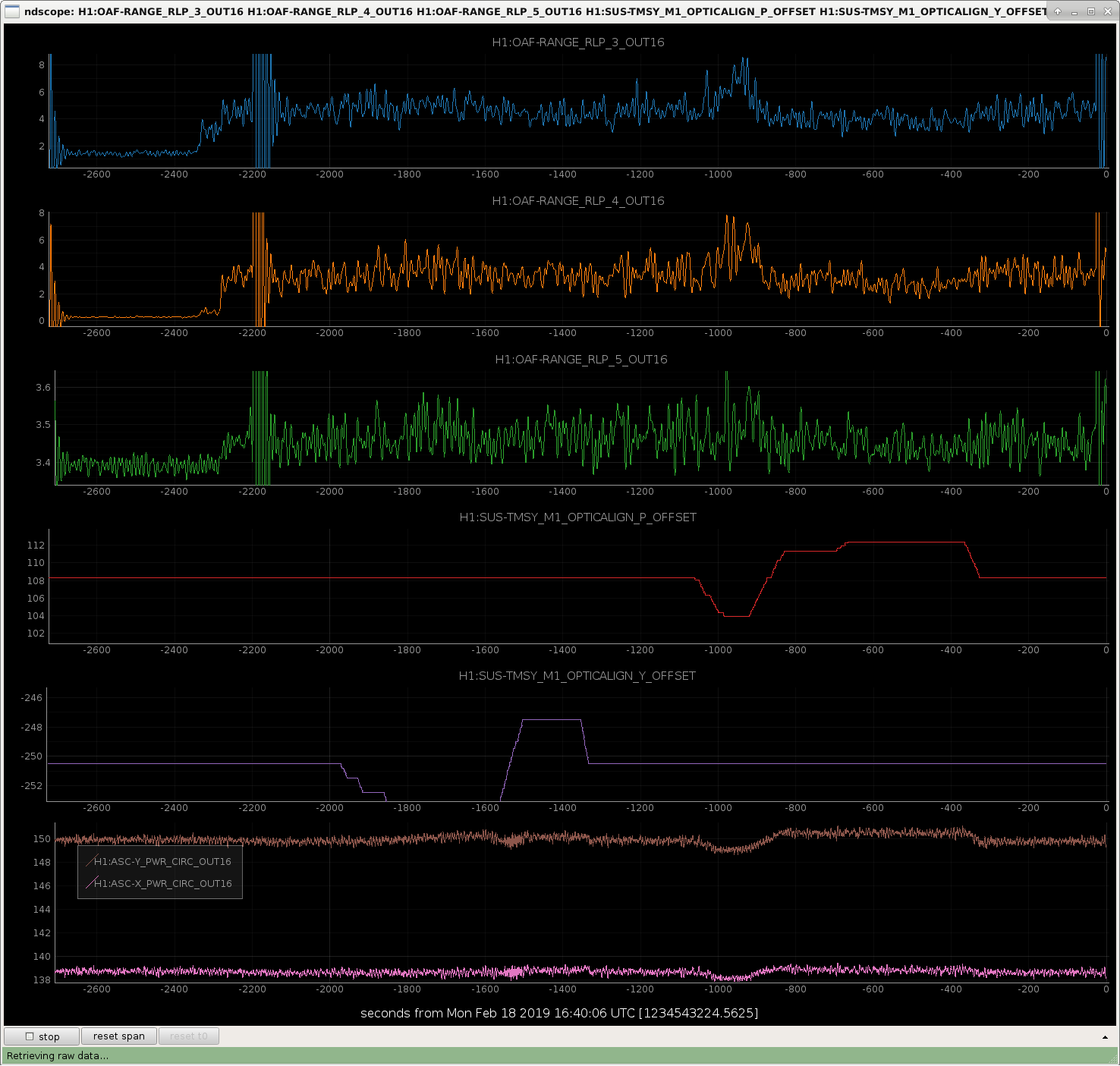
- Fig 1 is time series showing slightly better BLRMS 3, 4, 5 with pitch +4 urad from nominal (-650 s through -380 s), as compared with nominal (-350 s through 0 s).
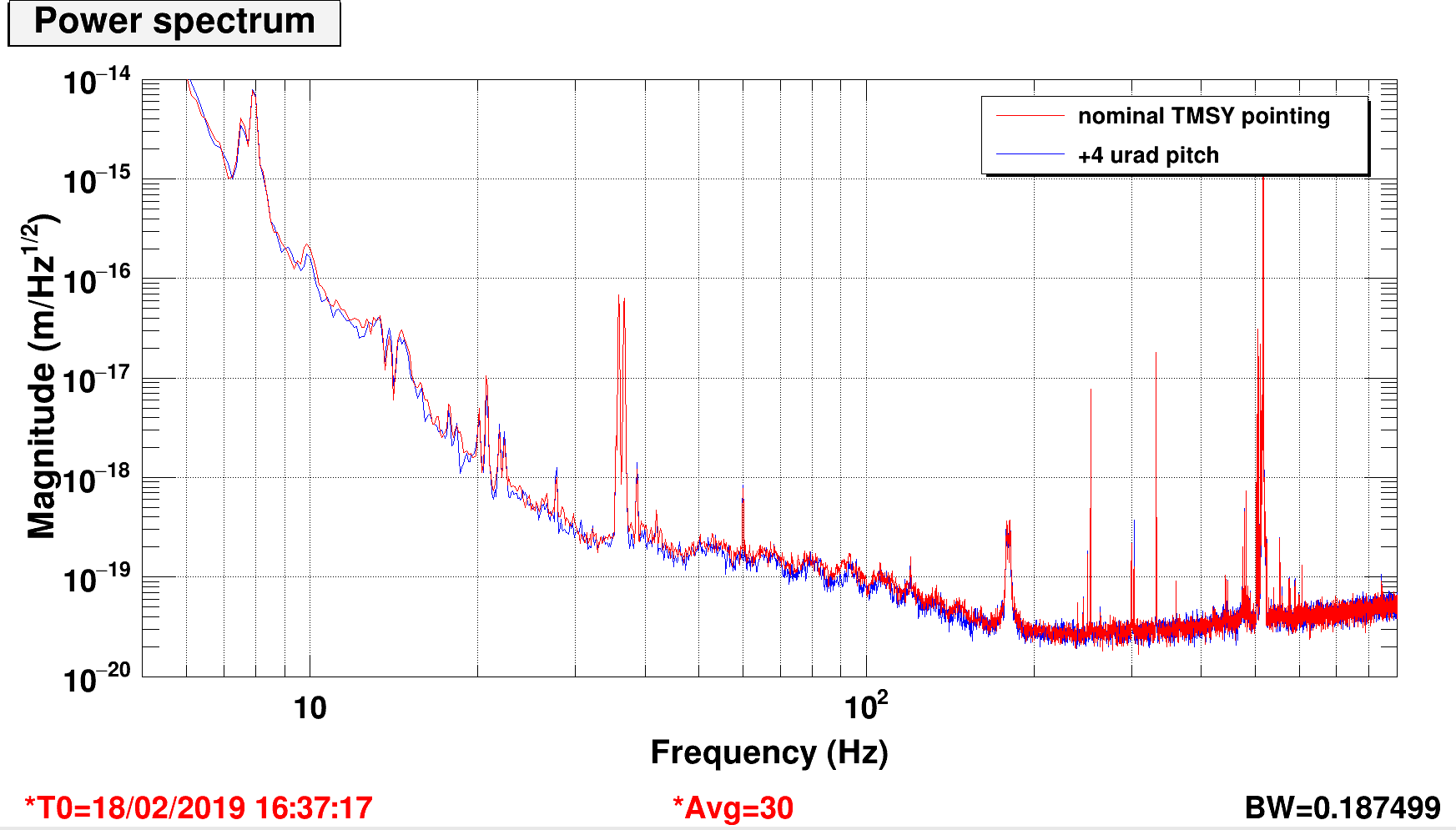
- Fig 2 is the same data as spectra, with red as the nominal TMSY position, and blue is +4 urad in pitch. Both are 30 avgs. Haven't done on/off tests yet.
- Seems to make a small offset in the pitch ADS DOFs, not sure why. It's very small though, so I'n not sure it matters. The offsets are less than 1 count, when a normal starting point when we're acquiring lock is 100+ counts.
- Move spot position on ETMY in pitch (nominal P2L gain value is 3.55)
- going to 2.35, then waiting for ADS to converge. High freq much worse.
- going to 4.55, wait for ADS to converge. High freq also worse.
- 3.95, slightly worse than nominal.
- 2.95, very slightly worse in the 30-50 Hz region, otherwise same as nominal.
- Leaving at nominal.
- Move spot position on ETMY in yaw (nominal Y2L gain value is 0.885)
- 0.485, very slightly better than nominal, would have to do on/off tests to confirm.
- -0.31 worse than nominal.
- 1.485 a bit worse than nominal, but buildups were all much better than nominal.
- Leaving TMS and ETM spots at nominal locations, since nothing seems dramatically better.
- Sometimes the spectrum seemed to get a bit better until the SRC ASC loops converged, then it was either the same as nominal, or a bit worse, as listed above. So, maybe we should (as is on our whiteboard to-do list) look at SRC pointing.
- Kara set up a shaker injection, using the setup noted in alog 46524.
- Dither TMSX in length, same settings as TMSY above. Don't see oscillation in power buildups with the same amplitude of 500 counts at 0.3 Hz.
- As with TMSY, when dithering TMSX I don't see any effect in DARM at frequencies above 7 Hz (I'm not looking lower), although I do start to see the power buildups oscillate a small amount when I dither length with 1000 counts (2x the TMSY dither).
Lost lock trying to de-blend CHARD. My TMS dithers weren't giving enough velocity to make any fringe wrapping show up at frequencies that are useful, but I can't push harder since the TMS motion is causing ASC signals to move the IFO. Normally, CSOFT P, DSOFT P, as well as CHARD P and Y all use the TMS QPDs. When I was shaking TMS in length, I was seeing a lot of yaw motion on the TMS QPDs, as well as a lot of yaw motion in other ASC channels. This indicates that much of this coupling was through CHARD, since the SOFT DOFs are not using yaw right now.
Recall DARM BLRMS 3 looks at 38 Hz - 60 Hz. DARM BLRMS 4 looks at 60 Hz - 100 Hz. DARM BLRMD 5 looks at 100 Hz - 450 Hz.
Images attached to this report