
Sheila, Georgia, Craig
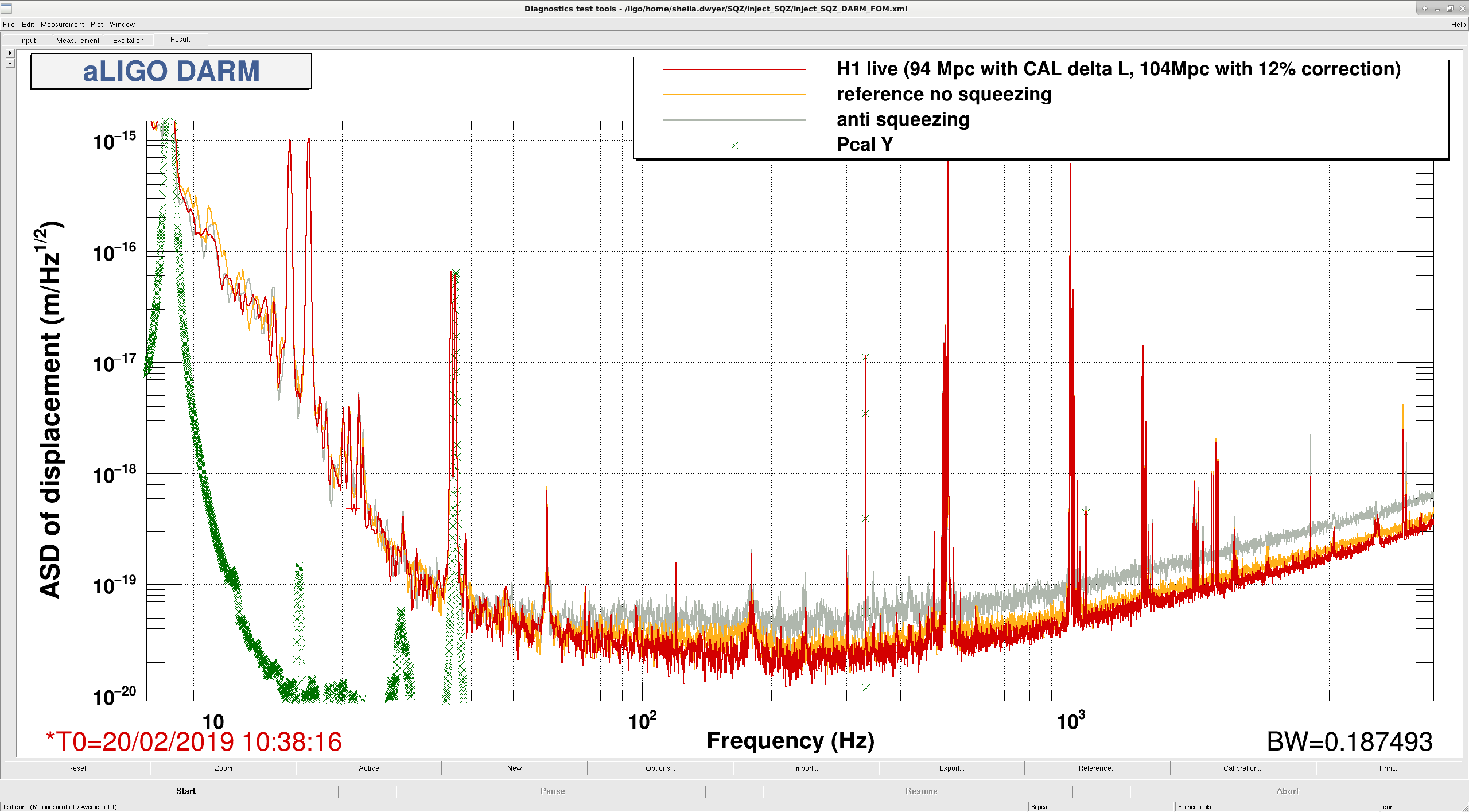
After improving the broad shoulders on the power lines by increasing the OMC dither, 47007, and finding that our 9 MHz coupling to DARM is reduced 47008 and that the DCPD cross correlation shows improved noise around 50-60Hz 47012, we decided to inject squeezing again since we know from 47006 that it can improve our sensitivity. The attached screenshot shows the reference, anti-squeezing and DARM with squeezing. The sensmon range is between 93-94Mpc, and we think that this is underestimating the range by about 12% according to the PCAL sweep that Jeff did this morning 47003.
Wonderful - very nice progress.
Great work!
Excellent news!
Great!
If it were safe to assume that the frequency dependent systematic error were the same between lock stretches (it's not), I could apply the same correction I'd done to the 2019-02-19 23:00 UTC lock stretch to this data. This is a false assumption (and, naturally, the quantification of time-dependent correct factors is back in to the realm of confusing non-functionality so I don't know *how* different parameters are), but hopefully at the ~few% level in response function change, and the effect on BNS range was mapped out in LLO:31156 to be also in the ~few% level.

But y'know, because we're crazed to surpass the 100 Mpc BNS range, aka #KeepIt100, I've done the same analysis as was done in LHO:47003, multiplying the ASD at this time (Feb 20 2019 10:38:16 UTC, 1234694314, for 120 seconds) by the previous lock stretch's PCAL 2 DELTAL sweep, and computed the BNS range difference.

As a testament to the hilarious comedy of life, the corrected range is 99.91 Mpc.
(And note that I tried shifting the ~120 second time stretch by 15, 30 seconds on either side and the range went down to 99.5 ish, so somehow Sheila found a magically delightful time.)

This ASD has not had any offline subtraction done, which I believe Team DetChar has been geared up to do.

I've updated the function that generates these plots a bit,
    /ligo/svncommon/CalSVN/aligocalibration/trunk/Common/pyDARM
        correct_bns_range.py
and I *know* that this function as-of-yesterday doesn't work in the control room.

Regardless, I quote the exact command line used on my laptop configuration of python:
python3.6 correct_bns_range.py --run='O3' --IFO='H1' --GPSstart='1234694314' --GPSend='1234694434' --PCAL2DARMTF='/ligo/svncommon/CalSVN/aligocalibration/trunk/Runs/O3/H1/Measurements/FullIFOSensingTFs/2019-02-19_H1_PCAL2DARMTF_A_PCALYRX_B_DELTALEXT_tf.txt' --PCAL2DARMCOH='/ligo/svncommon/CalSVN/aligocalibration/trunk/Runs/O3/H1/Measurements/FullIFOSensingTFs/2019-02-19_H1_PCAL2DARMTF_A_PCALYRX_B_DELTALEXT_coh.txt' --DARMmodelfile='modelparams_H1_20190219' --modelFunction='modelPars' --resultsTag='/ligo/svncommon/CalSVN/aligocalibration/trunk/Runs/O3/H1/Results/FullIFOSensingTFs/2019-02-20_H1_sensingFunction_BNSRangeCorrection'

The data is committed to the CalSVN here:
    /ligo/svncommon/CalSVN/aligocalibration/trunk/Runs/O3/H1/Results/FullIFOSensingTFs
        2019-02-20_H1_sensingFunction_BNSRangeCorrection.pdf
        2019-02-20_H1_sensingFunction_BNSRangeCorrection_ASD.txt
        2019-02-20_H1_sensingFunction_BNSRangeCorrection_PCAL2DELTALTF.txt


At the time of our excellent spectrum, the offline noise subtraction codes from DetChar (TJ Massenger & Derek Davis) and Calibration (Aaron Viets) gives us about 1.5 more Mpc, so we can say that we really did get above 100 Mpc - in fact about 101.4 Mpc. See, for example, a comparison of cleaned vs. pre-cleaned spectra: https://ldas-jobs.ligo.caltech.edu/~aaron.viets/H1_CAL_NoiseSub_20190220/H1_1234694144_1234698240_spectrum_comparison.png
