georgia.mansell@LIGO.ORG - posted 23:08, Wednesday 20 February 2019 (47042)
Old (unmodified) PZT driver back in; 4.5Hz DARM oscillation obstructed locking today
OMC PZT driver
- This afternoon around 4pm local time Fil replaced the modified OMC PZT driver with the old driver.
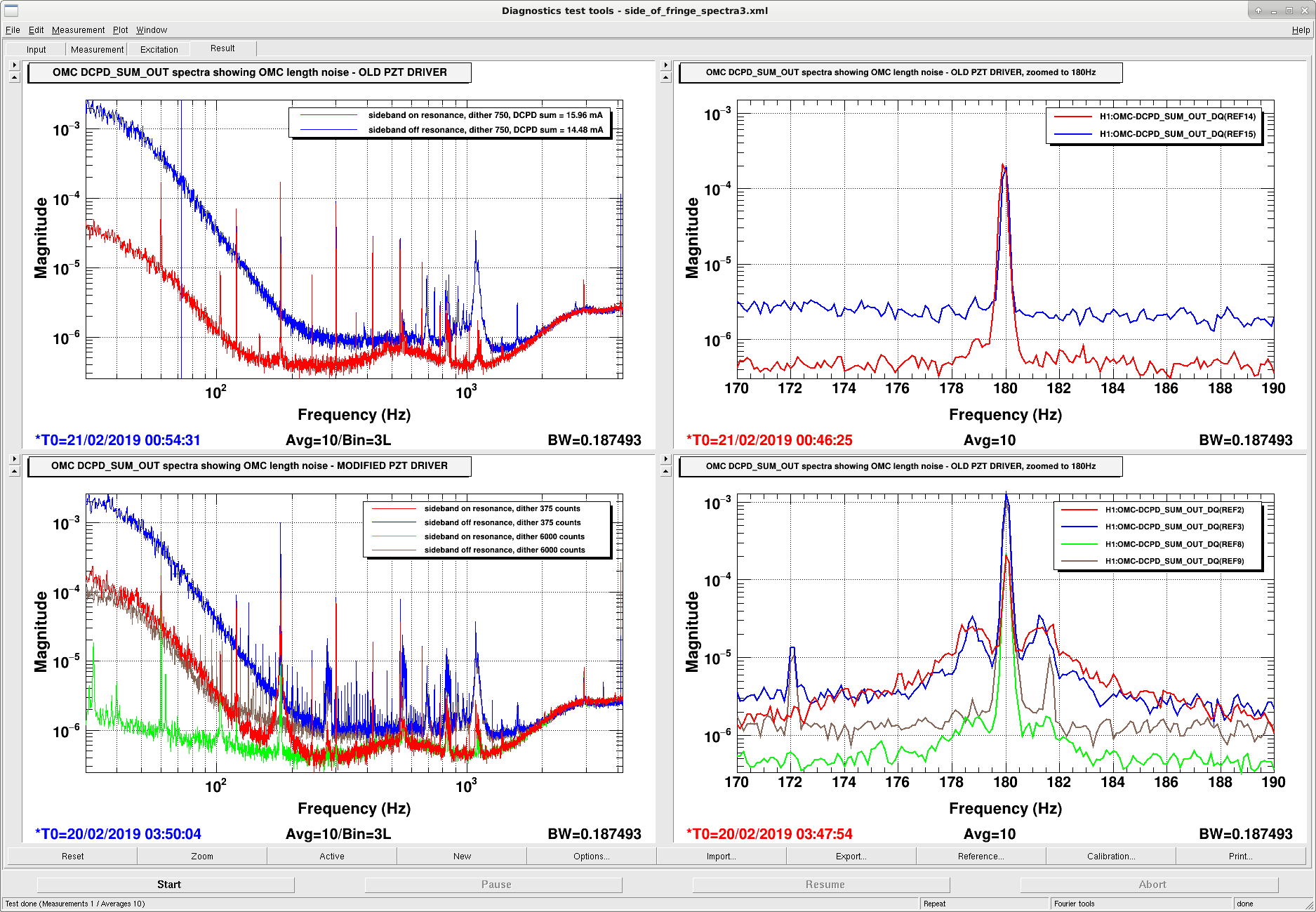
- We retook the measurements for the OMC length noise, measuring the DCPD spectra when locked on the carrier and sideband, on resonance and detuned from resonance. Stay tuned for a length noise spectrum. Looking at the raw data we took today compared to the same spectra from yesterday (top and bottom plots of the first attachment respectively) it's clear that the 180 Hz is much narrower with the new driver. The right colum of plots are the same as the left but zoomed into the 180Hz. The height of the 60Hz line was not reduced. The 10Hz comb of lines is also no longer present.
- We have not yet got to re-measure the RF9 coupling or look at the DARM spectrum with the old driver returned, as we have had trouble locking.
4.5 Hz DARM oscillation
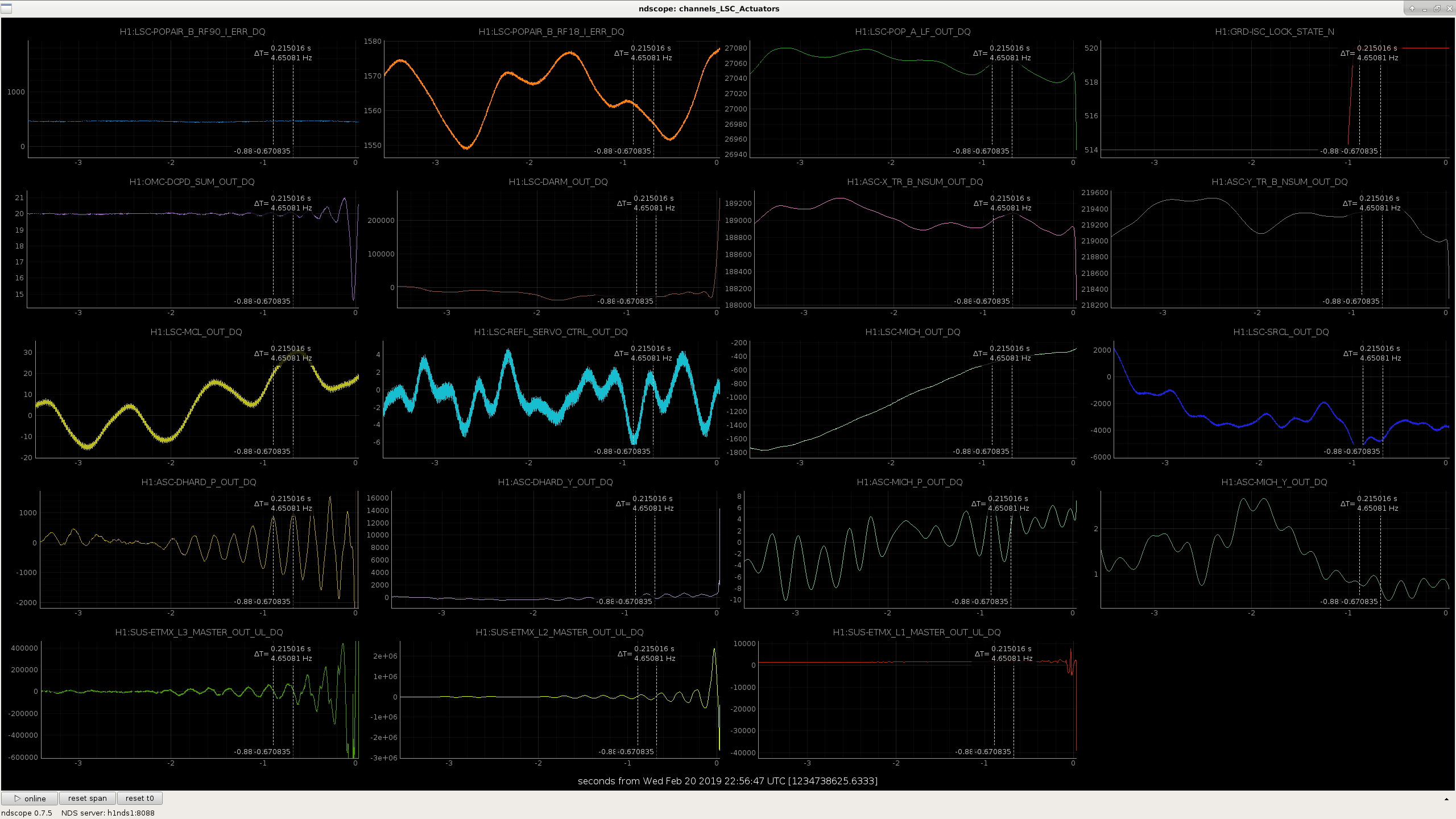
- We've lost lock many times today due to the 4.5 Hz ring up in DARM, which occurs during or shortly after the transition to from {ITMX L3 and ETMY L1+L2} to {ETMX L1+L2+L3}.
- Plots from example lockloss shown in second attachment, showing what looks like L2 and L3 fighting for control at this frequency.
- Later this evening Sheila tried to complete the DARM actuator transition with new filters and gains in the ETMY LOCK L1 filter bank, to better match it to ETMX (i.e. the same filters as installed in EX by Sheila and Keita last week). We still lost lock during the transition however, and the changes were not put in guardian.
- Craig tried increasing the ETMX L2 gain further than what Sheila and I tried on Monday. Initially we tried going from 15 to 22 - the actuator signals, and DARM IN and OUT looked better, but still marginally stable. We next increased the gain to 30, and managed to make it to nominal low noise.
- Once we were locked with this higher ETMX L2 gain it was clear we needed to retune the MICH-FF, Craig started this measurement and got the MICH to DARM transfer function, but not the MICH-FF to DARM transfer function. An oversealous excitation caused us to lose lock. We have left the high ETMX L2 gain in the guardian in LOWNOISE_ESD_ETMX, but are not 100% confident we actually solved the problem or if this was just another fluke.
Images attached to this report