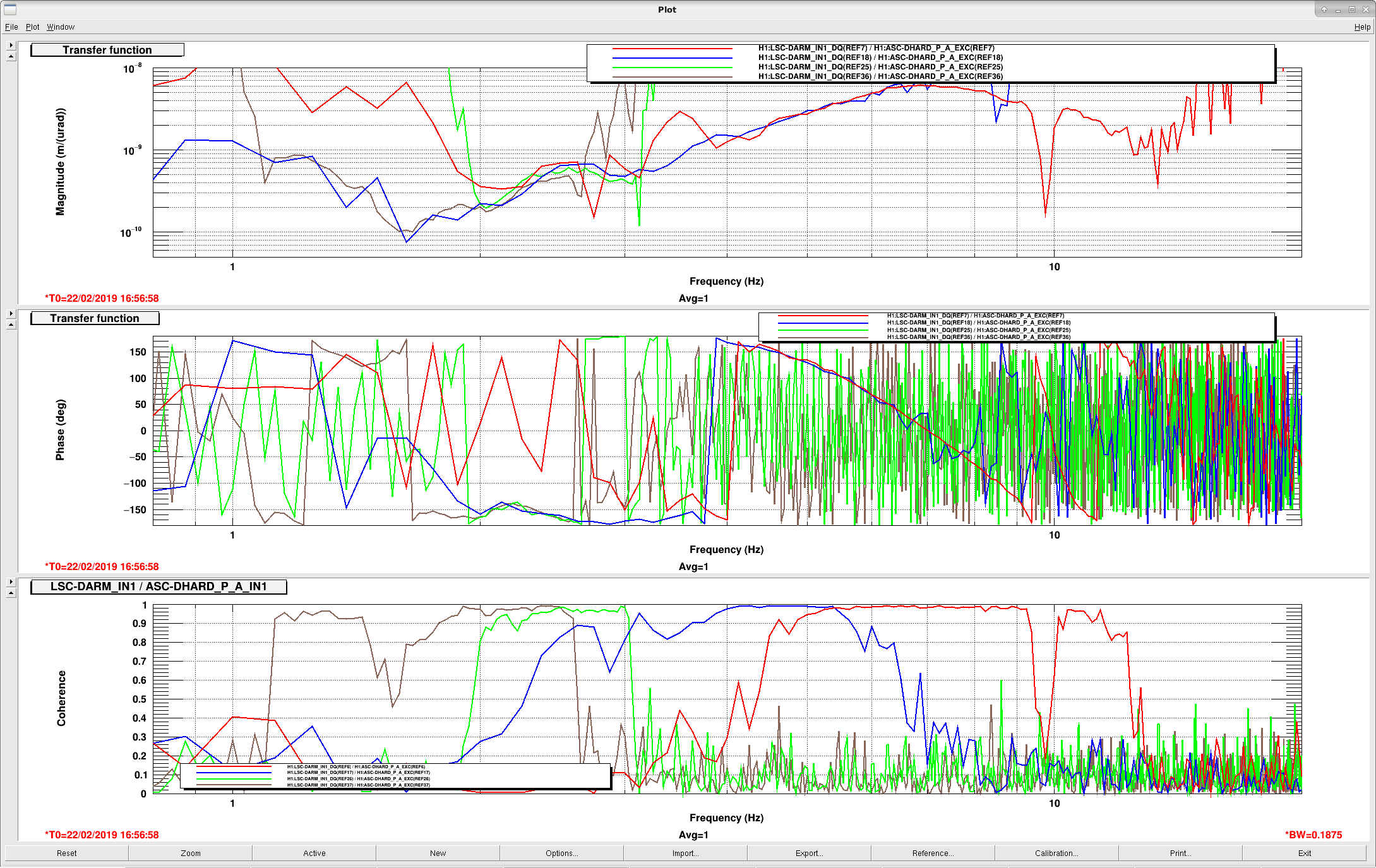
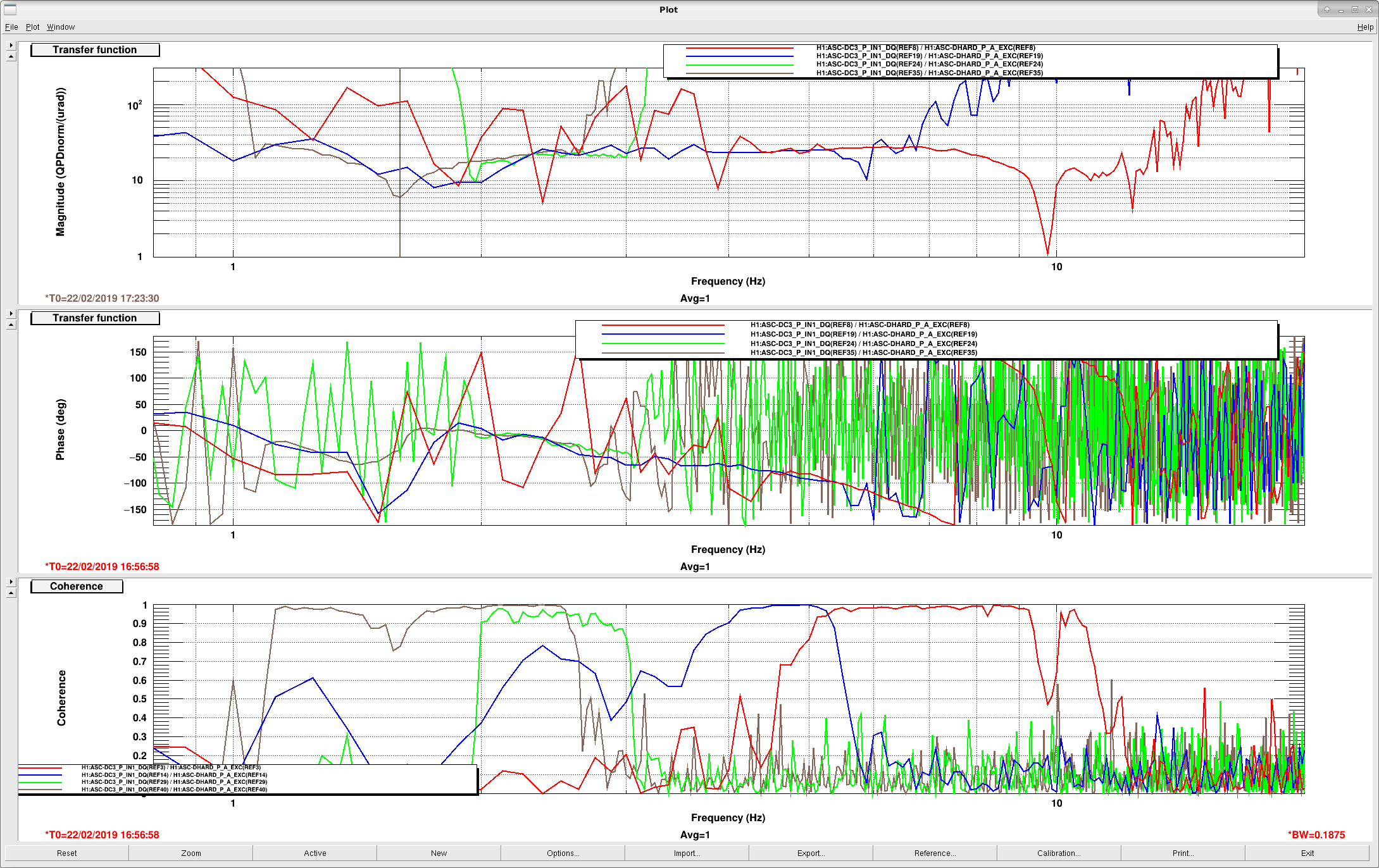
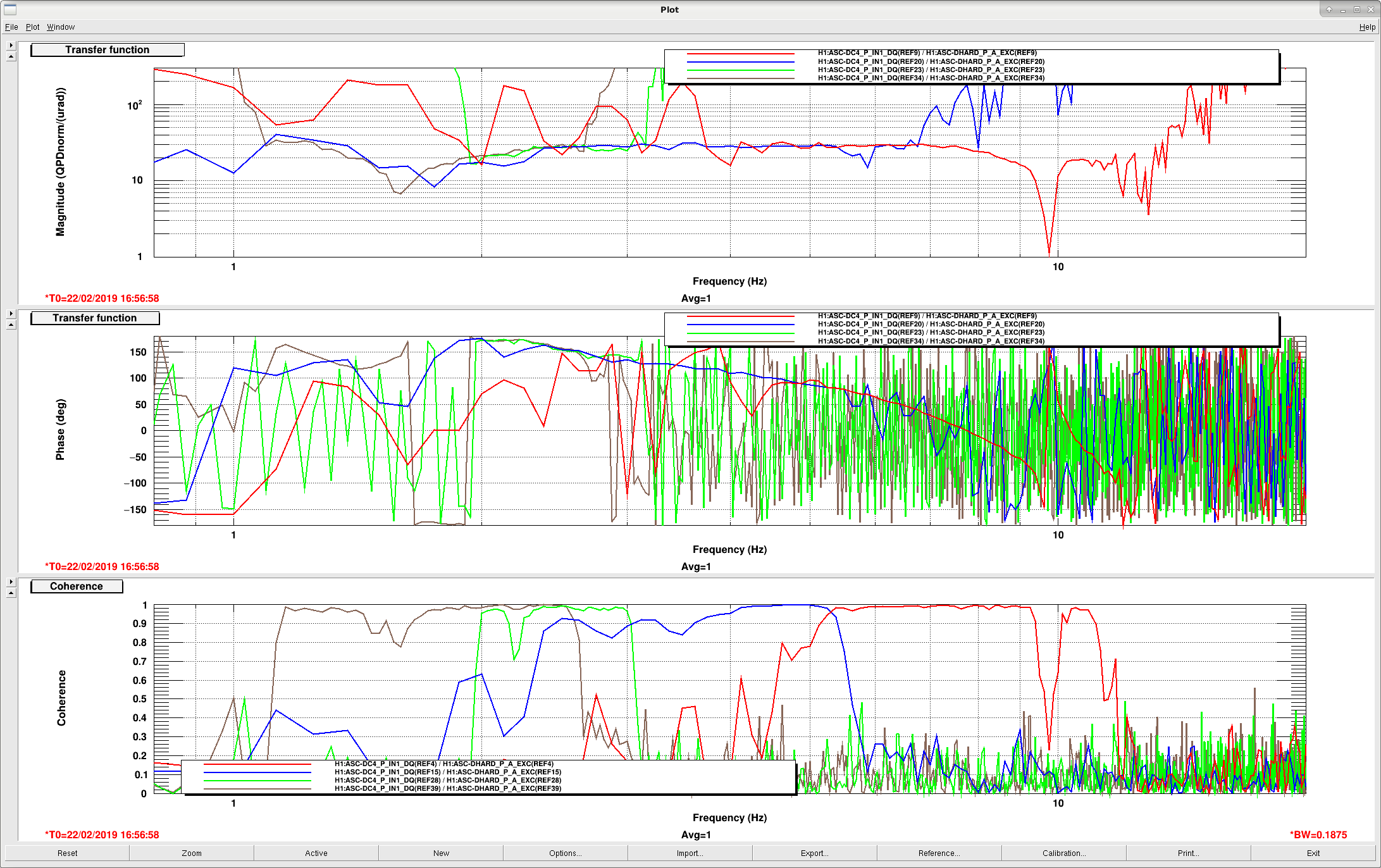
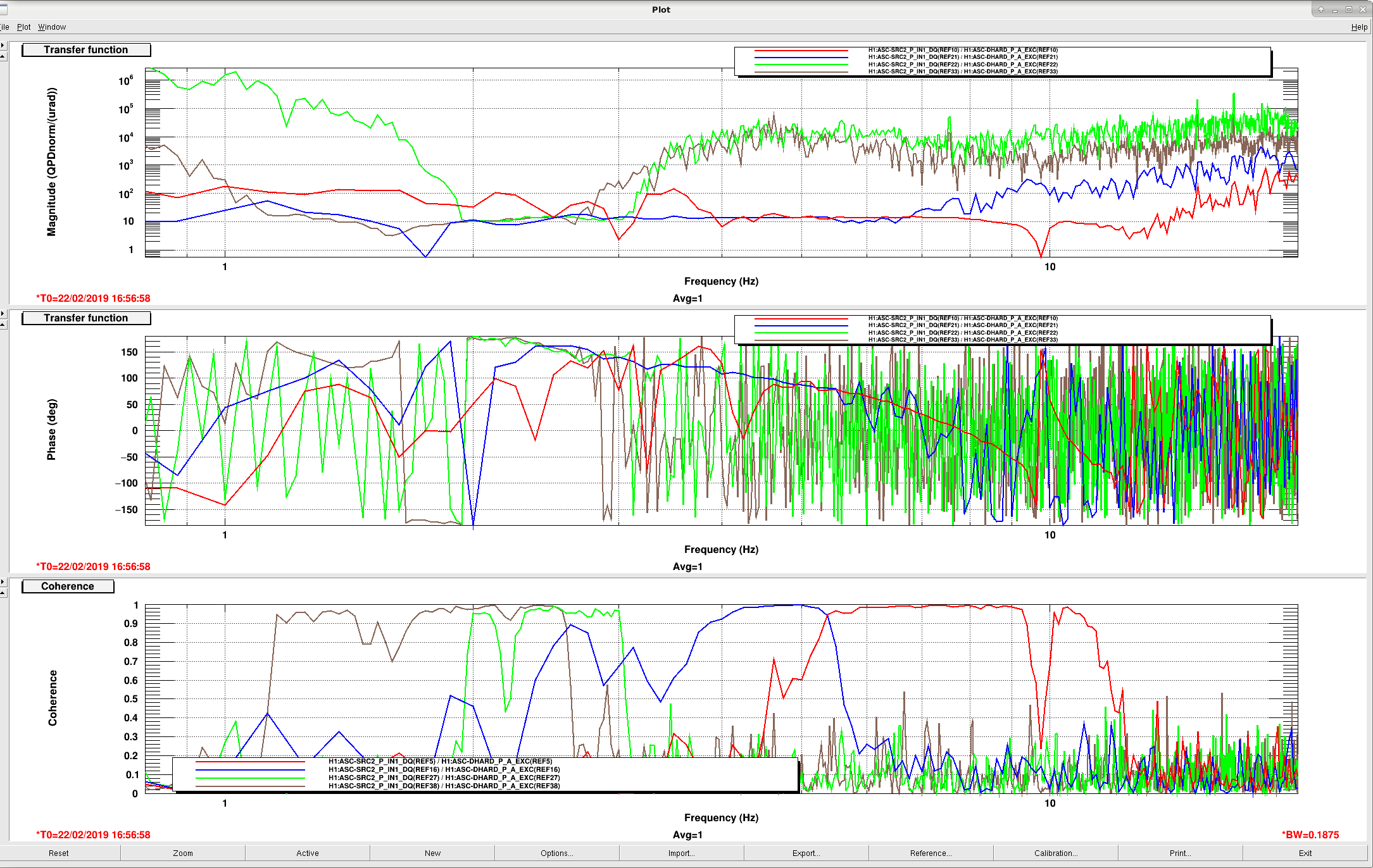
Sheila and Keita had pointed out that DARM could effect the DC centering loops on the AS WFS, which could then couple in to the ASC loops. This is particularly suspicious since we see a lot of DHARD motion when we lose lock due to the 4.5 Hz DARM ring-up.
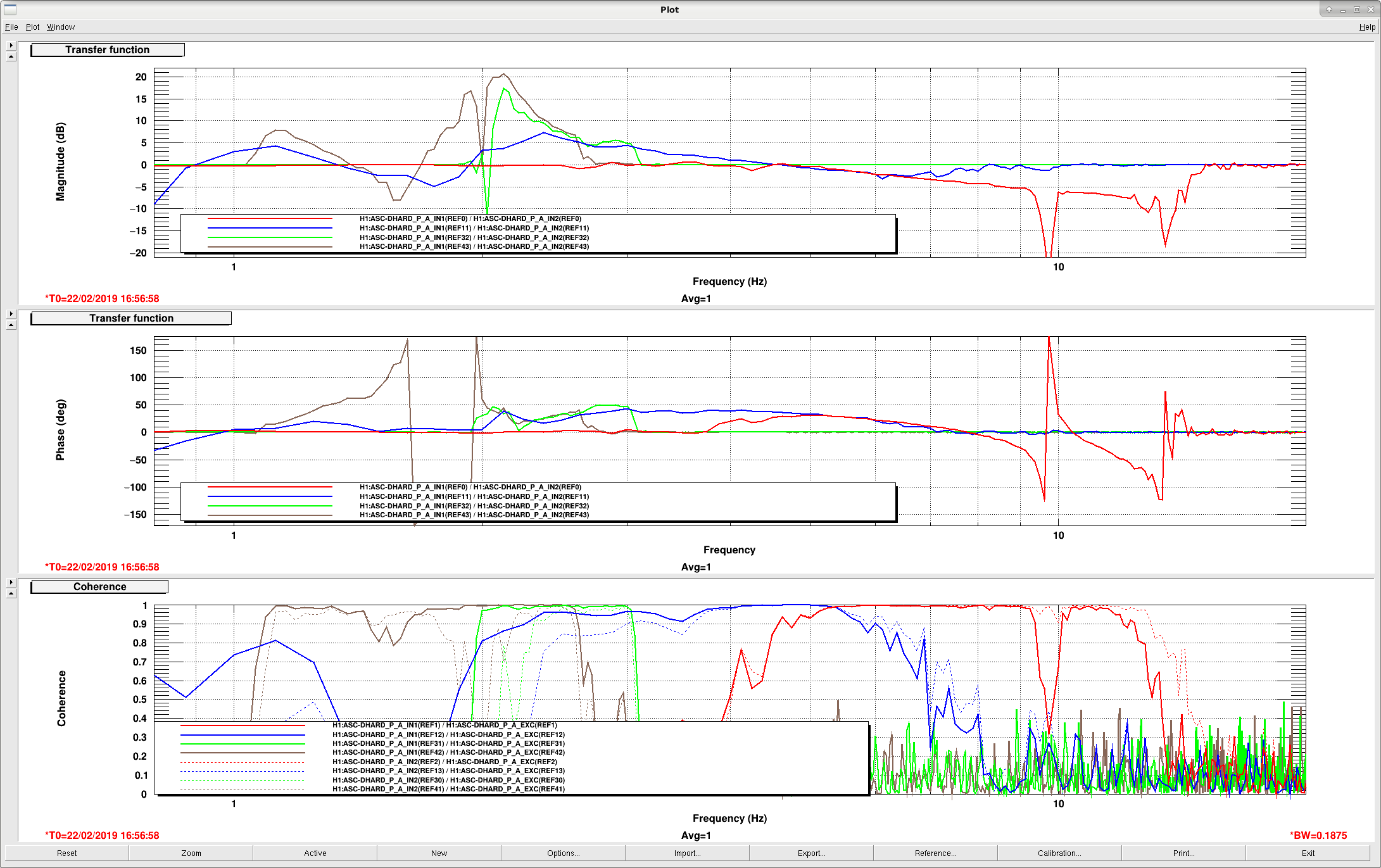
So, I made a DHARD_P measurement and plotted the response in DARM, DC3 (AS_A), DC4 (AS_B), and SRC2 (AS_C). Each attached figure has the relevant transfer function (either DHARD_P open loop gain, or DHARD_P_EXC to other degree of freedom's IN1), along with the coherence. I did 4 different frequency bands of noise injection, so that's why there are so many traces on each plot.
DC3, DC4, and SRC2 all seem to have fairly flat couplings to DHARD, with perhaps a bit of a dip around 1.6 Hz. DC3 and DC4's couplings are about 20 normalized QPD counts per DHARD microradian, while SRC2's coupling is about 10 normalized QPD units per microradian.
DARM's coupling with DHARD increases with frequency, but it's coupling level at 4.5 Hz is 2 picometers / microradian.
Recall from Hang's alog 47034 that we hope to keep our DHARD noise below 1nrad rms.
** Calibration of DHARD comes from alog 46453. Calibration of DARM comes from the inverse sensing function filters in H1:CAL-CS_DARM_ERR for O3. I could (but didn't) also multiply by Craig's fudge factor of 1.177 in the gain of that filter bank to give us a DARM to DHARD coupling of 2.3 pm/urad at 4.5Hz.