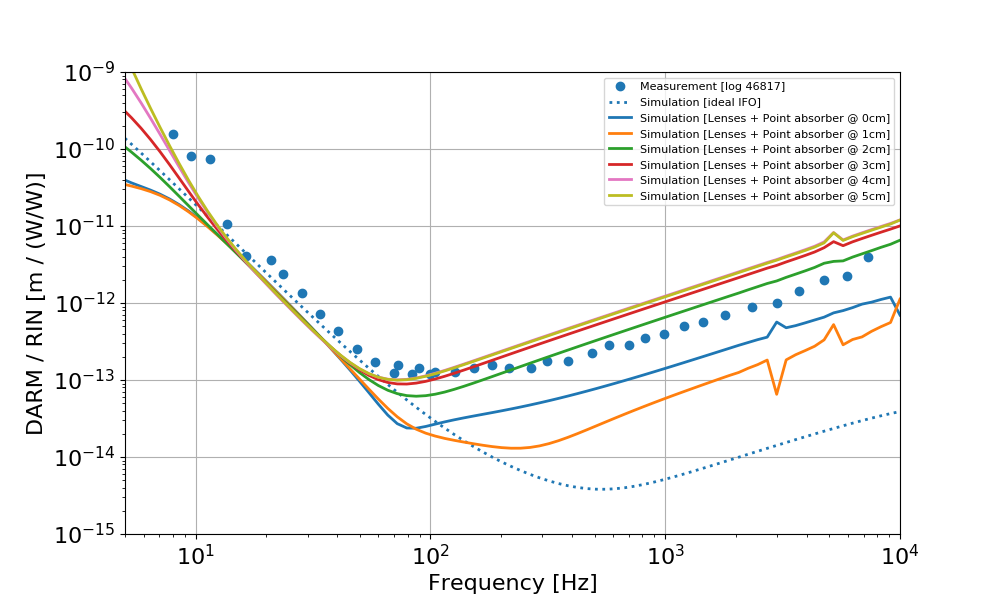
Here's another update to previous simulation of the effect of the optical path distortion (OPD) in ITMY due to the point absorber (following up on 47027 and 46952).
Simulation details:
- simulated the effect of the point absorber while moving it with respect to the beam center. I kept the same optical path distortion (OPD) amplitude, but moved the peak from the beam center (labelled 0 cm below) in steps of 1 cm, up to 5 cm from the beam center
- the effects of the intrinsic substrate lens, CO2 and RH are included, following 47060
- improved the IFO locking: now DARM, CARM, PRCL and MICH are locked using the simulated error signals. SRCL error signal is not good for the lock, there are multiple zero crossings, and none of them correspond to a place where the DARM transfer function looks like what it should be in broadband signal recycling configuration. So SRCL is kept at a nominal "zero" position which gives a reasonable DARM response
Results:
- moving the position of the point absorber has a large impact on the RIN to DARM coupling. The trend is not monotonic. The OPD caused by a point absorber at a few cm from the beam center seems enough to explain the measured RIN coupling.
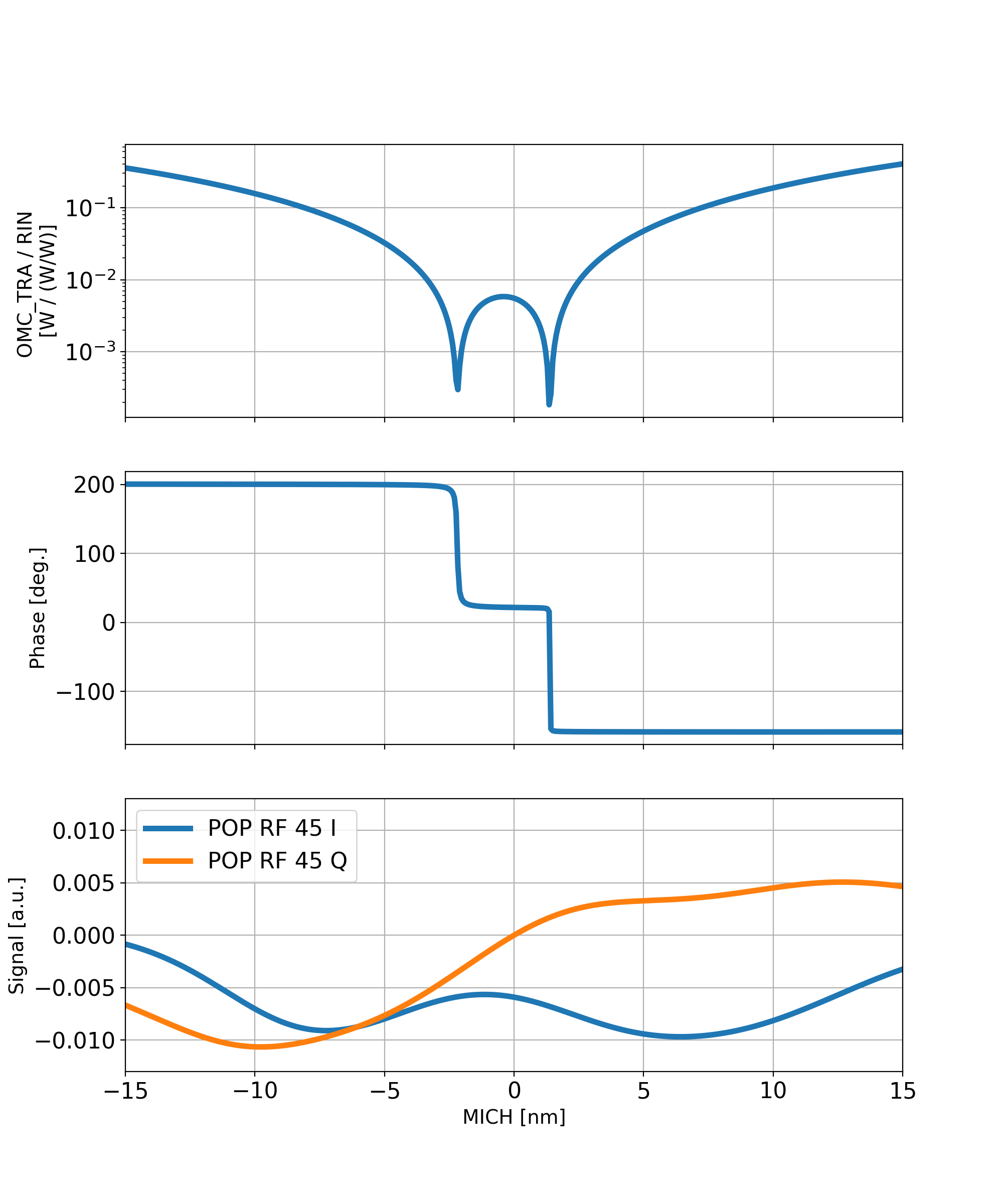
- it looks like the change in the high frequency (>100Hz) RIN coupling depends strongly on the MICH locking point. The main effect of the OPD is to induce offsets in the MICH error signal. The plot below shows what happens when MICH is moved around the error signal zero, with the point absorber at 5cm. The DARM / RIN transfer function is computed at 1 kHz for reference. Clearly, the zero of the MICH error signal does not coincide with a minimum of RIN coupling. It's worth noting that moving MICH by a few nm around the error signal zero does not change much the DARM response. The bottom panel shows the I and Q of the MICH error signal. MICH is locked on POP RF45 Q.
The two plots below show the mode content at the OMC input as a function of the point absorber position. The input power is 26 W and the modulation depth is 0.2 for 9 MHz and 45 MHz and 0.1 for 118 MHz. The first plot shows the decomposition into all modes, while the second shows the total for each order.
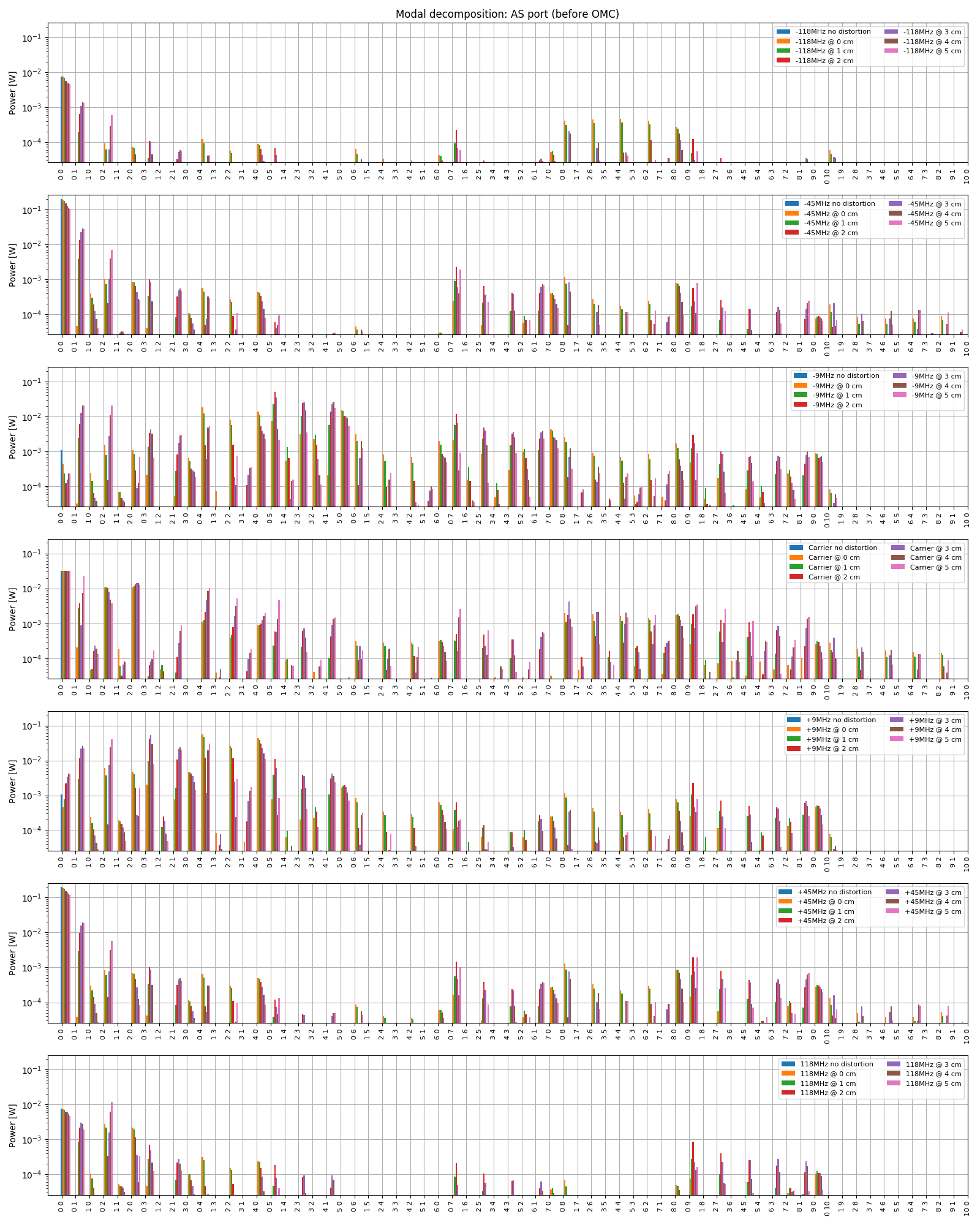
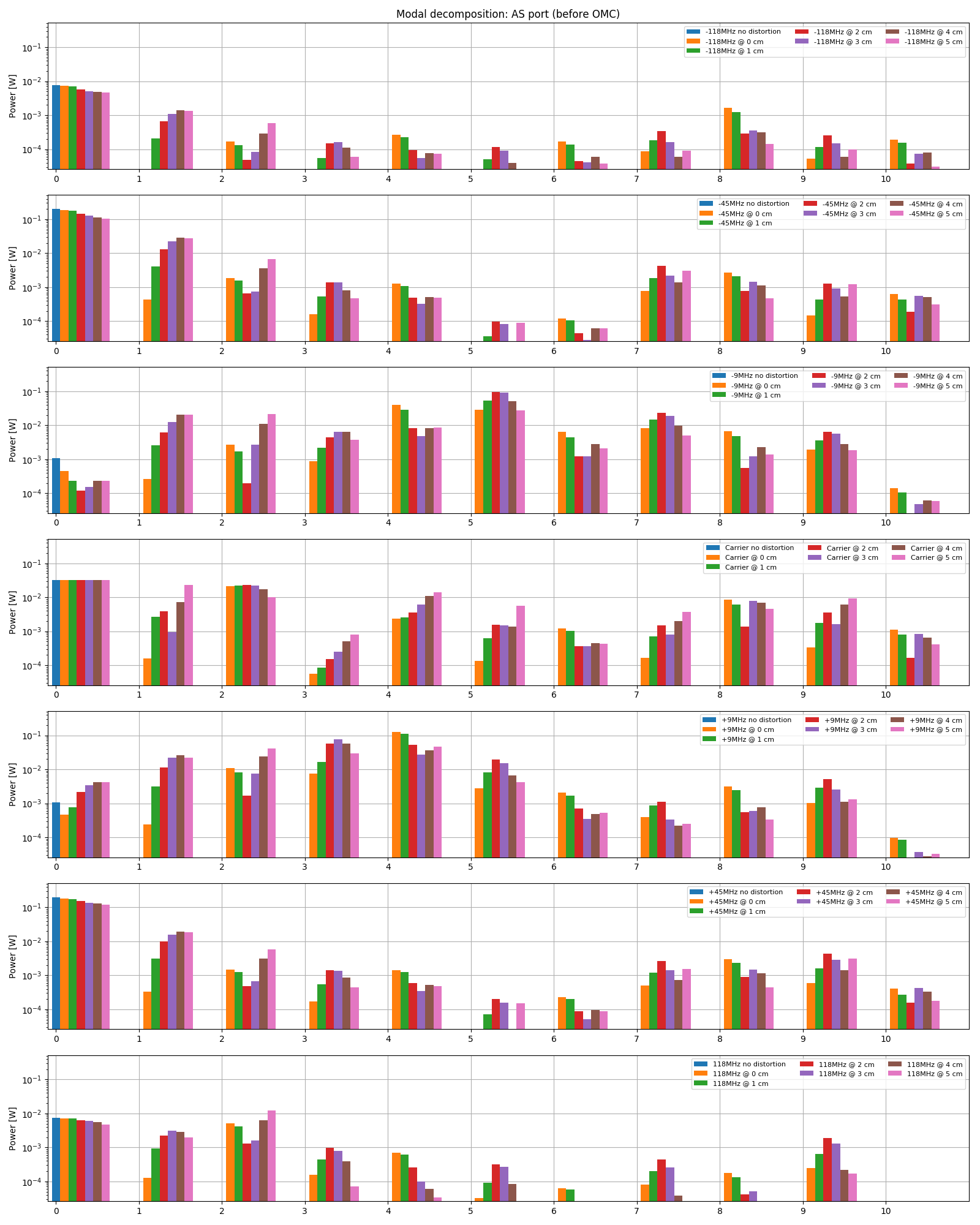
In the worst case scenario, with the point absorber at about 2cm from the beam center, the largest TEM9 mode has about 5 mW of power, so five times more than what initially reported in 47027. This means that (assuming all the TEM9 mode is transmitted by the OMC) we would need a RF9 RIN of about 1e-7 /rHz to explain the DARM excess noise.