peter.king@LIGO.ORG - posted 10:47, Wednesday 27 February 2019 - last comment - 14:48, Thursday 28 February 2019(47158)
FSS work
This morning I decided to clean slate the alignment of the AOM.

    Measured 145 mW incident on the AOM.  111 mW in the first order; thus a diffraction efficiency
of 76%.  Not great but passable, should be closer to 80-85%.

    Measured 83 mW in the double pass beam headed towards the reference cavity.  This is 57%,
which is close to the expected value of 59%.

    Aligned beam towards reference cavity.  With the transmission photodiode signal at 4.1 V, this
was measured to be 24 mW at the input to the ALS fibre.

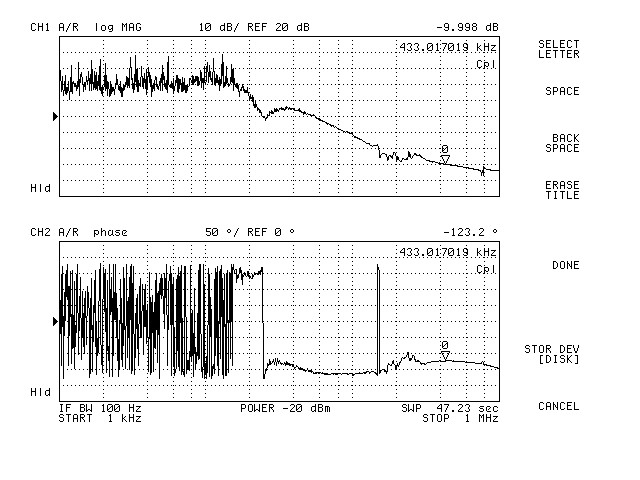
    Measured the transfer function and found the UGF to be ~24 kHz, in a repetition from yesterday.
I wiggled the LO and PD SMA cables at the TTFSS end, no effect.  The PD SMA cable at the PD end;
no effect.  Wiggling the SMA cable to the 21.5 MHz EOM instantly restored the UGF to 433 kHz
(CG = 20, FG = 18, see C20F18.jpg).  So either there's a problem with the 21.5 MHz EOM or the cable
going to it.

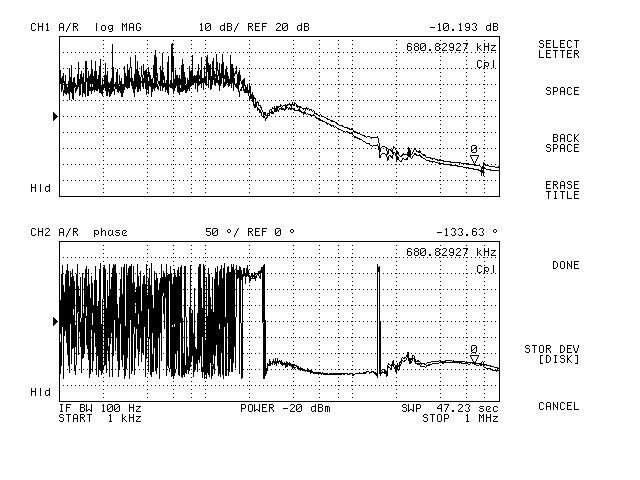
    I left the FSS with CG = 23, FG = 18 (see C23F18.jpg, C23F18.txt for data).  We could probably
dial the common gain back a little.
Images attached to this report
Non-image files attached to this report

Comments related to this report
IMC gain is back up
Non-image files attached to this comment

Good that the problem was solved.
There was some speculation that the problem came from accidentally catching a single-path AOM beam (alog 47147), but judging from the SQZ and ALS lasers' temperature feedback it doesn't seem to be the case. In the attached, the original jump of frequency was at around -20000 sec, the fix came at around -11000 sec. Frequencies moved in the same direction in SQZ and ALS lasers for both of the instances.
Images attached to this comment
