
I have been looking at the 9MHz RIN coupling to DARM in a Finesse model to see how it compares to the measurements done in alog 47243. In particular I was interested in the shape and its dependence on the DARM offset.
In summary: the model suggest that what we are measuring is the 9th order HG mode of the 9MHz coupling through the OMC.
Modulating the 9MHz modulation index results in both the 9 and carrier being amplitude modulated. Modelling the transfer function dependence on DARM offset (Quantified in DC power at OMC DCPDs) produces this:
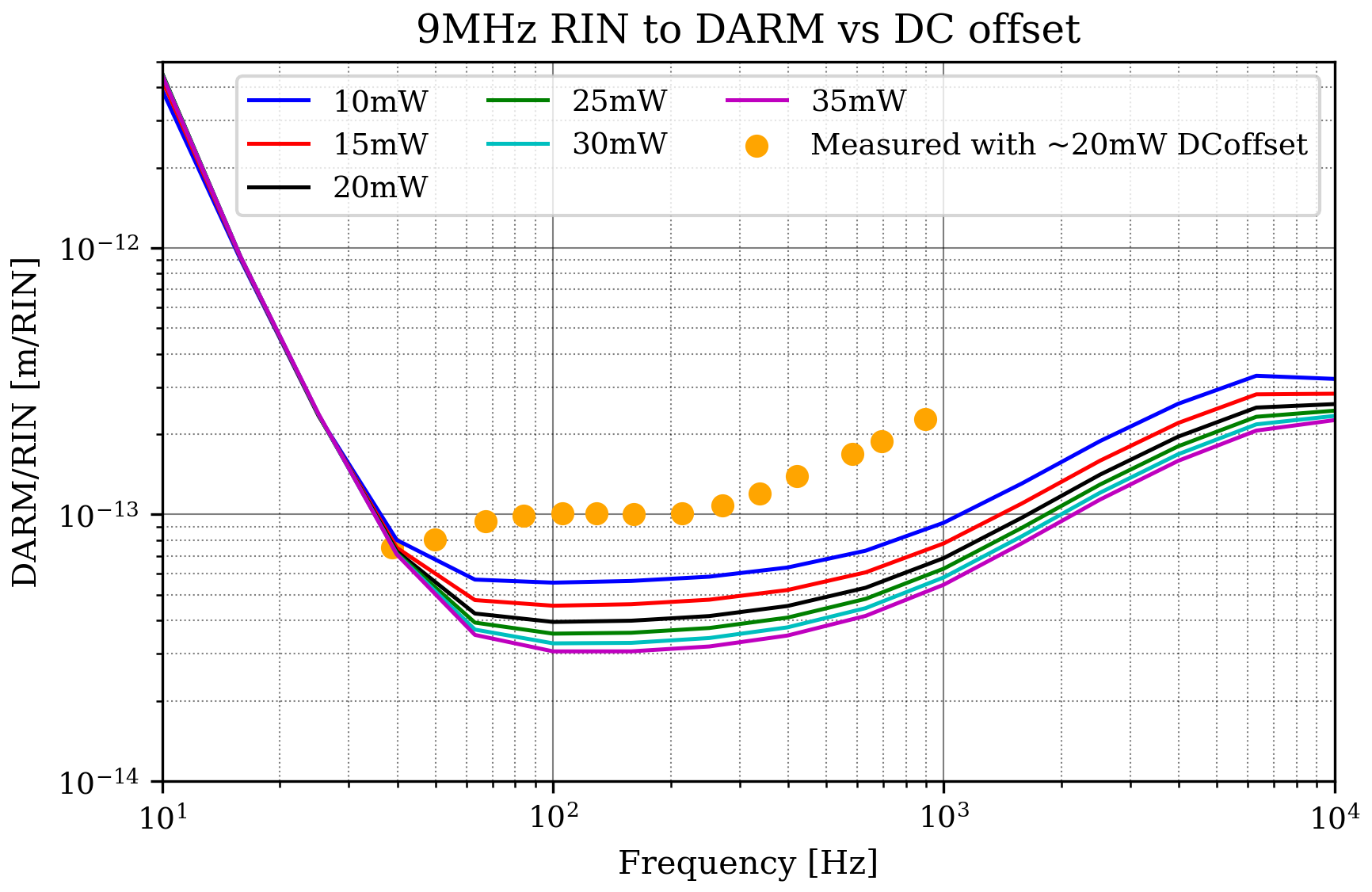
Breaking down the various terms of the coupling we see:
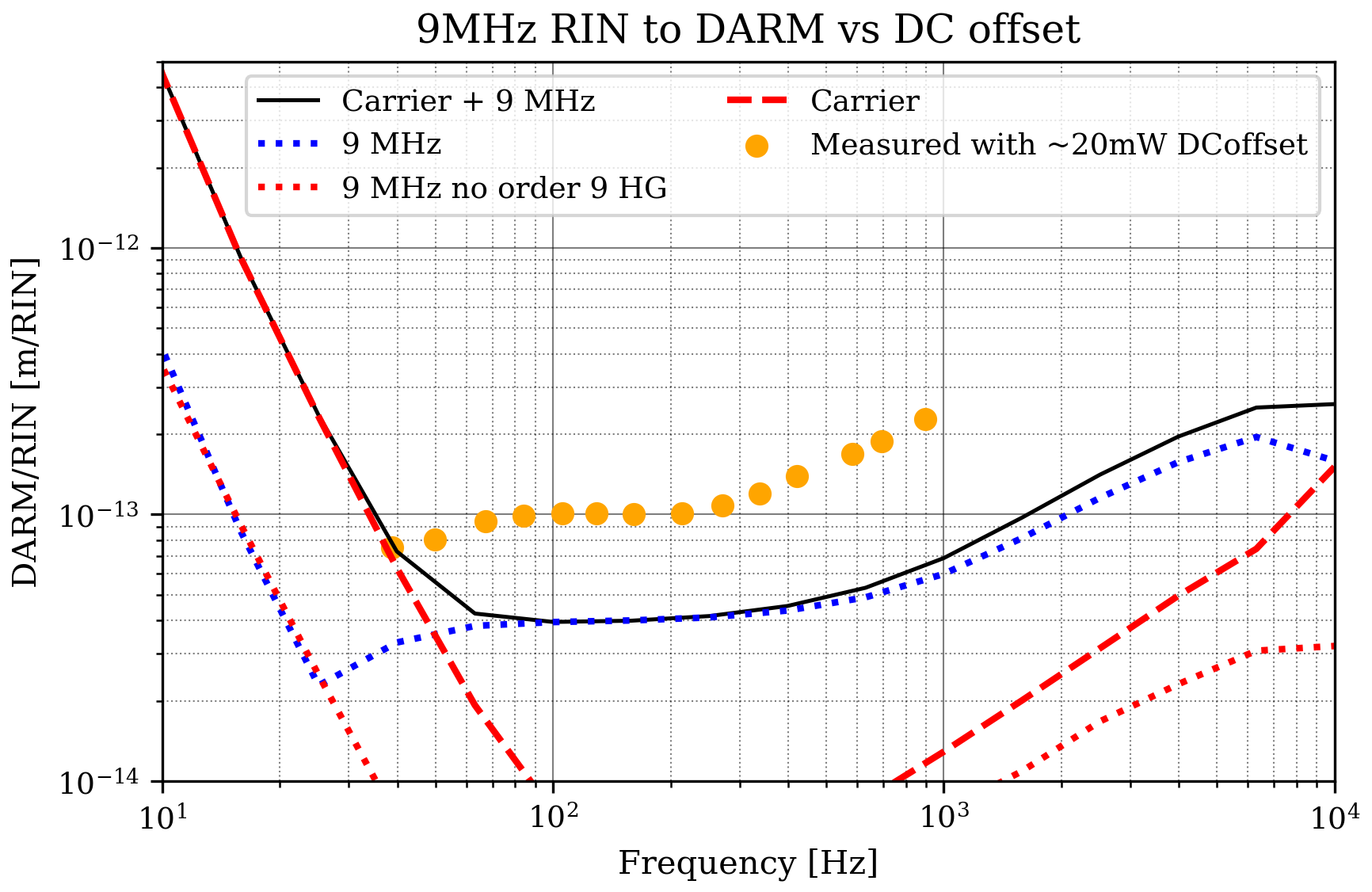
The carrier coupling term does not change with DARM offset, the 9MHz does. Also plotted is the 9MHz coupling with the 9th order modes removed. The 9th order terms are the dominant at high frequency. The shape also appears to match the broadband injections, reducing below 100Hz.
If the individual couplings terms are to be believed the carrier term is actually much less than modelled, whereas the 9Mhz 9th order is greater. The latter will depend on the position of the beam relative to the point absorbers which I haven't explored yet. Why the carrier term would be much lower in the measurements I am currently unsure.
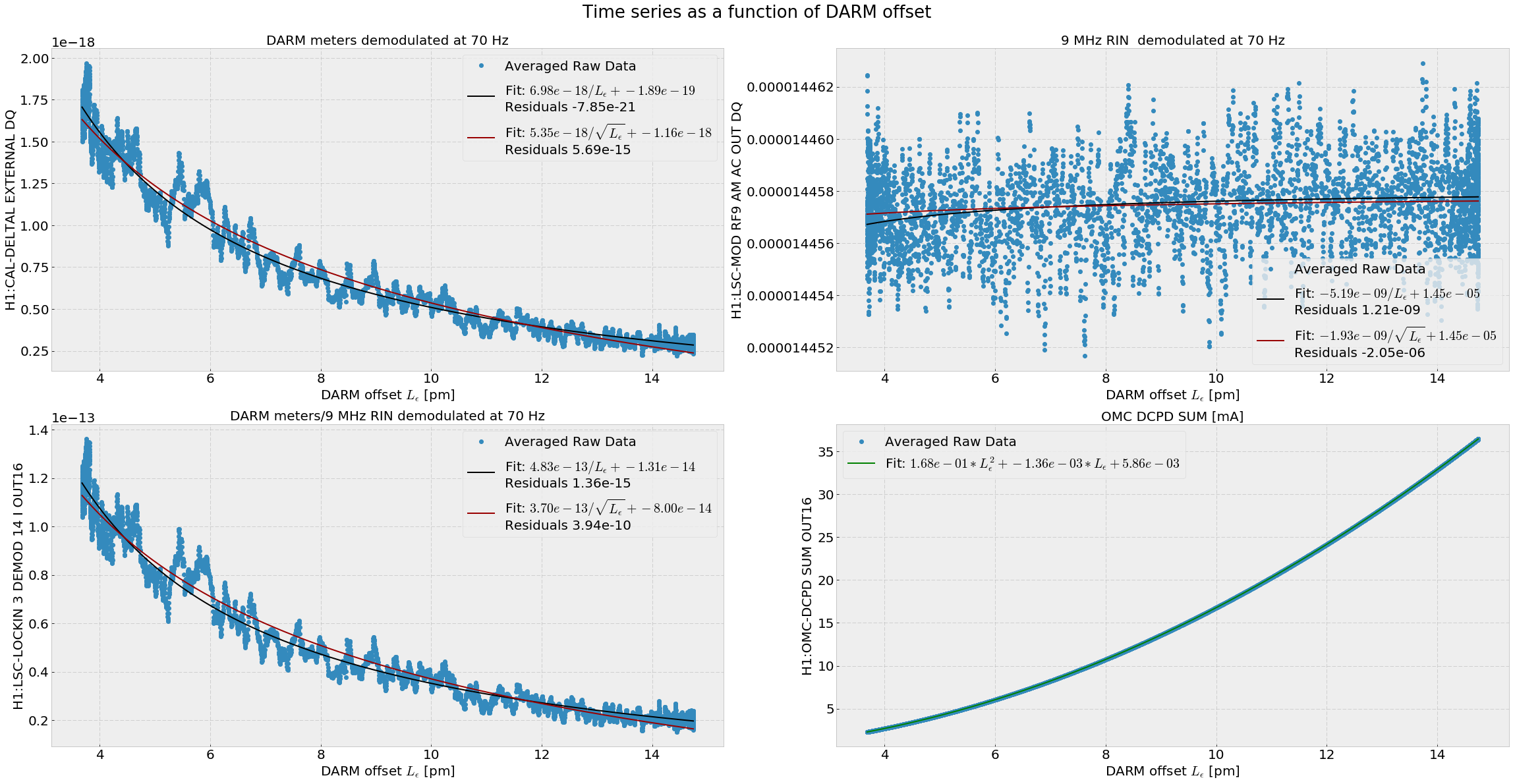
We can also plot how the 9th order 9MHz coupling drops with DARM offset, looks like it is 1/sqrt(DCPD power) or equivalently 1/(DARM offset) from the model. Which is the lower residual fit that Craig tried.

The model contained:
- ITM substrate maps based on the optical depths from the HWS measurements, point absorbers and all
- ITM transmission imbalance
- A slightly more astigmatic OMC than design (https://dcc.ligo.org/LIGO-T1900084)
The 1/DARM_offset of 1/sqrt(DCPD) coupling can be explained by considering a CONSTANT amount of 9MHz HOM coupling to the DCPDs, while the optical gain scales with the offset, such that the same amount of 9MHz RIN at the DCPD is interpreted as a different noise level in m/rHz.