This is a follow-up on Sheila's alog about DHARD limiting the sensitivity (47209).
In summary: DHARD_P coupling to DARM is non stationary, we can subtract more with a non-stationary algorithm (at least during the noise injection, to be checked during quiet time)
Evidence of non-stationary coupling
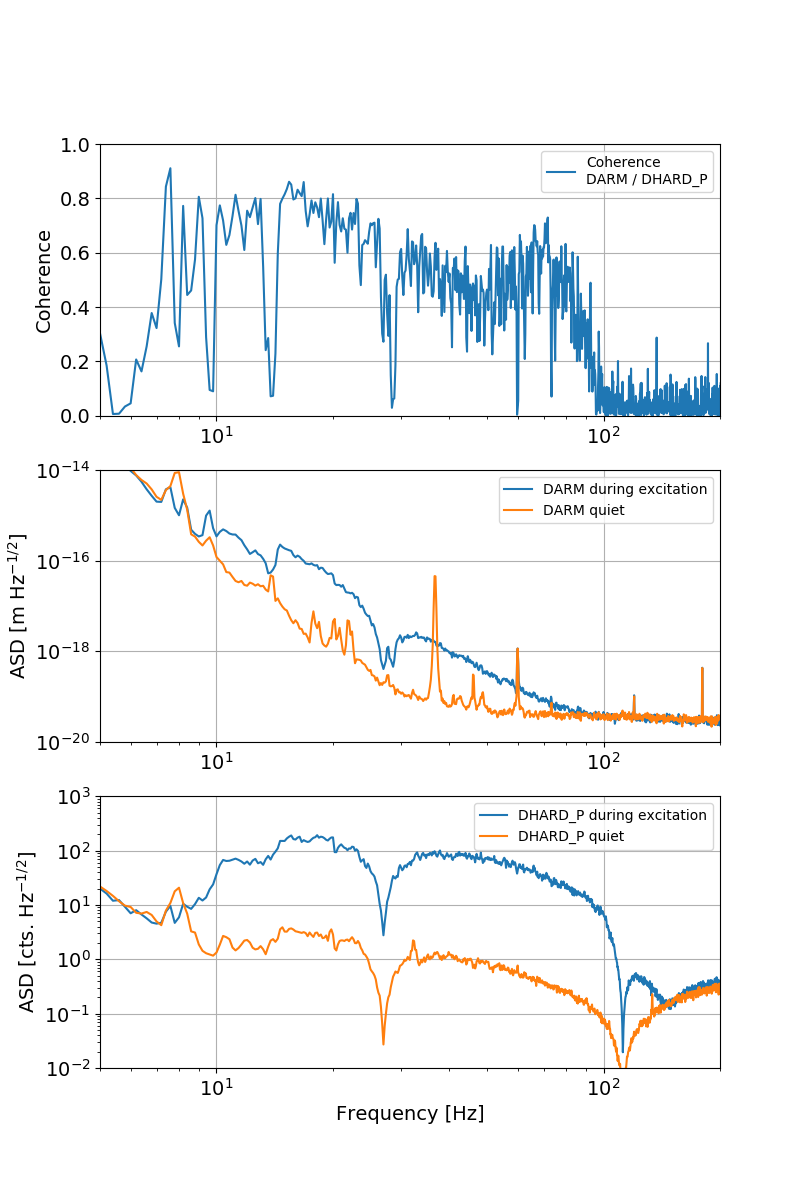
The first evidence, as pointed out by Sheila, is that during a DHARD_P noise injection "the noise in DARM was increased by about a factor of 10-20 below 50Hz, but the coherence between DARM and the excitation is only around 0.7". The plot below shows the increase in DARM noise during the injection (note: I don't know what the line at 3X Hz is, probably my "quiet" time was during some other test) and how the coherence is too low, considering the SNR of the injection in both DARM and DHARD.
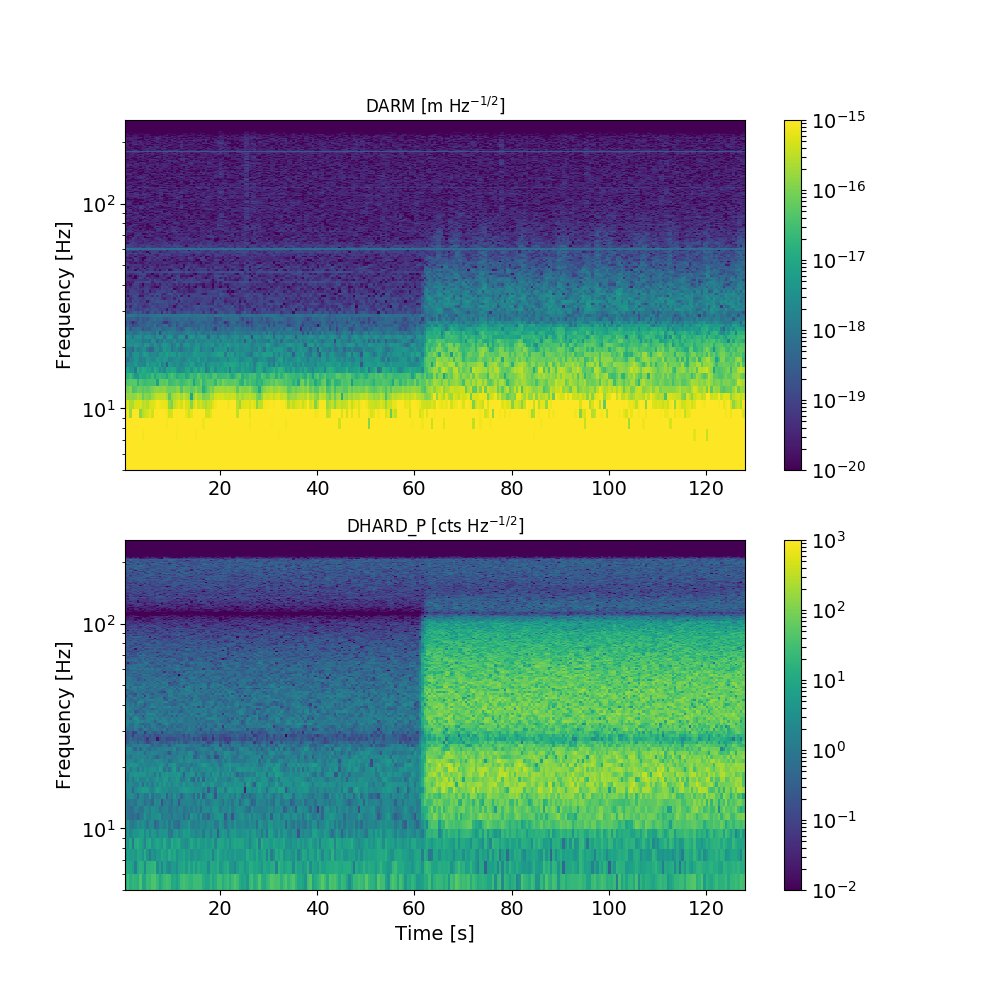
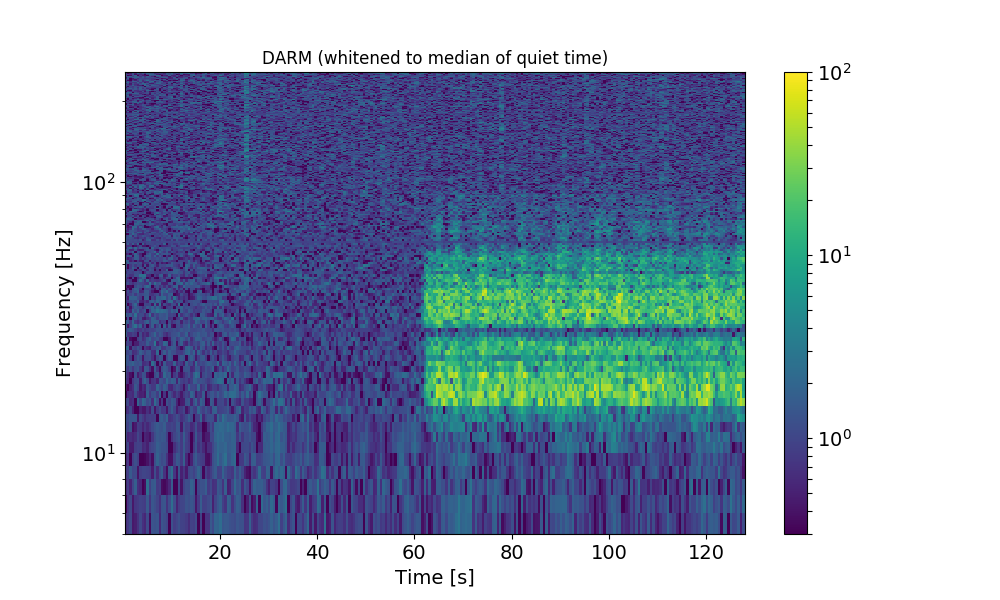
Another better evidence is provided by the spectrogram of DARM and DHARD around the injection time. The first figure below shows the DARM and DHARD signals when the noise injection is turned on (quiet time before t~=60s, DHARD_P injection for t>~60 s). DHARD_P is stationary, DARM is not. The second figure shows the DARM spectrogram, whitened to the median of the quiet time. The non-stationarity of the DARM noise is evident.
Non-stationary noise subtraction
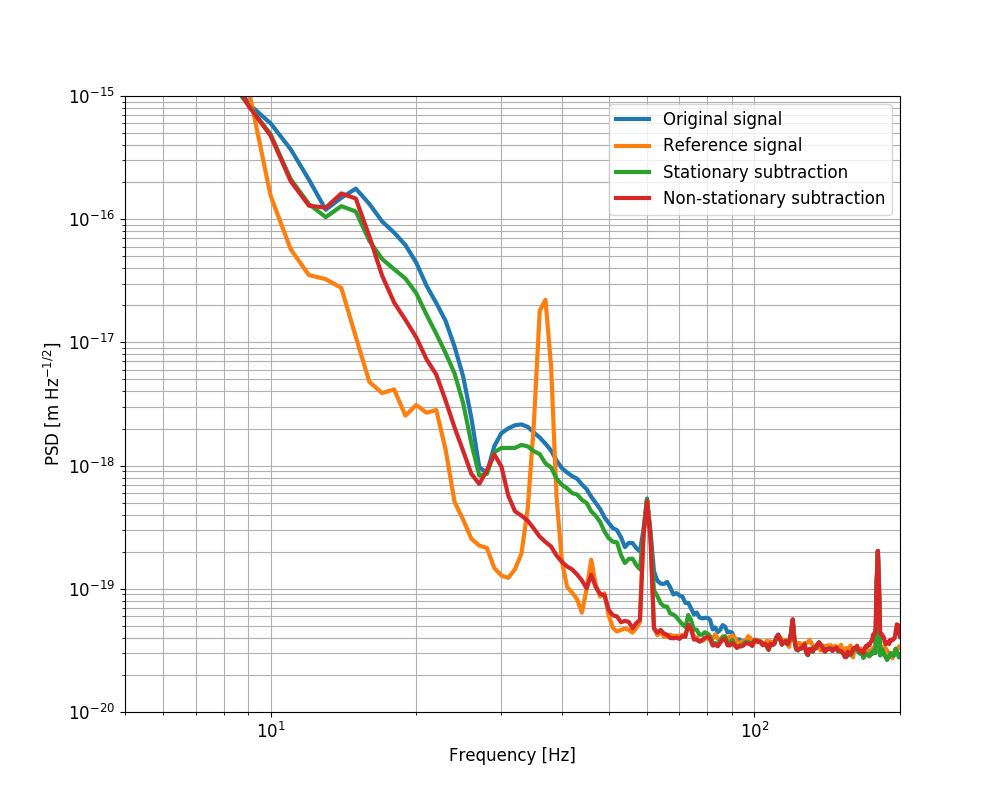
I used the non-stationary noise subtraction code described in many previous alogs for SRCL (45823 and links therein) and in all the details in T1800525. The noise witness channel is in this case ASC-DHARD_P_OUT_DQ, and the modulation channels are all the ASC input monitors. I used about 60 seconds of data during the DHARD_P noise injection (GPS = 1235434291 + 60s) to train the non-stationary model. For now the performance of the subtraction is shown on-target, meaning that I am using the same 60s to train and evaluate. There are other noise injections near that time and some quiet periods that I will later use.
First observation: the linear noise subtraction (green trace) does not perform very well, since it reduces the DHARD noise into DARM only by less than a factor 2. Second observation: the non-stationary noise subtraction (red trace), obtained by allowing the coupling to be modulated by the ASC input signals, performs much better at frequencies above 30 Hz, and slightly better at frequencies between 10 and 30 Hz. Not all DHARD noise is removed (compare red and orange).
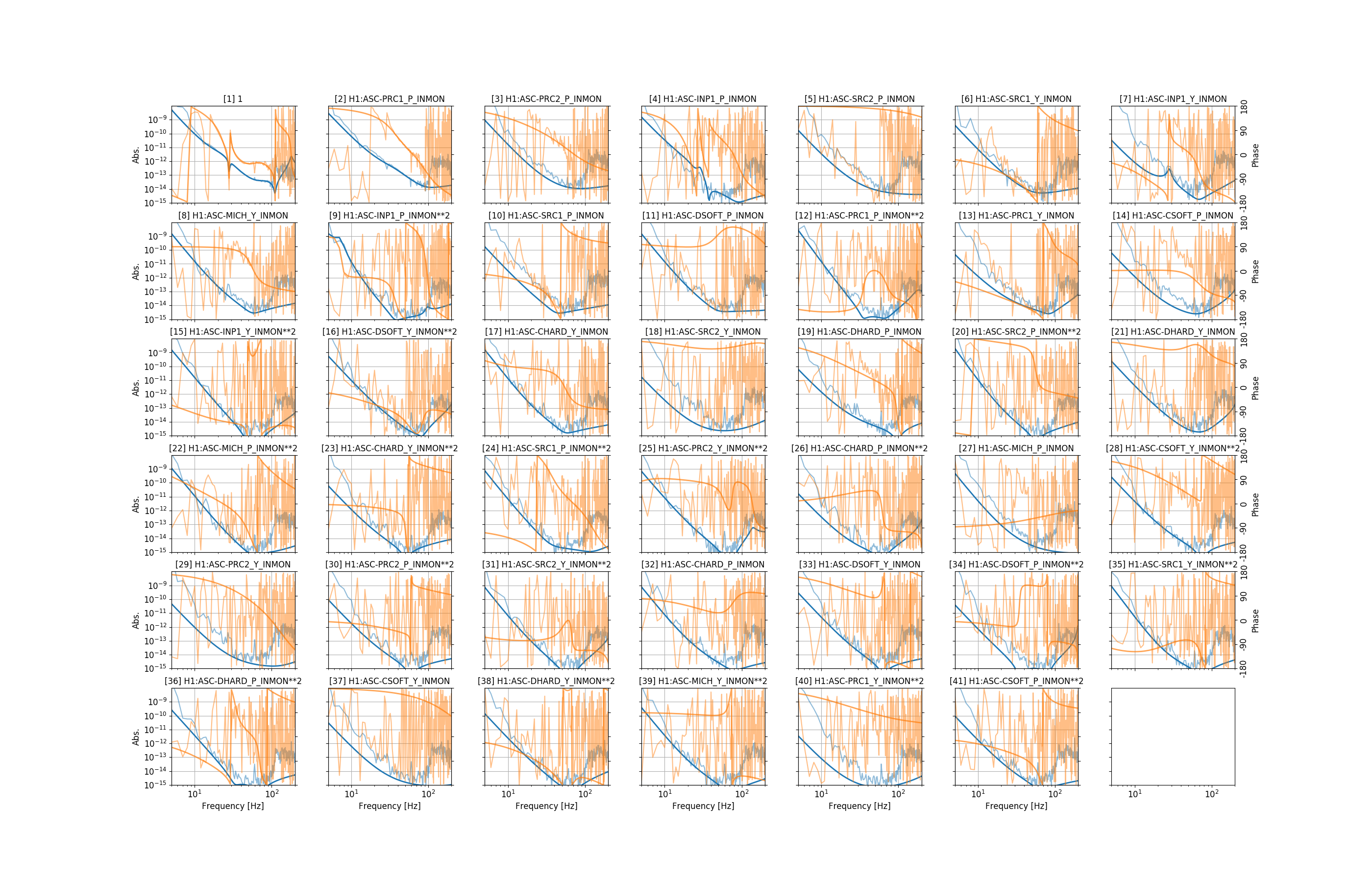
The plot below shows the main contribution to the noise subtraction, the main modulation coming from PRC1_P.
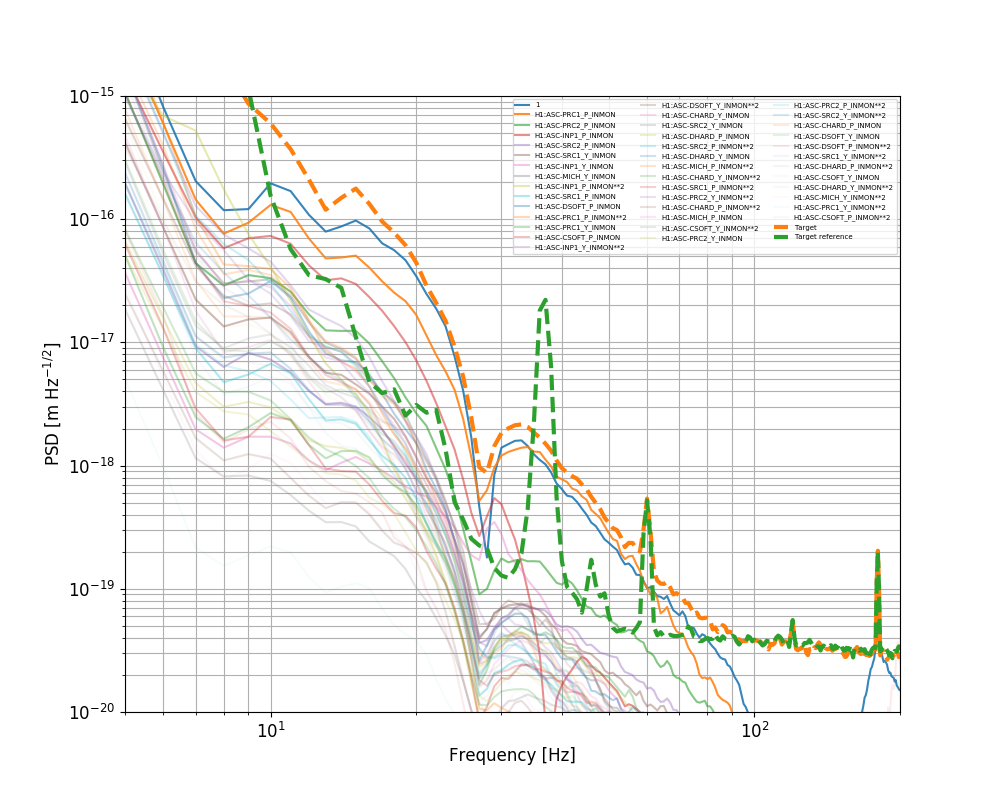
The last plot attached (not shown inline) contains all the coupling transfer functions.
To do list
- convert the subtraction filters to time domain
- apply the time-domain subtraction to
- another noise injection to check off-target performance
- a quiet time, to see how much we can gain at low frequency