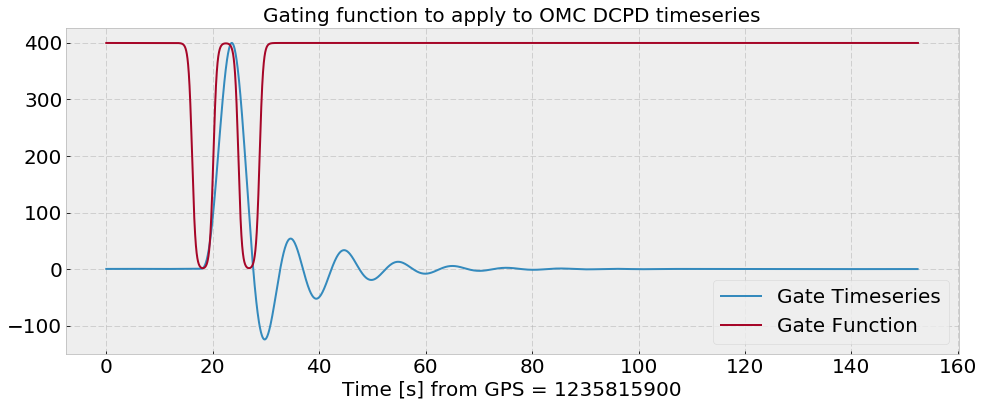
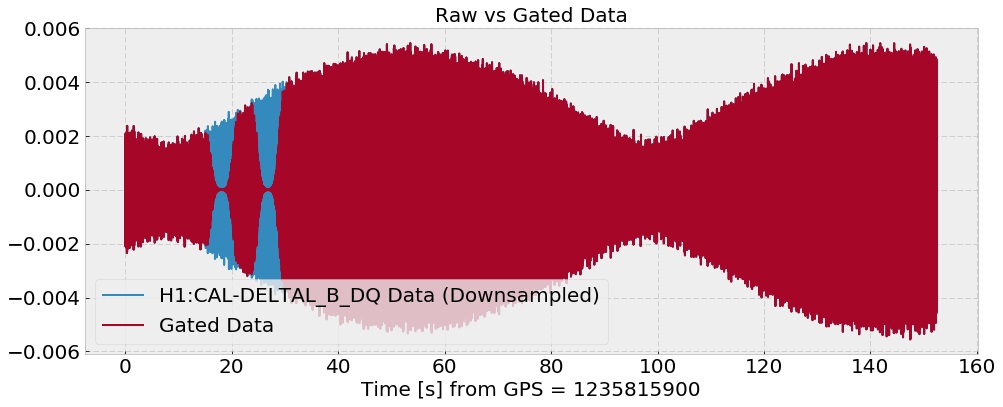
I wrote some python code to create cross-correlated DARM spectra over long, glitchy locks. Stefan balanced the PDs recently, and we saw our correlated DARM noise was fairly high at high frequency. Stefan supposed this was from glitches, but from this alog, this seems to not be the case. The info we want from the cross-correlated DCPD spectrum is the correlated noise from the IFO. We can average away the shot noise like 1/sqrt(N) where N = number of ASD averages. The problem is we need many averages to integrate away the shot noise. However, during these locks, we have frequent, strong ESD saturation glitches which spoil the spectrum. DTT is not able to "gate" the glitches, i.e. remove them from the timeseries. This code solves this problem. Attachment one shows a DARM ASD and DARM CSD between the OMC DCPDs during the lock last night. I have 2000 averages with a binwidth of 0.2 Hz and 50% overlap, or 1.4 hours of data. During this time there were 4 glitches which spoiled the spectra (the blue, purple, and green traces). With gating we have the red and orange traces. Attachment two shows a zoomed in gate function of one of these glitches. The gate I apply is just a logistic function with the mean of the data added in. The glitches are witnessed via the DARM BLRMS increasing to huge values, specifically H1:OAF-RANGE_RLP_3_OUT16 going above 100 counts. Attachment three shows the DARM OMC DCPD data with and without the gate applied. Code lives in/ligo/home/craig.cahillane/Git/IFO/Crosscorrelations/scripts/gated_DCPD_CSDs.ipynb. To run you'll have to run:$ setupanaconda (or $ source /opt/rtcds/userapps/release/cds/h1/scripts/setup_anaconda if your .bashrc alias isn't set up) $ source activate cragenv $ jupyter notebook /ligo/home/craig.cahillane/Git/IFO/Crosscorrelations/scripts/gated_DCPD_CSDs.ipynbShoutouts to TJ Massinger for help with understanding gating.

Please can you say exactly what is saturating in the ESD chain and, if you know it, what causes the saturation?
Rich:
The large glitches that show up in the BLRMS and as range drops used to always saturate the ESD, but they no longer do saturated the ESD every time (See 46642). The ESD saturation seems to be a symptom of the glitches which happen because the ESD sees DARM, not a cause. Our normal drive to the ESD is not close to saturating, and the glitches don't seem to be happening at times when we have large excursions in the drive to the ESD.
Looking at Craig's cross-correlated noise at high frequency, I remembered that we often see ~low coherence with PSL signals at a few hundreds Hz and above. In particular, looking at a BruCo scan for one of the last locks (bruco_lho_1236004218) I found that above a few hundreds Hz there is significant coherence with H1:PSL-PWR_HPL_DC_OUT_DQ (I'm not sure what that channel is...)
So I used a subset of the time Craig's listed in the plot (between 1235816126 and 1235816900) and computed
- PSD of DARM from GDS-CALIB_STRAIN
- Cross spectral density of OMC-DCPD_A and B (projected into DARM using the transfer function between OMC_DCPD_SUM and GDS-CALIB_STRAIN)
- Coherence-based projection of H1:PSL-PWR_HPL_DC_OUT_DQ into DARM
I used 1-second-long FFTs, to increase the number of averages. Maybe this is why my CSD is a bit lower than Craig's. In any case, it looks like the correlated noise lines up nicely with the projection from that PSL channel (I don't know what the "notch" at 2.5kHz is in the PSL channel projection, but it looks to be at about the right place where the intensity and frequency noises cross over in the noise budget 47351).
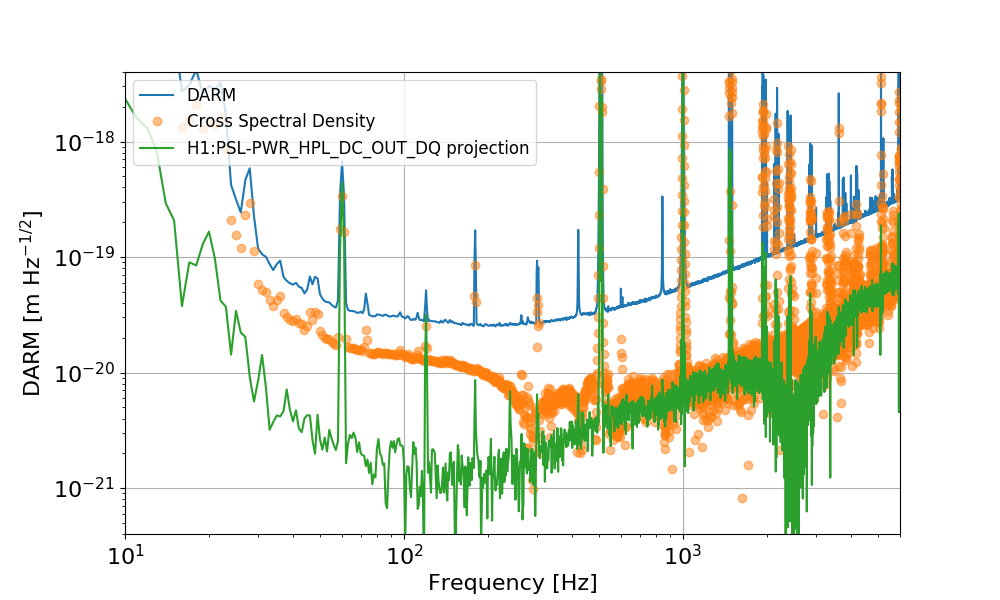
For future reference, the channel H1:PSL-PWR_HPL_DC_OUT_DQ is a power monitor PD on the PSL table. This PD sits before the ISS AOM (it is PD01 on the PSL table drawing, D1300348 (drawing update for 70W amp in progress update complete)), so any intensity noise it sees is free-running and therefore not suppressed by the ISS.