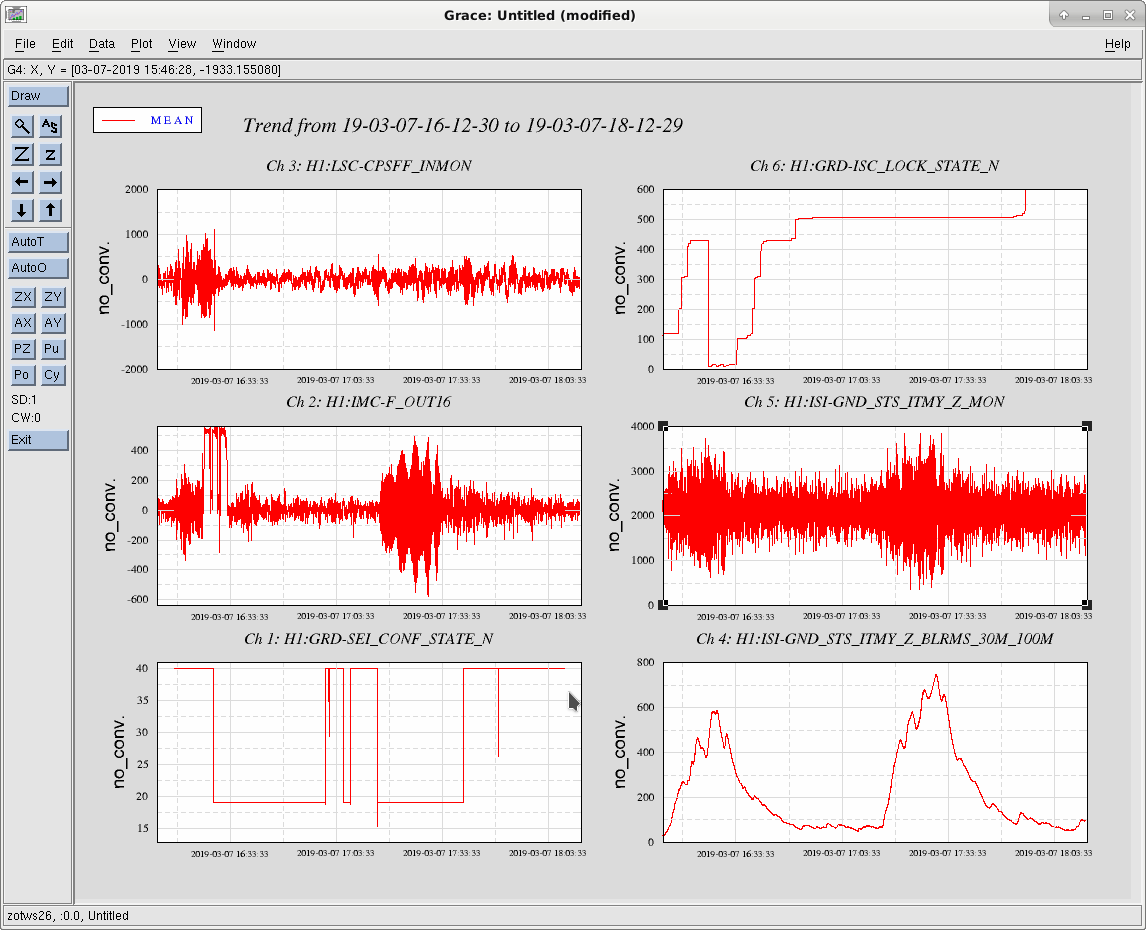
When I arrived on site this morning, Corey had just lost lock due to a couple earthquakes, one 5.5 from New Zealand and a 5.7 in Chile, which arrived on site at about the same time. The ground was still settling down, he was not really trying to lock, but ALS was having difficulty. I asked him to switch SEI_CONF to the EARTH_QUAKE state (this is NOT the big red button, this is a state in the SEI_CONF guardian) , which changes the sensor correction path to a sensor correction path that uses a local differential ground for isolation. The differential signal is calculated by subtracting a common ground, which is the average of all 3 VEA (ends and corner) ground seismometers, from the local ground sensor. Because of the way this subtraction is done, this reduces the isolation at the microseism, so this state will probably only help when the microseism is low. After making the switch, Corey was able to start locking again, even though the ground motion was still well over 100 nm/s rms in .03-.1hz band. We usually wait for the ground to get below 100 nm/s. After he got to somewhere around DC Readout, we switched back and forth from WINDY to EARTHQUAKE and were able to stay locked through both transitions. Around this time we got another earthquake notification from New Zealand. When this earthquake started affecting the the interferometer, we switched back to the EARTH_QUAKE state, and were able to ride this second, somewhat larger quake out with the interferometer in a robust state.
Here is a timeline:
March 7 2019, times are UTC
16:12 First set of earthquakes arrive
16:25 Lockloss
16:29 Switch SEICONF to EARTHQUAKE
16:33 ALS locks, RMS ground motion is around 300nm/s
17:00 Transition back to WINDY
17:05-17:07 Transition to EARTH_QUAKE and back to WINDY. EARTHQUAKE is noisier, but in POWER_30W this doesn't break the lock. Around this time we get another earthquake notification from New Zealand, a 5.7 this time, we got something like 15 minutes early warning for the R waves.
17:15 We start seeing more low frequency noise in the IFO (I think I was watching the LSC CPS FF channel) as the second earthquake arrives, so we transition to EARTH_QUAKE again. IFO sees more microseism in ASC, IMCF, ETMX SUS length drive, but I don't think we see as much low frequency as we would see in the nominal configuration. This earthquake is a little bigger than the first earthquake, but we ride it out. ISC_LOCK stays in POWER_30W for the duration.
17:39 Ground RMS is back down to about 200nm/s rms, we transition SEICONF back to WINDY.
All of these steps are shown in the attached trend. 40 is the WINDY state for SEICONF, 20 is the EARTH_QUAKE state number.
A few notes:
All earthquakes were in the 5.5-6.0 magnitude and roughly 10,000 km away. Peak eq band rms velocities were around 1 micron/s.
The only seismic configuration change was selecting the EARTH_QUAKE state in SEI_CONF, not the big red button or the LARGE_EQ state. This state also doesn't change the added gnd Z to HAM3 and HAM4 feedforward. I tried turning the HAM3 ff off and on during the second earthquake, but I didn't see any difference in IMC F.
The IFO stayed in POWER_30W for the second earthquake, which is before low noise coil drivers and low noise ASC, so the IFO controls were in a pretty robust state. Jenne suggests we can look at various drives to see if this we could stay locked during low noise.
This will probably only work with low microseism. Right now peak rms velocities are about .3 micron/s. I would guess that this might work up to around .5 micron/s rms, we more or less loose all of our microseismic isolation, and .5 micron/s was about the highest velocity we could handle during O1 with blends that similarly didn't suppress the microseism.
Both of these earthquakes were just under 1 micron rms in the .03-.1hz band. During the lock with the second earthquake we got a notification of some IMC SERVO voltage being high, which I think means that something in CARM may ultimately be the limit on our ability to ride out an earthquake.
The wind was also up around 20 mph during this time, I'm sure it didn't make this easier, but it didn't seem to be a problem for us.
The sensor correction ramp times are set at 15 seconds, this seems to work ok, might be ok to go shorter. Because the EARTH_QUAKE state changes the BSC ST1 Z blends to 250mhz blends form 45mhz blends, it takes around a minute for the total SEICONF transition to complete. Going the other way takes 2 minutes to turn the 45mhz blends back on. This didn't seem to cause any problems for the IFO. No other blends are changed going from WINDY to EARTH_QUAKE.
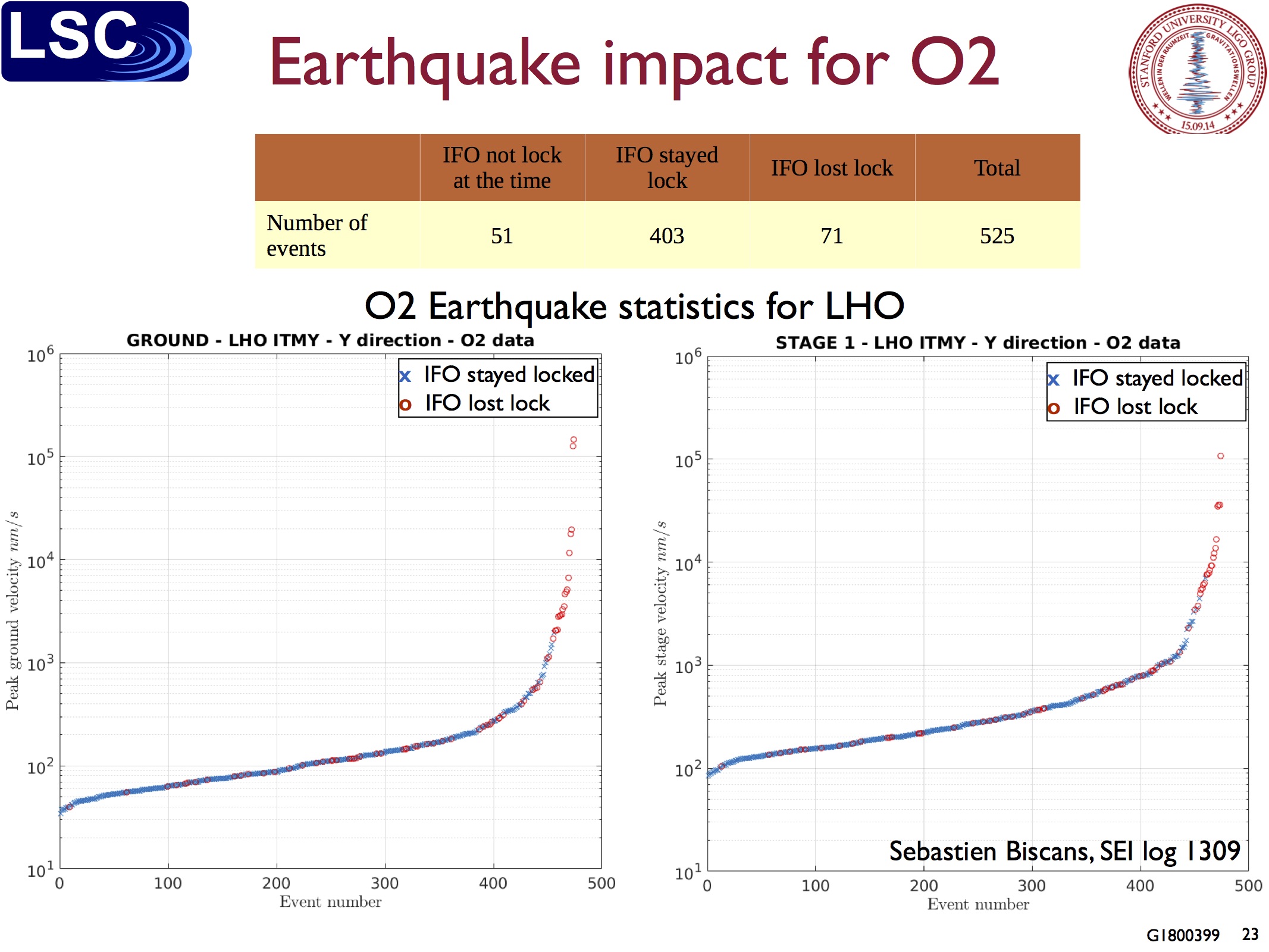
Nice work Jim, Corey, TJ, et. al. I've attached a plot from Sebastien's SEI log 1309, which shows that at a PEAK velocity in the Y direction of 2 microns/ sec the IFO can't stay locked, and that at a peak of 1 micron/ sec it stayed locked some of the time - so this is very encouraging news.
Interesting comments about the impact of the microseism and the wind. The differential isolation against the microseism should be a bit better, but you are seeing the real performance in the IFO as a bit worse - interesting. Also the injection of tilt at 10- 20 mHz should be much worse, so I'm pleased that it worked w/ 20 mph wind. Credit to the BRS and big loop gain of the IFO controls, I suppose.
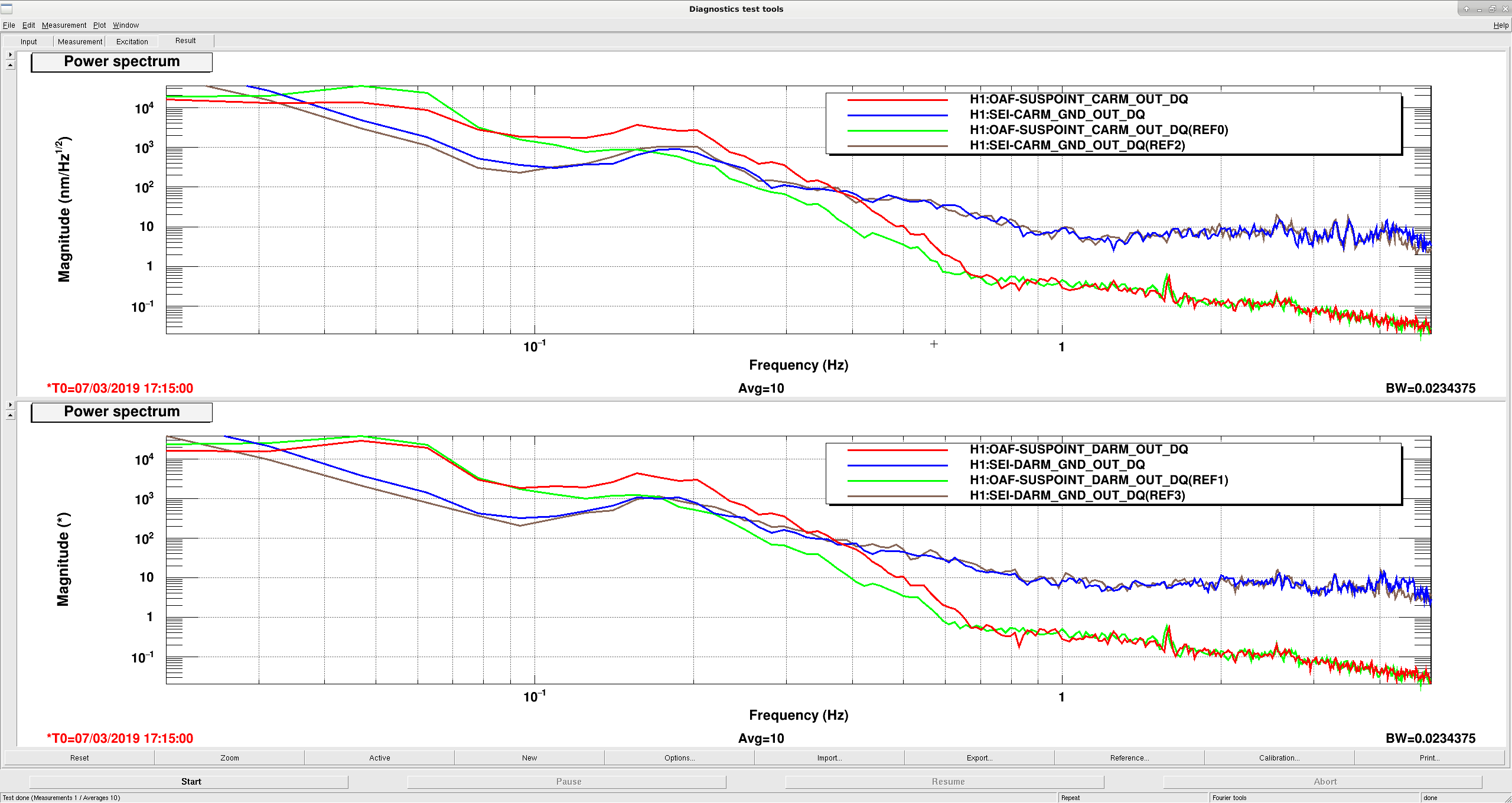
I'm adding spectra to try to capture the performance of the ISIs during these two earthquakes. The channels I looked at are the ground CARM and DARM reconstructions and the OAF SUSPOINT CARM and DARM reconstructions using the ISI gs13s. These spectra are taken during the first several minutes of each earthquake, the references are from the first earthquake, where we stayed in the nominal configuration, the live traces are during the second earthquake where we were running the EARTH_QUAKE configuration.
The top plot are the CARM channels, and you can see comparing the red and gold trace, that the earthquake mode reduces the very low frequency (around .05 hz) CARM motion by about a factor of two, but the above .1hz motion is increased a lot, almost an order of magnitude.
The bottom plot shows that the very low frequency DARM table motion doesn't see very big difference, again comparing the red and gold traces, but the above .1 hz motion is made worse, to about .5 hz.
These results make me wonder if the low pass used to compute the common mode ground signal should be tweaked. Somewhere I've done some modeling of this, BrianL has also worked on this. I just wish that there was more frequency space between the earthquake band and the microseism.