Georgia, Craig

This evening we revisited the scattering shelves we saw last Tuesday.  Gabriele thought further about OMC ASC scattered light.

This evening we drove OMC Ang X with a 0.5 Hz sine wave injection.  By increasing the Ang X RMS by around a factor of 10, we are able to replicate the scattering seen on Tuesday.

The plot shows the DARM scattering plus the OMC ASC calibrated into DARM meters from here.  With not a huge increase in OMC displacement RMS (red vs green in the plot), we see significant scattering in DARM.  Probably what is a better witness of scattering is OMC velocity RMS: the 0.5 Hz line is fairly energetic for this control loop.  In any case, it's possible this scatter shelf lies not far below DARM at around 10Hz.

Tomorrow we will make a physics model of this scattering and project it into DARM for all OMC ASC.

Here I am trying to build a model of the scattering. If you don't have time to read all of it, jump directly to the last plot, which gives what I believe is a reasonably good model that we could use for noise projections.
Here's a spectrogram of DARM during times around the OMC ANG X injections. It is evident that even without any injection, there are scattering shelves in DARM going up to 20-30 Hz.
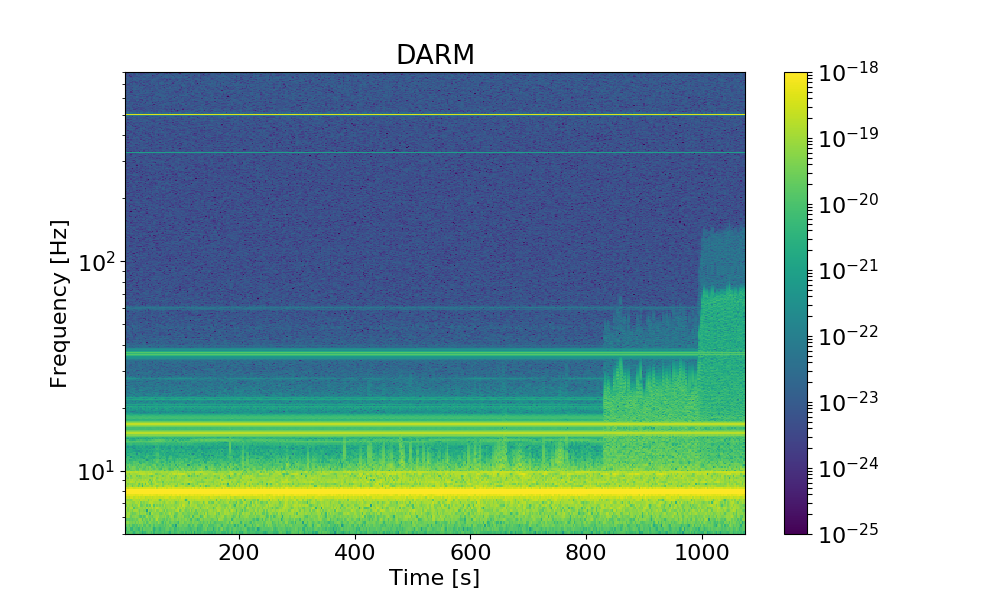
I selected four periods: two before the injection (fist at T=100s in the spectrogram above: almost no scatter visible, second at T=600s, some scattering visible) and two during the injection (T=850s: low amplitude injection, T=1000s: high amplitude injection).
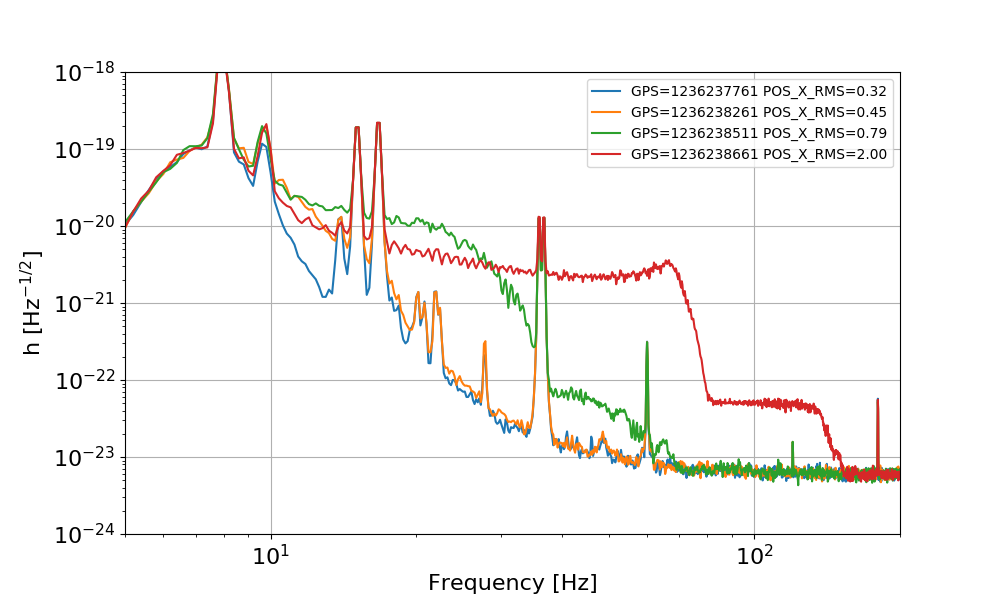
Using H1:OMC-ASC_ANG_X_INMON as a proxy for the scatterer motion, I can fit a scattered light noise model based on the "phase wrapping" model (from Accadia 2010 and Canuel 2013), including a single bounce and a double bounce. The model simply assumes that the fringe wrapping gives a noise in h(t) that can be modeled by

where f_1 and f_2 are the two coupling coefficients for the single and double bounces (related to the amount of light which is scattered back) and k_1 is a factor converting the OMC_ANG_X into the actual length change in the scattering path.
If I use the medium amplitude injection, I can find coefficients that described quite well the spectrum of scattered light. The parameters are f_1 = 1e-19, f_2 = 1e-21, k_1 = 22e-7. In the plot below I use those parameters to "project" the scattered light noise for all four periods. The bottom left plot shows that the fit is good for the medium amplitude injection, but clearly fails for all other cases.
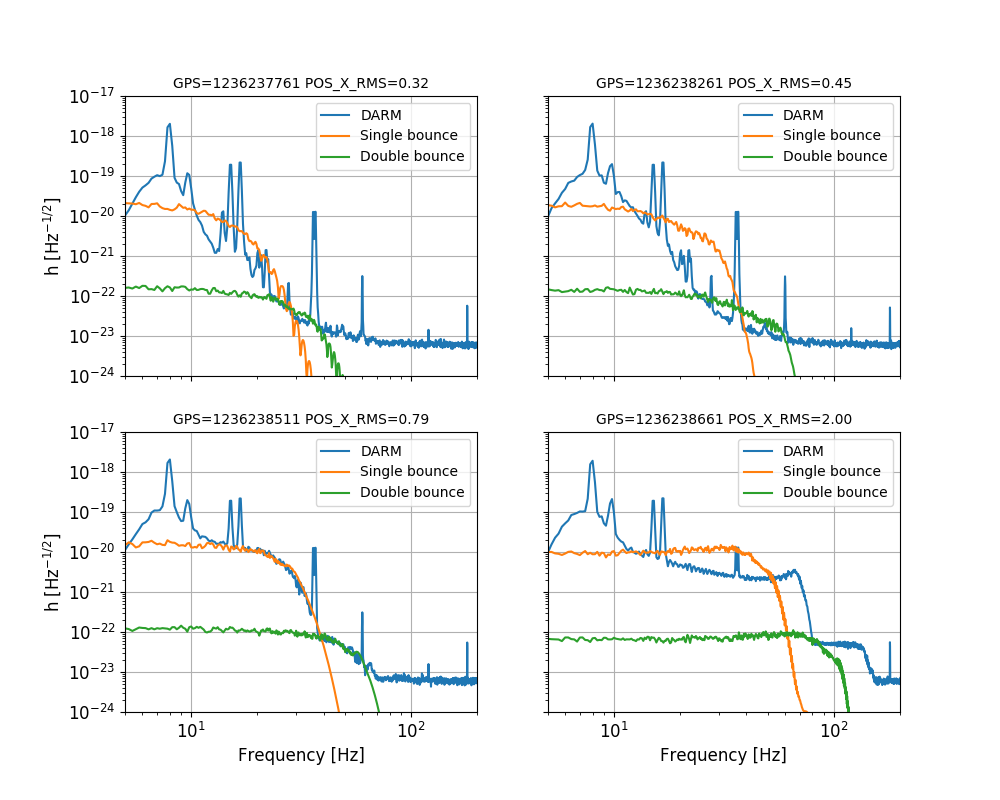
I can't reproduce the scattered light noise for both medium and hgh amplitude using any of the H1:OMC-ASC_[AND/POS]_[X/Y]_INMON signals. In particular for the high amplitude injection I can't reproduce the rising edge of the shelf. Typically one gets such rising edges when the RMS of the motion is concentrated at almost a single frequency.
If we assume that only the 0.5 Hz motion is responsible for the scattering, we can proceed as follows:
- First, I apply a narrow band filter to H1:OMC-ASC_ANG_X_INMON, composed of a zero at 0 Hz plus a complex pole at -0.1 +- 0.5j Hz, scaled to maintain a gai of 1 at 0.5 Hz.
- Then I can use the filtered signal to fit the high amplitude injection noise.
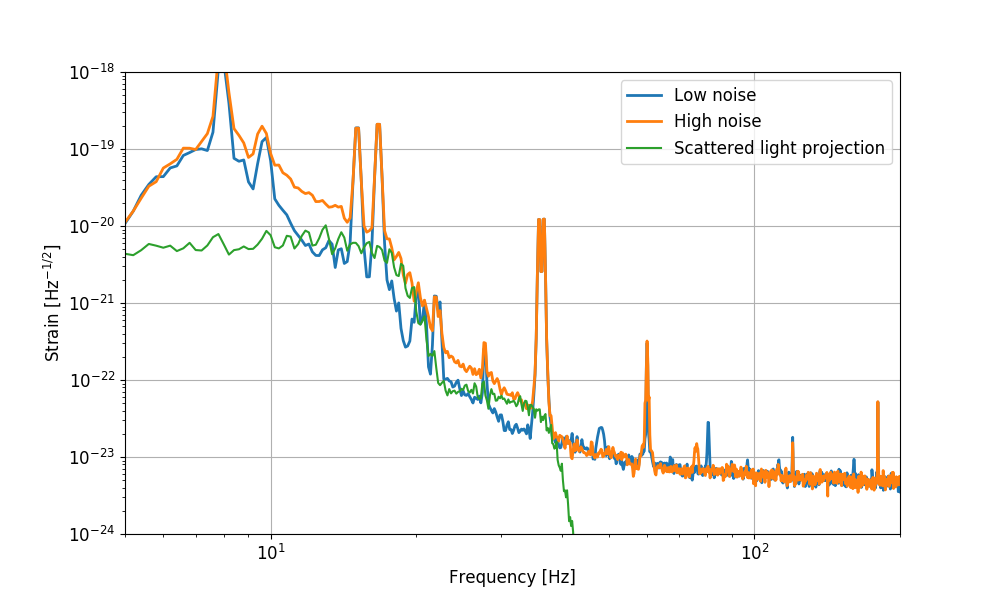
The best parameters are: f_1=3.5e-20, f_2=5e-22, k_1=1.6e-5. The resulting noise projects well for both the high and medium injection amplitude, and it is also in the right ballpark for the high scattering period without injection. So this seems to be a good model.

We can apply the same scattered light model to the noisy period reported in 47399. It looks like the same parameters over-estimate the up-conversion (i.e. the corner frequency of the scattered light is too high). So I had to reduce the k_1 coefficient from 1.5e-5 to 1.0e-5, while I could use the same coupling factors f_1 and f_2.
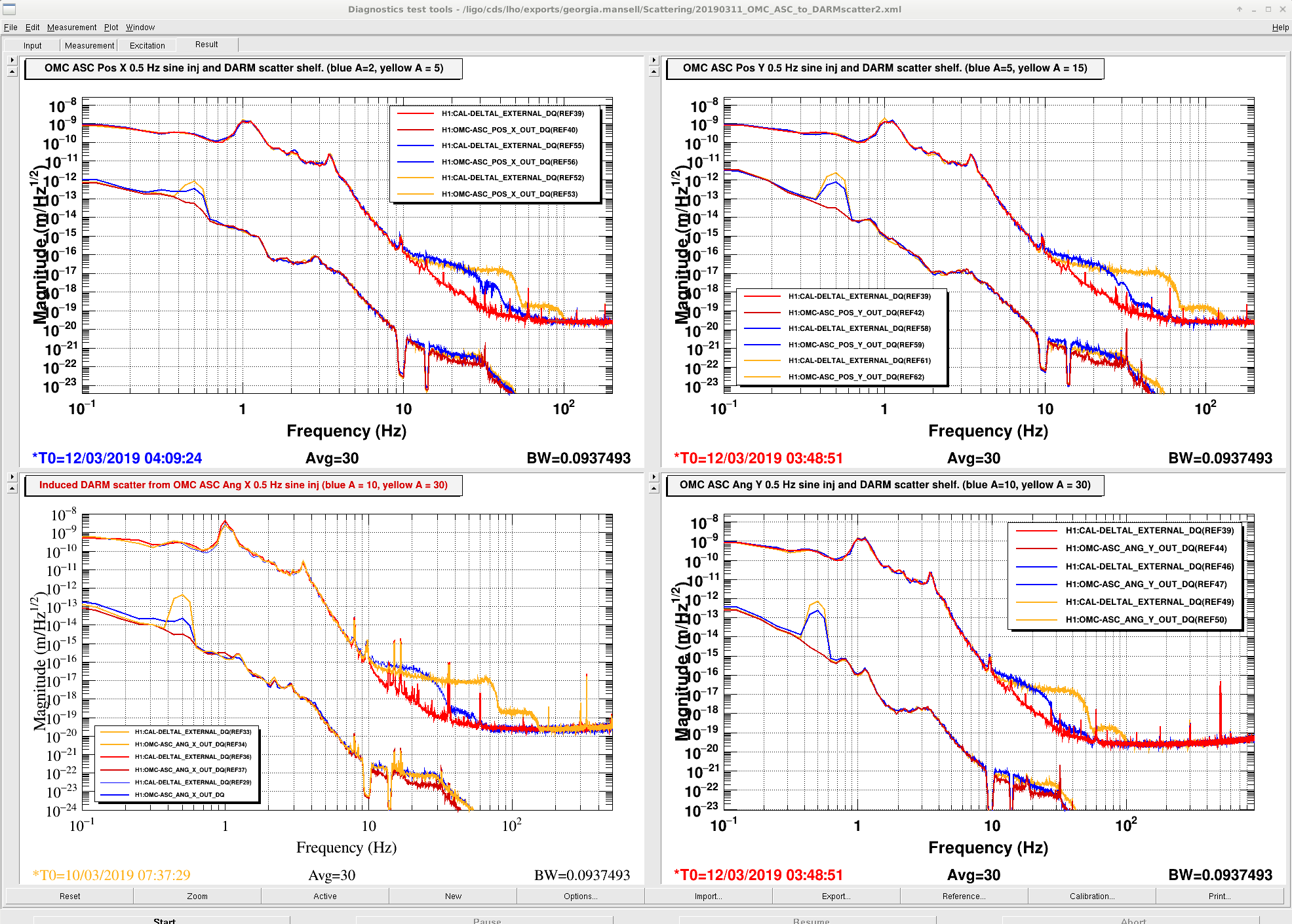
I ran some 0.5 Hz line injections in the other OMC ASC degrees of freedom to see if there were any differences in the coupling.
First attached figure shows DARM and the control signals for (clockwise from top left) POS_X, POS_Y, ANG_Y and ANG_X. Red is ambient noise, blue with a moderate excitation and yellow with a larger excitation. Apologies for the different excitation amplitudes. POS_X has the strongest coupling.
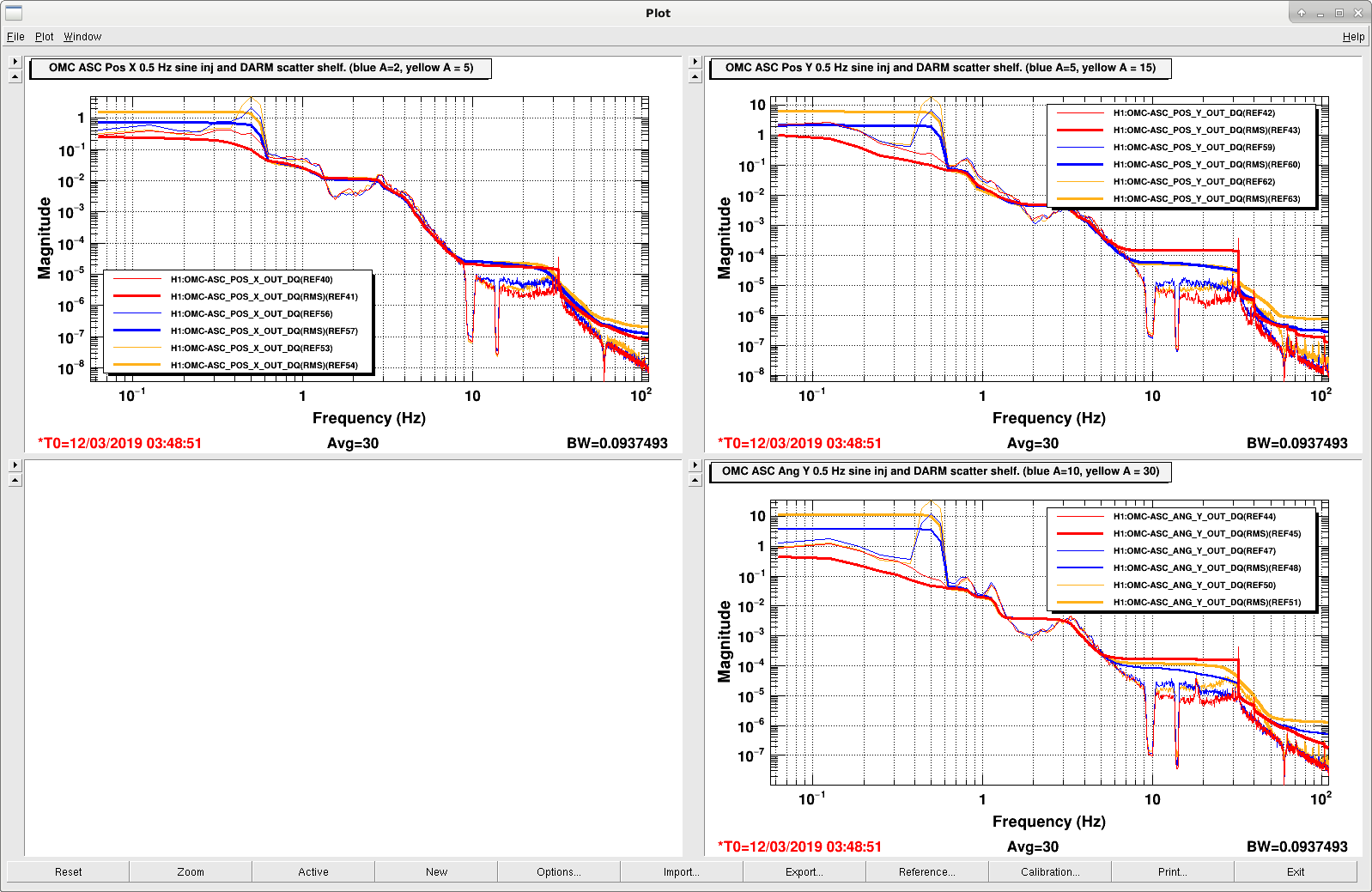
Second attached figure is the control signals and corresponding RMSs.
I haven't done the work of projecting these into DARM yet, but in case anyone wants to the template can be found here:
/ligo/cds/lho/exports/georgia.mansell/Scattering/20190311_OMC_ASC_to_DARMscatter2.xml
Ran some more injections into OMC ASC ANG X, this time with a BB Inj 0.1 to 1 Hz.  Stored at https://lhocds.ligo-wa.caltech.edu/exports/craig.cahillane/Scatter/
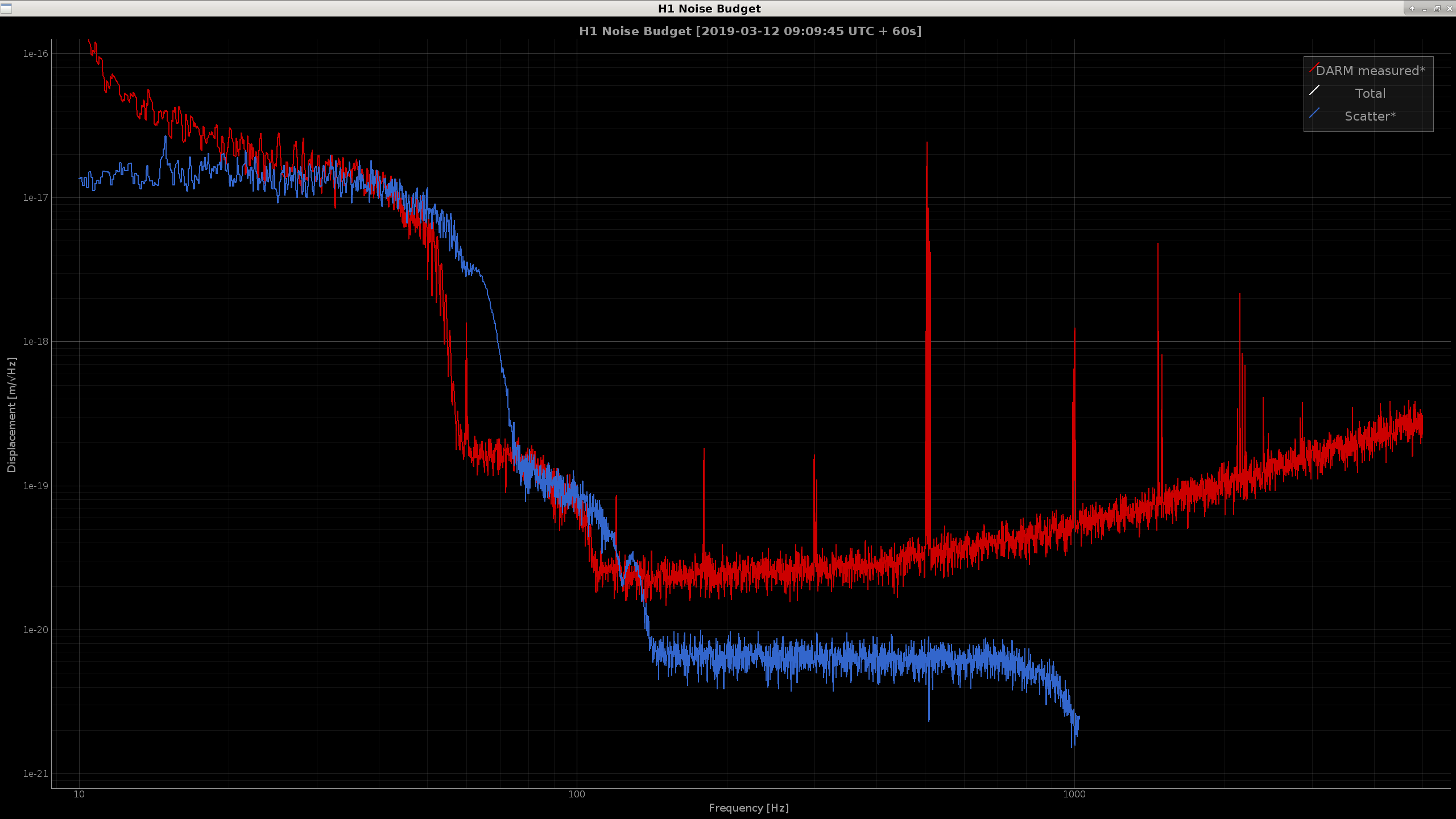
Continuing work on the scattering projection into DARM in the live noisebudget.  It's not too far away, needs more work though.