sheila.dwyer@LIGO.ORG - posted 17:32, Sunday 17 March 2019 (47597)
locking notes from this afternoon
- Squeezer guardian was continuing to try to inject squeezing after the interferometer lost lock, I'm not sure when this started happening but I've edited the down state to request PREP_IFO_SQZ. Since we are transitioning to running we will be wanting to run the squeezer continuously so we don't gain much by blocking the green into the fiber when the interferometer unlocks, since we are just going to try to relock it.
- Sometimes the green arm WFS don't work well, this seems to be solved at least sometimes by running the WFS DOF2, which takes a WFS signal and sends it to TMS in addition to the loop that we are normally running to the ETM. We might be able to make things easier by changing the guardian to do this.
- Guardlog doesn't work, it opens the log then immediately closes it. Also the lockloss tool isn't displaying the guardian logs around locklosses in a useful way, they are showing only the guardian log. The thing that works is to run gaurdctrl log with the same arguments that used to work for guardlog.
- I lowered the lockloss thresholds in OFFLOAD DRMIASC. We were transitioning from using POP18 to using POP LF here, which seems a little early. Robert and I lost lock here three times, I'm not sure it was the lockloss thresholds, but the value was 33-34 and the off threshold was 30. I changed them to 21 (on) 20 (off).
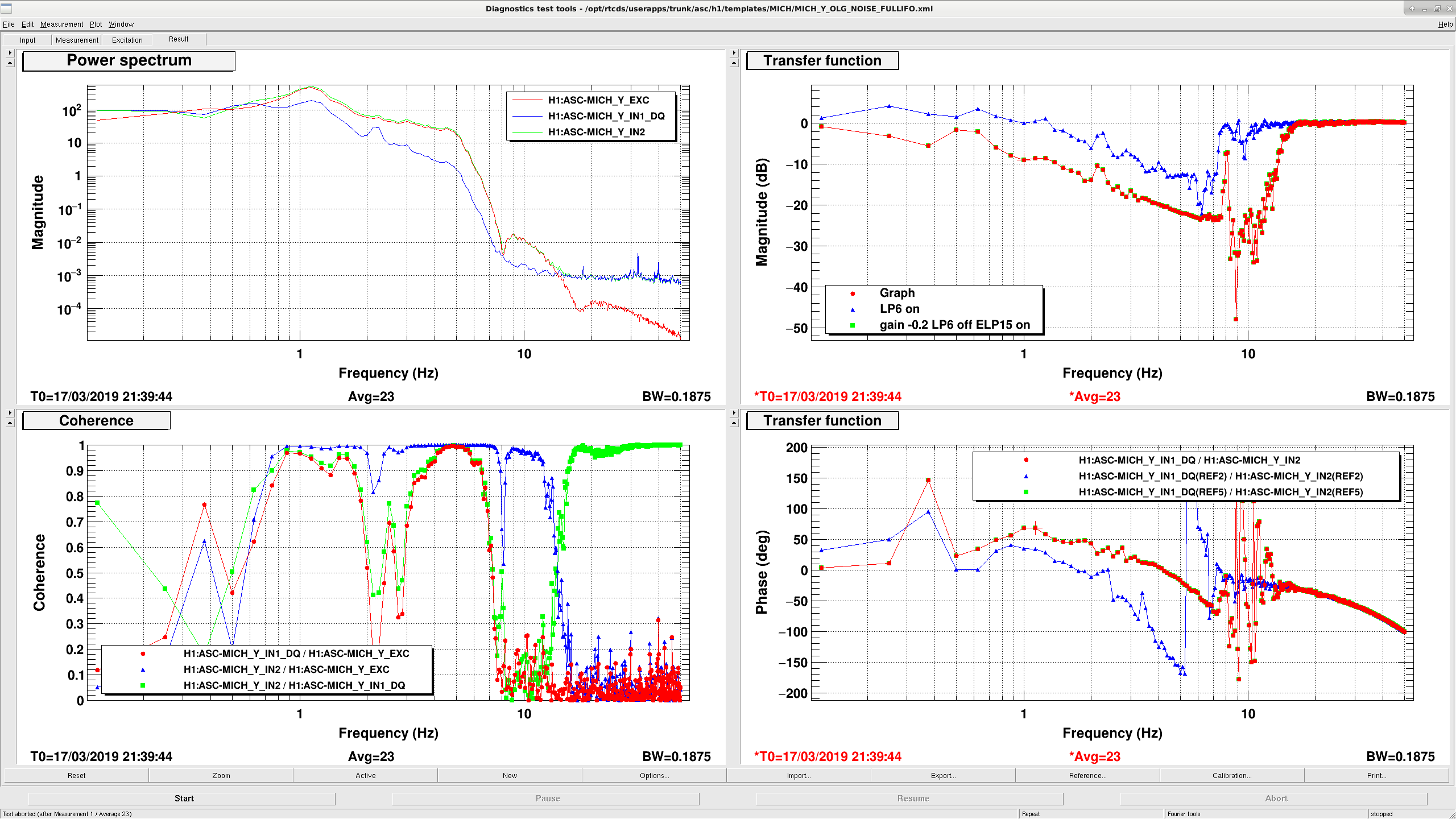
- DAn and I stopped before doing low noise ASC to measure MICH ASC loops, because of problems reported locking with the SR3 heater on last night 47591. We saw that the MICH P loop looked similar to what Jenne posted 47352 and that her gain increase which brings the UGF to about 2 Hz and the cut off are fine. For Yaw, there was no phase margin for a 2 Hz ugf, and the gain increase in the guardian would have made the loop unstable. In the attached screenshot the reference is Jenne's measurement from March 6th, the new measurements were made with the gain at -0.2 and the low pass switched from the 6 Hz one to ELP15. After measuring this we increased the gain to -0.6, which should give us a ugf around 1.5Hz.
Images attached to this report