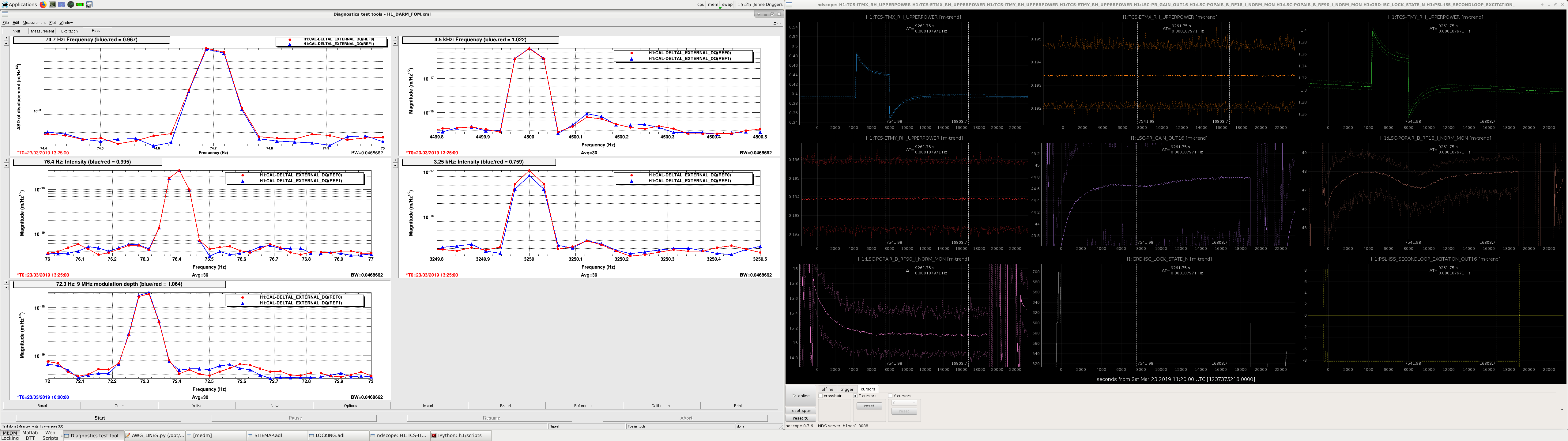
I had a brief look at some data from a short ring heater test that was done Saturday night. It's not alogged when the change was made, but Ed alogged when he did the step back (alog 47797). It looks like both ITM ring heaters were increased by 0.2 W total (0.1 W upper, 0.1 W lower) for one hour, and then lowered back to their nominal values.
Attached is a screenshot showing the step times, some of the circulating powers and power recycling gain, as well as spectra taken at 2 times. The spectra are from the times of the 2 vertical cursors on the time series plots. The step up in ring heater power was done about an hour into the lock, so there are still some thermalization effects going on. But the step down an hour later helps make things more clear. In the spectra, red is the hotter ring heater state, and blue is the nominal ring heater state. Recall for the spectra that we'd like all of the peaks to be smaller, indicating a lower coupling of that noise to DARM. For POP90 we'd like it low, and for PRG and POP18 we'd like them high.
- I see no effect on POP 90 (lower left corner of time series)
- The power recycling gain (center of time series plots) seems to be overall increasing due to thermalization, but when the ring heaters are stepped up, it stops increasing, and then when the ring heaters are returned to their nominal value, the PRG continues to increase for a little while longer.
- POP18 (center right) seems to decrease when the ring heater is stepped up, and then re-increase when the ring heater is stepped back down.
- The peak heights for the lines don't change very much between the 2 spectra around 75Hz. The frequency and intensity coupling goes down a teensy bit, while the 9 MHz RFAM goes up a small amount.
- The peak height doesn't change much for the 4.5 kHz frequency line either.
- But, the 3.25 kHz intensity line decreases pretty significantly with the cooler, nominal ring heater values.
So, overall, I conclude that the nominal common ITM ring heater values are better than the hotter ring heater values. This is opposite of what one might expect with the increase in total circulating power in the IFO, if we assume that we had fine tuned the TCS for our previous 30W settings. But, we hadn't actually done the fine tuning for TCS at 30W.