
evan.goetz@LIGO.ORG - posted 14:02, Friday 29 March 2019 - last comment - 14:09, Friday 29 March 2019(48046)
Two additional combs in late ER14 low-frequency data
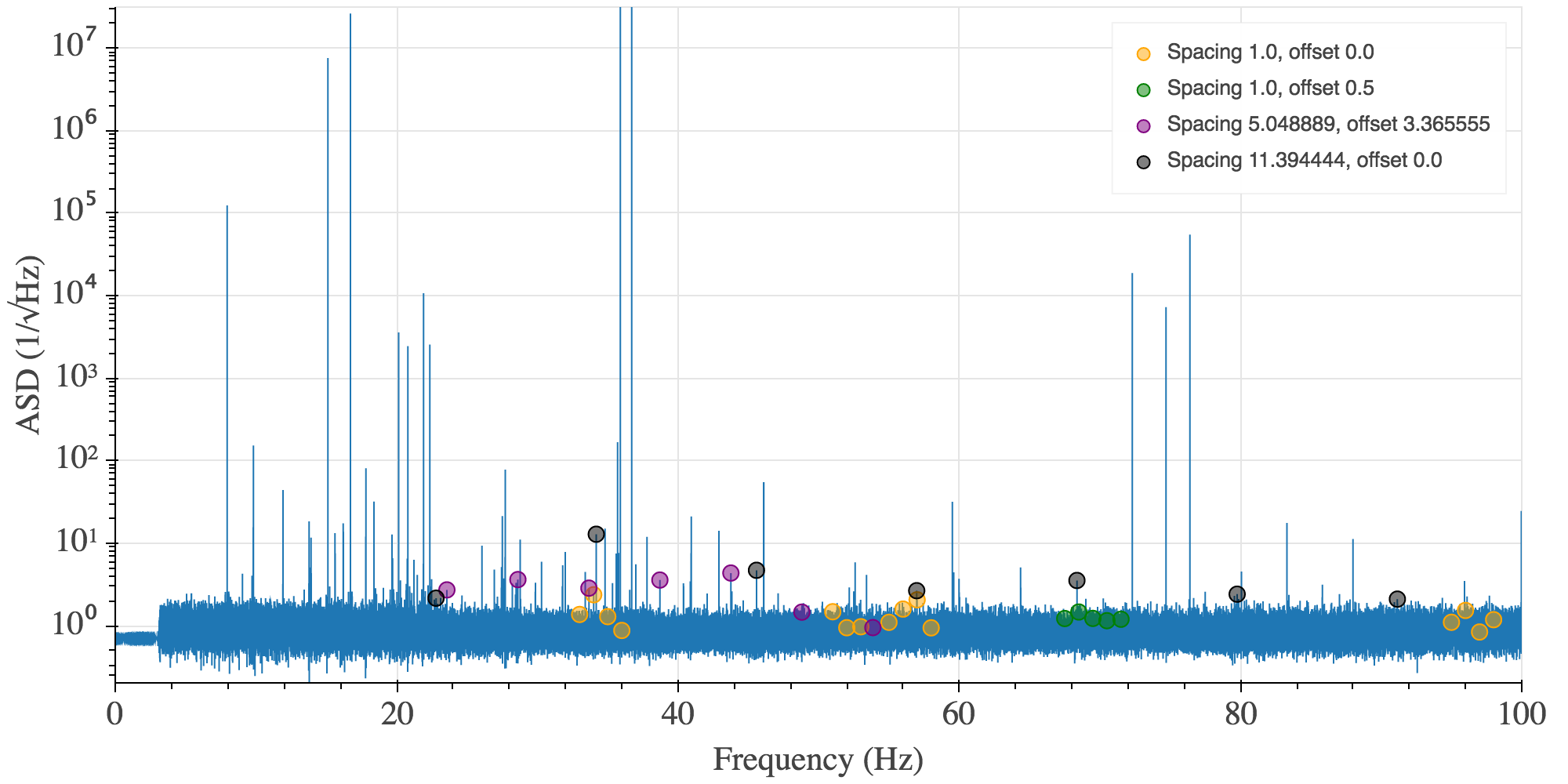
Summary: There may be two other combs at low frequency in H1 data: 5.048889 Hz with 3.365555 Hz offset and 11.394444 Hz with 0.0 Hz offset. These should be investigated/mitigated and potentially be added to the tracked combs.

Details:
After Pep reported that the 1 Hz comb was hopefully now mitigated (see LHO aLOG 48032), I wanted to check the current status of combs in the low-frequency, sub-100 Hz, region. I also wanted to regain familiarity with some of tools used to hunt for combs and to see if they would work on Fscan outputs, which I believe they should do. Fscans are useful because the data is normalized so the spectrum is essentially flat. Noise-weighted ASDs are also useful in this regard but also down-weight noisy frequency bands.

Using the Fscan output from March 28 (see plot here and data here), I used some of Ansel's very nice python tools modified to accept Fscans as input.

I saved a version here, which takes two arguments:
$ bash fscan2bokeh.sh {output dir} {input Fscan txt file}
so I analyzed this:
$ bash fscan2bokeh.sh ./H1 /home/pulsar/public_html/fscan/H1/daily/H1Fscan_coherence/H1Fscan_coherence/fscans_2019_03_28_17_00_02_PDT_Thu/H1_GDS-CALIB_STRAIN/spec_0.00_100.00_H1_1237766420_1237852820.txt

The normal output does not show any lines, so I added the currently tracked lines (with the argument inside the bash script --tagcombs "0.996795,0" "1,0" "1,0.5"). There is not much evidence for these combs in 1 day of Fscan data, but we need to monitor the situation in case things change during the O3 run.

Ansel's FineTooth suite has a program to search for additional combs (on LHO cluster ~aneunzert/FineTooth/findComb.py). Invoking Ansel's virtual environment (~aneunzert/gwpybokeh2), I used the findComb.py program:
$ python findComb.py --inputfile=/home/evan.goetz/public_html/CW/H1/dat_converted.hdf5 --fmin=5 --fmax=100 --threshold=1
This gave indication that there were two additional combs 5.048889 Hz with 3.365555 Hz offset and 11.394444 Hz with 0.000004 Hz offset (I've rounded this offset to zero in the plotting).

Attached figure shows these combs plotted from Ansel's findComb algorithm.

I'll check out L1 next and ping Ansel/Keith/Pep in case they have any additional thoughts.

Images attached to this report
Comments related to this report
The 11.39 Hz comb is an old friend from O2. It was also listed in the known lines/combs list made by Pep, Ansel, Bryn, and myself with inputs from Keith and Pat.