M. Wade
I made new GDS calibraiton filters based off of the currently running O3 calibration model. The new filters use the following parameters file (discussed in 48130):
trunk/Runs/O3/H1/params/modelparams_H1_20190401_ER14_095A.py
The new filters are located in
trunk/Runs/O3/GDSFilters/H1GDS_1238177020.npz
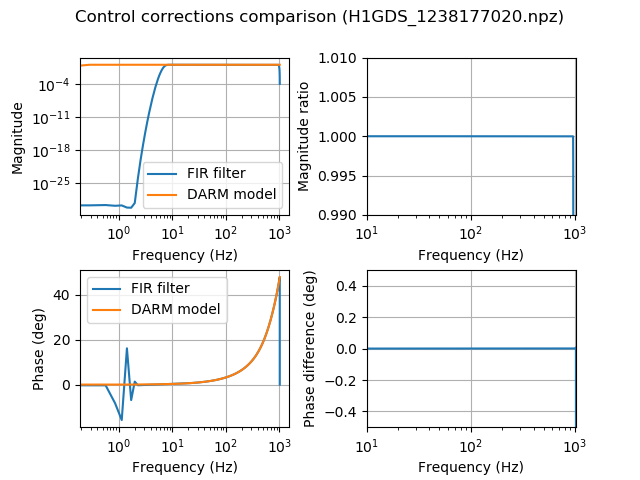
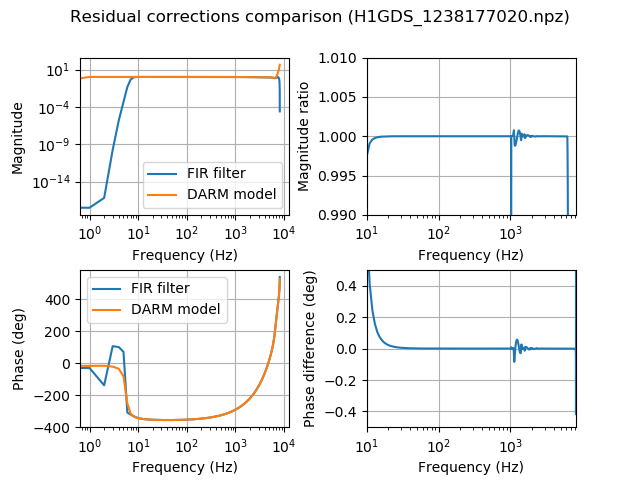
I'm not fully happy with these filters yet, because, while the filters themselves are self-consistent with their underlying models (see first two attached plots), using these filters to calibrate some data results in h(t) that is inconsistent with the overall response function in pyDARM at the expected level. As a reminder, the GDS calibration pipeline ingests the CAL-DELTAL_RESIDUAL and CAL-DELTAL_CTRL* channels, applies corrections to these channels (which are the filters referred to here), nominally also computes and applies time-dependent correction factors to the calibration (but the application of these factors is turned off at the moment), and then combines these products to form h(t).
The tests I have performed on these filters involved calibrating data (offline, using the new filters) during observing time from yesterday (GPS times 1238246061-1238246561). I then took the transfer function of h(t) to DARM_ERR to find the response function from this data and compared this to the response function from pyDARM. The third attached plot shows the results of this test. I've also attached a plot (fourth plot) of the ratio of the ASD from the GDS data calibrated with these new filters and the ASD from CALCS data at the relevant time. This ratio of ASDs shows that the new filters will result in a worse agreement to CALCS than what is currently running (see summary pages from today). I'm currently digging into both of these issues (1 - why the response function derived from GDS data with these filters is not as expected and 2 - why we don't get *better* agreement with calcs, which is what I would expect).