
evan.goetz@LIGO.ORG - posted 07:31, Wednesday 03 April 2019 - last comment - 12:43, Wednesday 03 April 2019(48192)
Pcal Y probably producing contaminating lines in h(t)
Summary:
Pcal Y seems to have a bad comb structure that is likely producing contaminating lines in h(t). The behavior of this Pcal is not similar to Pcal X or either of LLO's Pcals. I urgently suggest a check is done on H1 Pcal Y to remedy the situation.

Details:
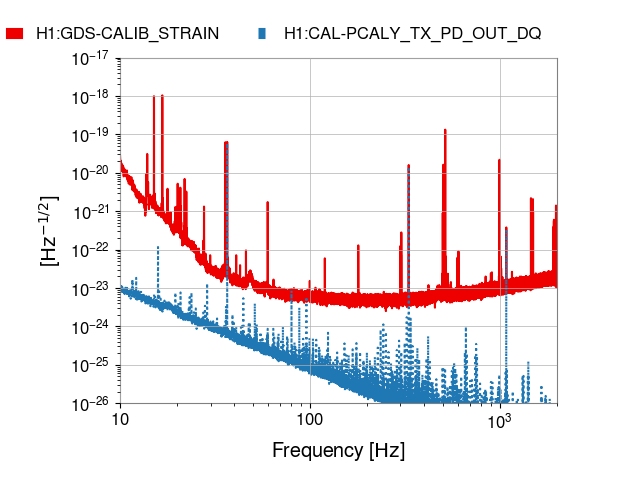
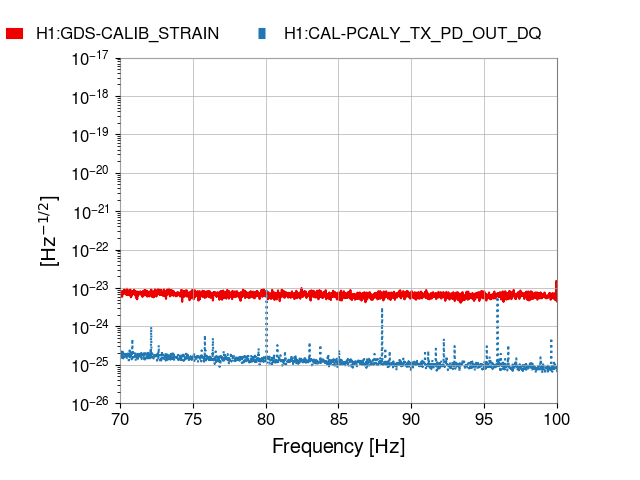
I was concerned that H1 low-frequency spectrum is so much more contaminated with lines than L1, so I started looking at some easy to check things, like the Pcal. Looking at summary pages, you see things like Figure 1 H1 Pcal Y. Compare that with figure 2 (H1 Pcal Y) or 3 and 4 (L1 Pcal X and Pcal Y).

Comparing H1 Pcal Y spectrum to GDS-CALIB_STRAIN, I find that many lines are very close to the noise floor. This is very concerning for long duration searches (CW and Stochastic).
Figure 5 is a broad band spectrum comparison
Figure 6 is a zoom on 10 - 200 Hz
Figure 7 is a zoom on 70 - 100 Hz

I don't think this is due to clipping on Pcal periscope because this is on the transmission module PD (so, light that actually reaches the ETM).

I hope it is not that hard to solve this issue.
Images attached to this report



Comments related to this report
J. Kissel for R. Savage & N. Lecoeuche

In fact, this problem has been going on for quite some time now: see for example its first discovery LHO aLOG 47372 and FRS Ticket 12491.

We think this is indicative of the PCAL Y laser heading out to the pasture.

An attempt to reduce the non-linear intensity noise was made on March 11 (see LHO aLOG 47444).

Rick and team will be going down to the Y end station today to attempt to address the issue.

We were hoping that a tune-up will help, but we have several back-up options:
(1) The optical plant is much more stable than it used to be, and specifically the optical spring is stable, and a factor of 2 lower frequency than it in O2. Thus, we can consider turning off the 7.93 Hz calibration line.
(2) Further, there have been some R&D efforts in the LSC to monitor the optical spring with the higher-frequency actuator reference line (currently at ~35 Hz), see appendix A of T1700106.
(3) Finally, we can also divert to using the X-end pcal system, but that will take a good bit of effort "transferring" the standard through measurement, and our measurement analysis code will likely be confused for a day or three while we figure out where all the hidden sign bugs are. (Examples of us clearing out the bugs include 48131 and 47574)
@Jeff, Rick, and Niko, thanks for working on this quickly! Hopefully it can be resolved fast so that groups don't have to reject too much data.

I wonder if some contamination might also be linked to Pep's study on bi-linear couplings (see LHO aLOG 48161). It might also be worth checking the Pcal spectrum to see if the noise seen in Pep's study is linked to this as well. Maybe that also will further clean up the Pcal PD spectrum...?
Mostly fixed by hardware adjustments on the Y-end Pcal (see LHO aLOG 48206). We should keep a watchful eye on this during O3.