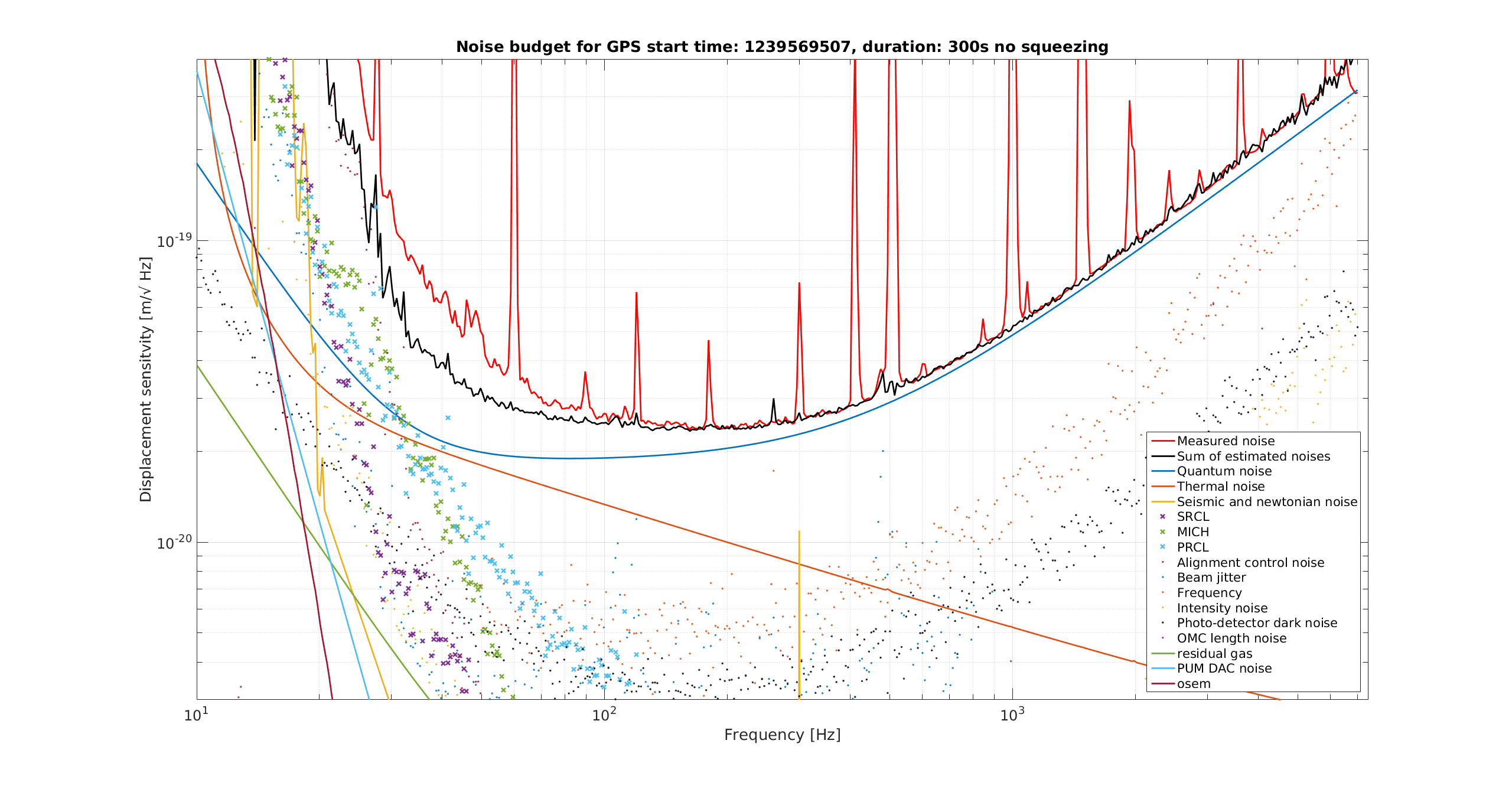
This is a quick update on the noise budget injections that we did last week. The first attachment is the noise budget for a time with squeezing, the second attachment is for a time without.
- To estimate the squeezing, I'm grabbing the data from the nonlinear gain monitor, which is the Q phase of the CLF diode normalized by the DC power on that diode. This is proportional to the normalized nonlinear interaction strength x=sqrt(P/Pthreshold), and indicates that we had a nonlinear gain of 2 at the time. The squeezing level is measured by a BLRMS normalized to the nullstream BLRMS at 4.68kHz, which reports 2dB of squeezing. I'm assuming that the phase noise is 150 mrad, based on Nutsinee's measurements here: 47562 The noise budget then infers the losses based on the level of nonlinear gain and the measured squeezing level, in order to predict the anti squeezing level. This is working OK for now, although the squeezing level is also limited by non-quatum noise which isn't taken into account.
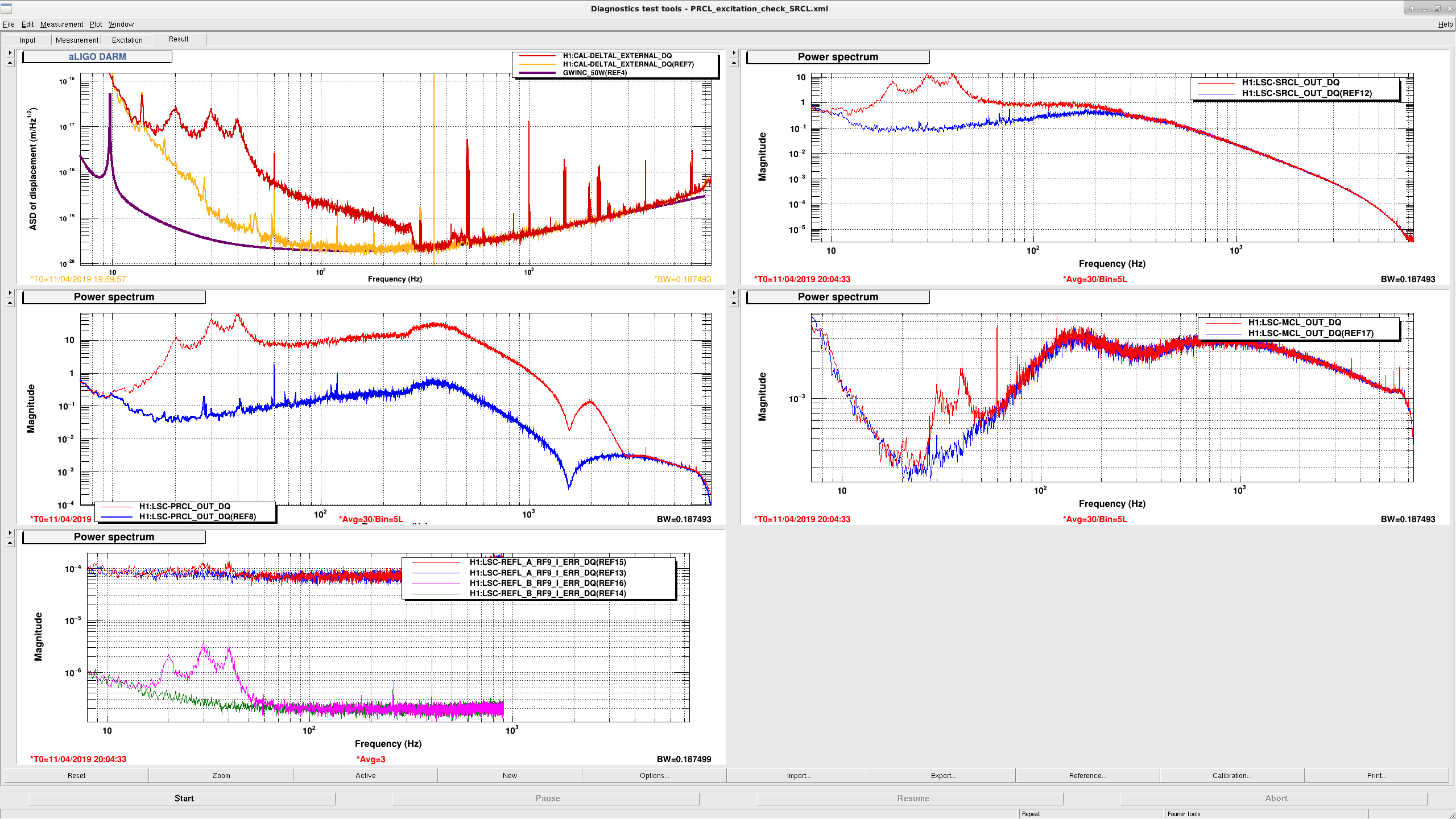
- The PRCL injection does show up in the SRCL drive, but that is too small to account for the coupling to DARM, so it's added as a separate term again. It also shows up in the out of loop frequency noise detector, but that is also small. (5th attachment)
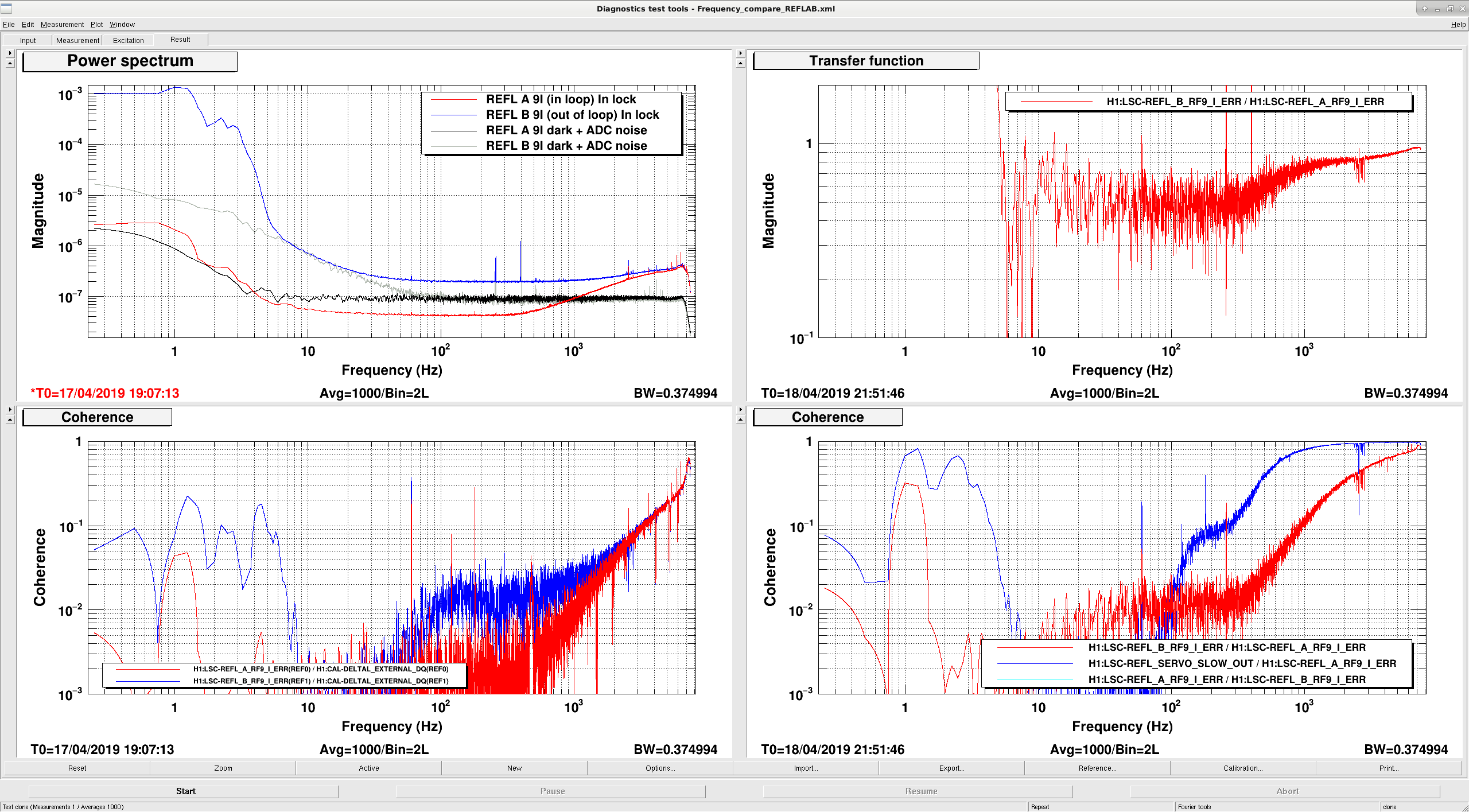
- We are using REFL B9I to estimate the ambient level of frequency noise, similar to what was done here: 47351 There are nearly equal amounts of light on REFL A and REFL B, so the shot noise of REFL B will be causing this to be an overestimate of the frequency noise (by ~sqrt(2)) where it is refl shot noise limited. On Tuesday I calibrated REFL 9I A into volts, so that we can compare directly REFL A+REFLB, this is shown in the 6th attachment.
- Upper left plot: Spectra in lock and with no light. The whitening is different on A+B which explains the difference in the dark noise, REFL B is limited by ADC noise from 8-30Hz while we are locked, while for REFL A we must be limited by dark noise which is suppressed when we are locked. In lock, at frequencies above ~1kHz where the loop is gain limited the two sensors agree. According to Criag's modeling the frequency noise here is limited by the IMC detector shot noise.
- Lower left shows the coherence between both sensors and DARM, with 1000 averages. They are both coherent with DARM where the CARM loop is gain limited. Where the frequency noise is limited by the REFL A shot noise, REFL B has more coherence with DARM than REFL A. At these frequencies we could get slightly better frequency noise by summing the two detectors.
- Craig is working on some modeling of the CARM loop that can be used to make a more accurate frequency noise projection, but for the time being the message is that our frequency noise is closer to DARM than it was before we increased the power.
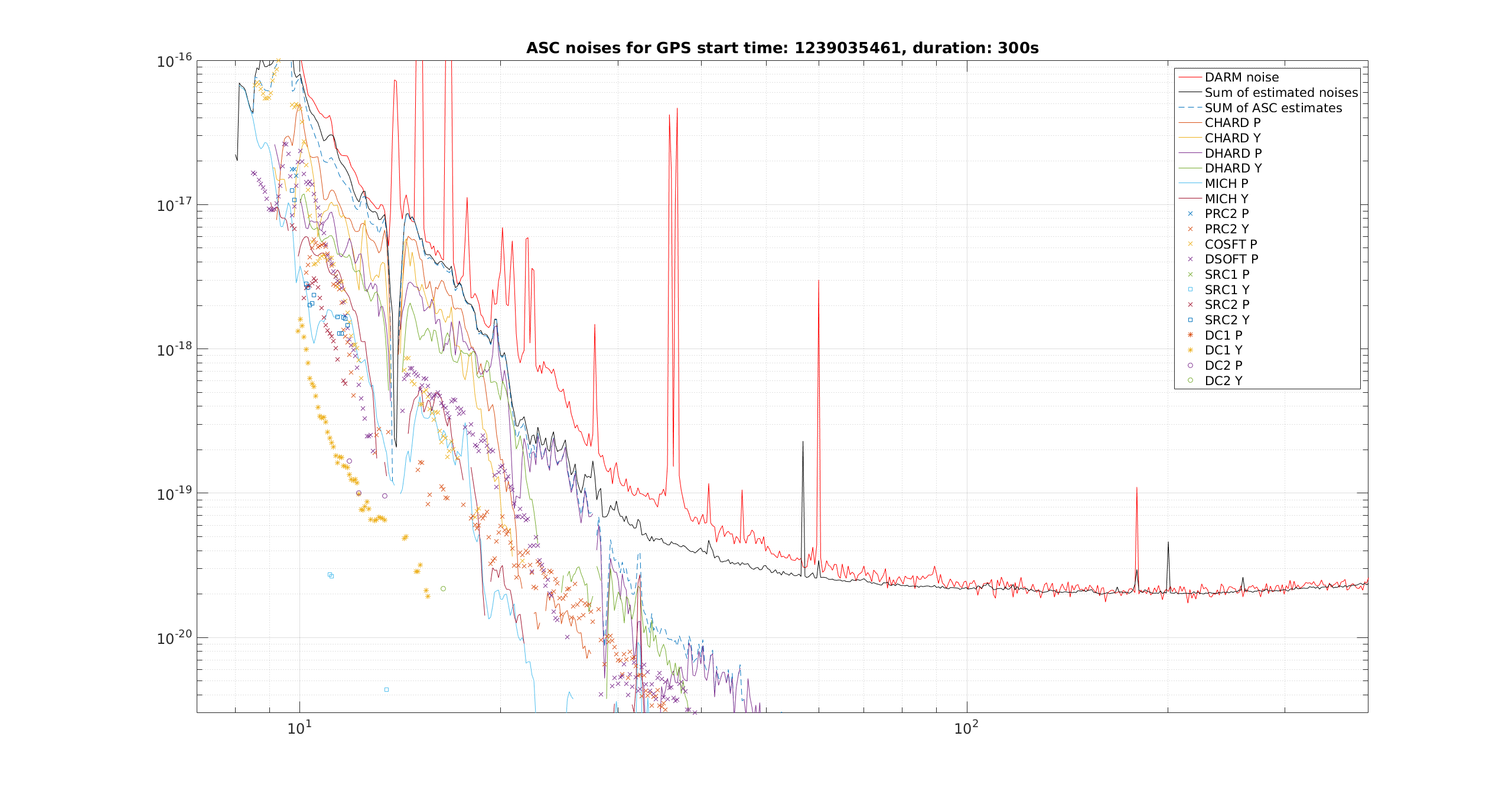
- For the ASC noise budget (third attachment), we also made injections for DC3+4 and INP1, but these don't show up in DARM for large excitations so they aren't included.
- The LSC noises are shown on their own here and the sum and residual are plotted in the last attachment.
- I'm using a logarithmic frequency vector, which makes the high frequency data look better than in past plots because of the binning. This noise budget has never done a good job of estimating line heights, which is more noticeable now, especially if you look at the violin modes.
- I'm also now using the GDS correction calibration produced by pyDARM, instead of just compensating for the whitening of CAL-DELTAL, which helps the noise budget line up at high frequencies.
- The forest of lines around 20Hz is the ADS lines.
Some things that can still be improved in this noise budget:
- The PUM DAC noise hasn't been updated with the new measurements at LLO or the change in the coil driver state.
- A model of the CARM loop can be used to estimate frequency noise from the REFL A shot noise and the IMC shot noise separately.
- There are several other (smaller) noises that we have the data to include (DC readout upconversion, acoustic noise added by squeezer, frequency noise downconversion around the OMC dither line, PEM injection data) but aren't on here yet.
- There are some noises we haven't measured recently, like output jitter noise and any of the electrostatic noises.
- We can produce projections of the benefits of specific improvements from this.
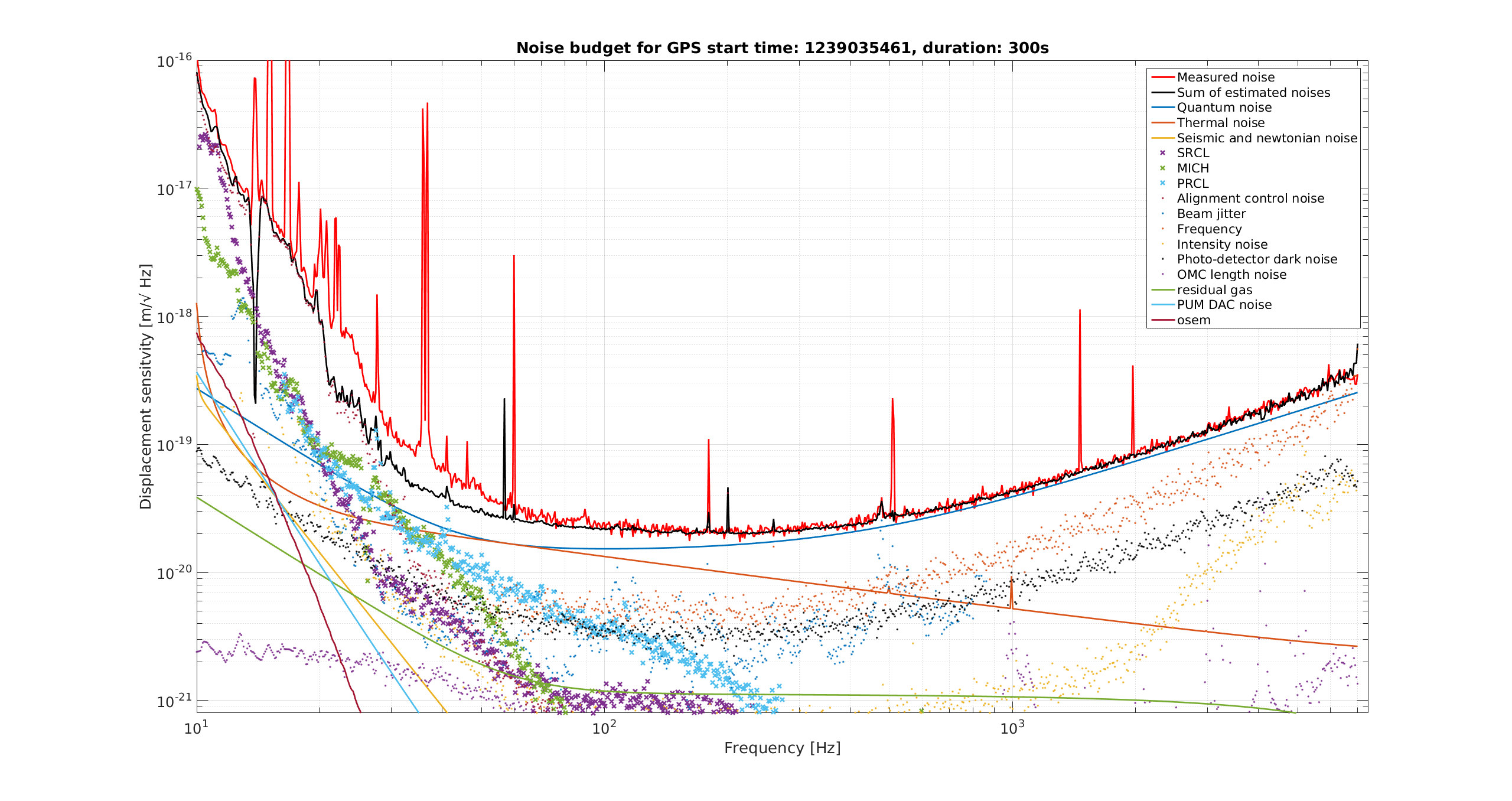
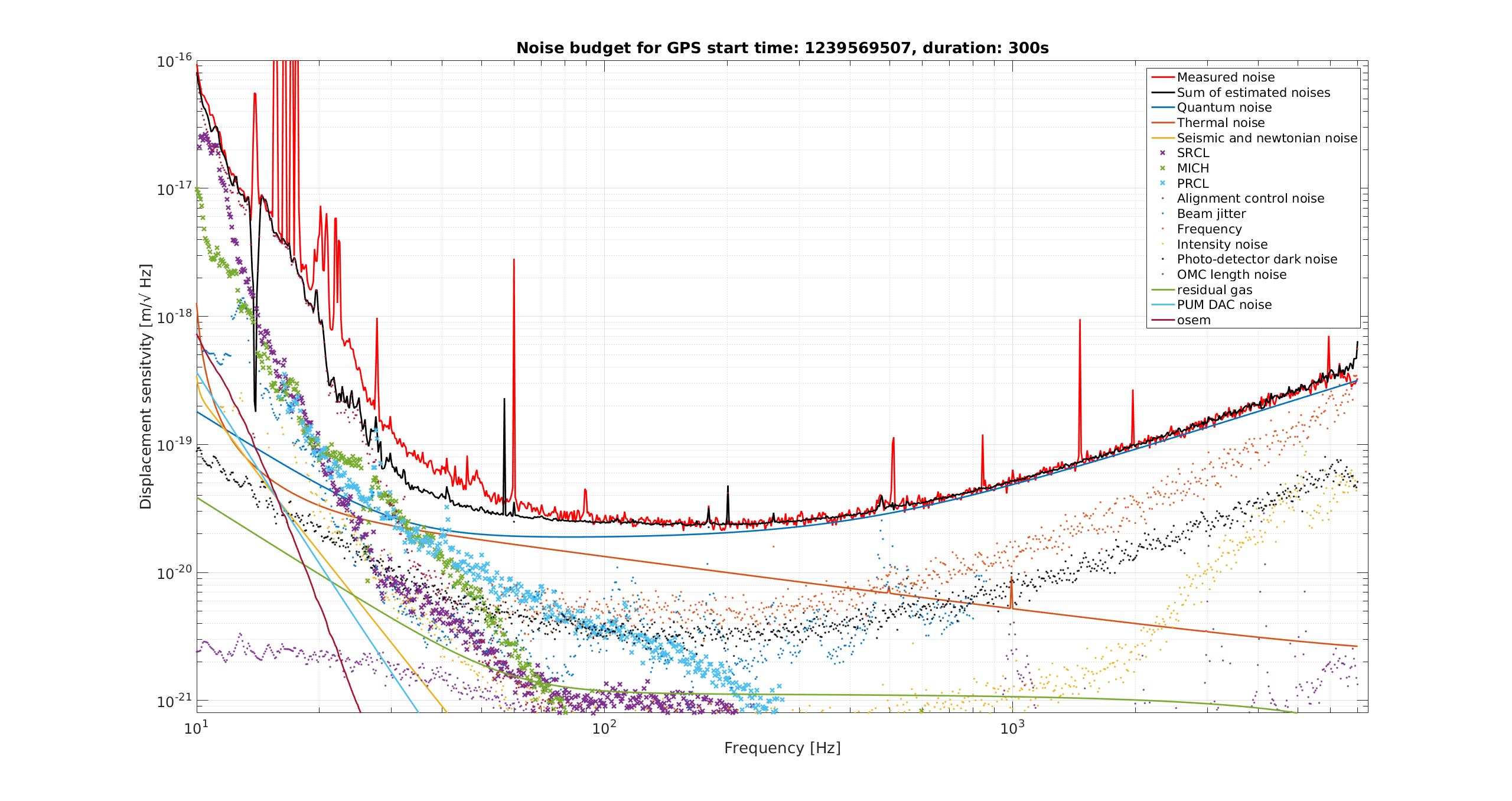


I used the noise budget to look a little more closely at the quantum noise.
The first two attachments are the noise budgets with and without squeezing (same data as above, logarithmic binning fixed using some code from Tobin Fricke).
The next attachment is a comparison of the cross correlation (produced by the front end) for the no squeezing time to the noise budget. The main message here is that the cross correlation is in rough agreement with the noise budget above 150Hz, and the noise budget residual below 150 Hz is due to noise that is correlated between the two detectors.
- Comparing the first two traces (blue and orange) you can see that the calibration of the DARM estimate exported from the cross correlation template agrees with GDS calib strain.
- The yellow and green traces show the noise budget total estimated noises, and the residual, and their sum (baby blue trace).
- The purple trace shows the correlated noise, which is fairly close to the baby blue trace, which indicates that the residual is noise that is correlated between the two DCPDs.
- The agreement between the cross correlation and the noise budget can give us a reasonable confidence in the estimate of the shot noise level without squeezing.
The fourth attachment shows a comparison of the DARM sensitivity with and without squeezing, and the modeled quantum noise in each case.

- Blue and burnt orange traces are GDS calib strain for the two times. (just a check that everything here is calibrated consistently).
- The green and baby blue traces are the modeled quantum noise used by the noise budget for each case. The radiation pressure noise is estimated using the input power (IM4 trans) and the power recycling gain monitor which is based on POP, this could be changed to use the arm circulating power monitors instead. The shot noise is calculated based on the power on the DCPDs, and calibrated into meter using the pcal monitor of the cavity pole, and kappa C. The level of squeezing is estimated as explained above.
- The yellow trace is an estimate of the classical noise based on the time without squeezing injected. It is stitched together from the total of the noise budget classical noises above 150 Hz and the measured noise with the modeled quantum noise subtracted below 150 Hz.
- The purple trace is the measured DARM noise with squeezing injected with the estimated classical noise subtracted. At high frequencies this should agree with the baby blue model of the quantum noise with squeezing, and gives us an idea of what our noise would approach if we could reduce the frequency noise contribution to DARM.
The 5th attachment shows the squeezing level based on the estimates used to make the 4th attachment.
- The blue trace is the squeezing level estimated from the ratio of the two sensitivities, which is limited by the classical noise in DARM. (Ratio of blue and burnt orange lines in 4th attachment) This should be the level of squeezing measured by the DCPD BLRMS, which just take a ratio of the sum and null stream BLRMs. At the time used for the squeezing DARM measurement, the mean of the DCPD blrms 4 was -1.96dB which seems like an overestimate in this 240 Hz band centered around 4680Hz.
- The burnt orange trace is the squeezing level with the classical noise subtracted. This was made by calculating what the quantum noise would be at the squeezing time if there were no squeezing, (the cavity pole and circulating powers are a little different at the squeezing time than the non-squeezing time), and taking the ratio of that the to purple trace from the 4th attachment.
- The yellow trace is the modeled squeezing level, the ratio of the modeled quatnum noise for the squeezing time with squeezing on and off.
- Comparing the orange and blue traces, you can see that we would get slightly more squeezing if the classical noise (frequency and DCPD dark noise) was reduced. It is difficult to make a statement about how flat the squeezing level is as a fucntion of frequency because the subtraction of the classical noise is imperfect and makes the estimated squeezing level noisy below 100Hz and above 2 kHz where there is a lot of classical noise to subtract.
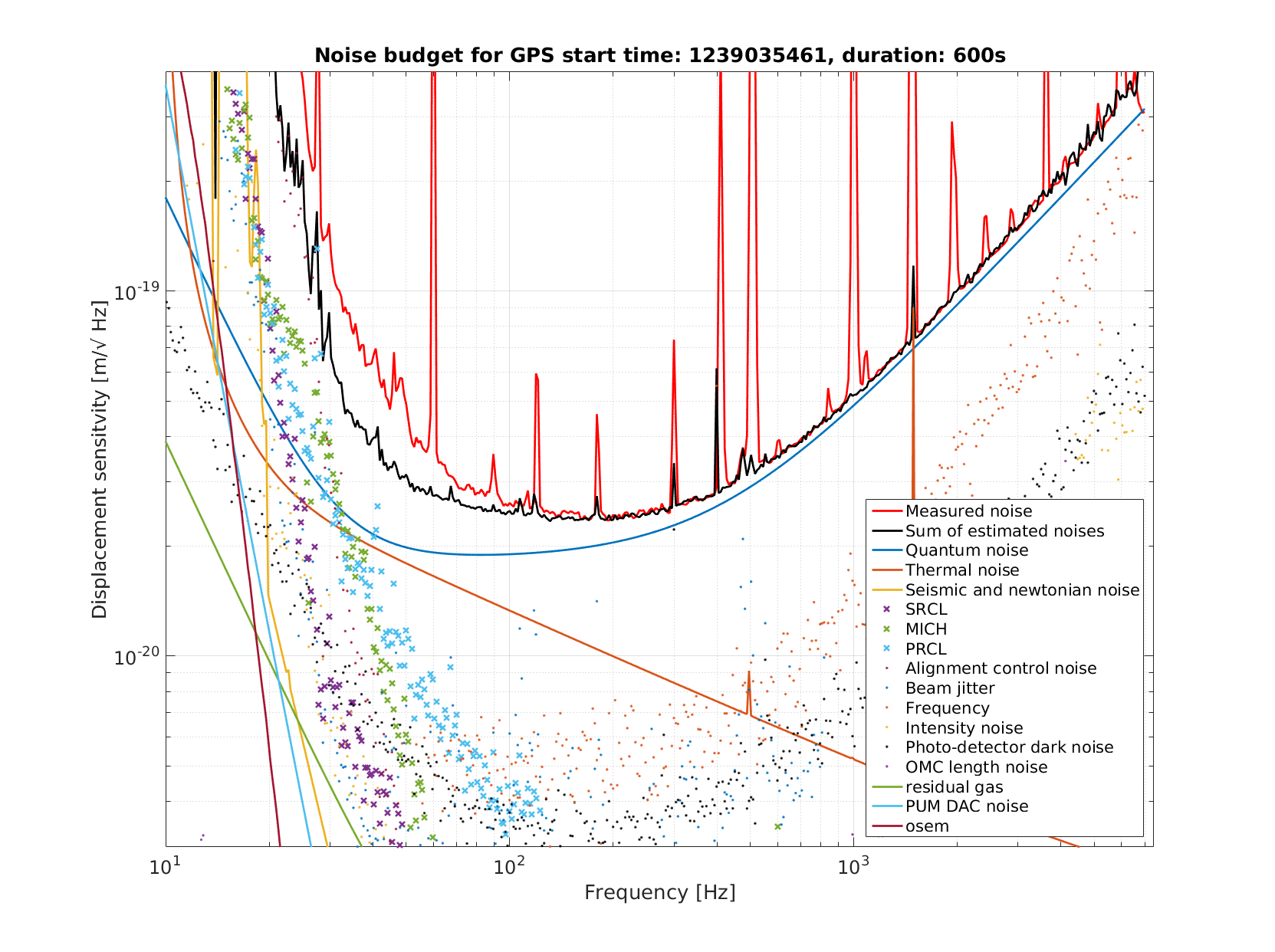
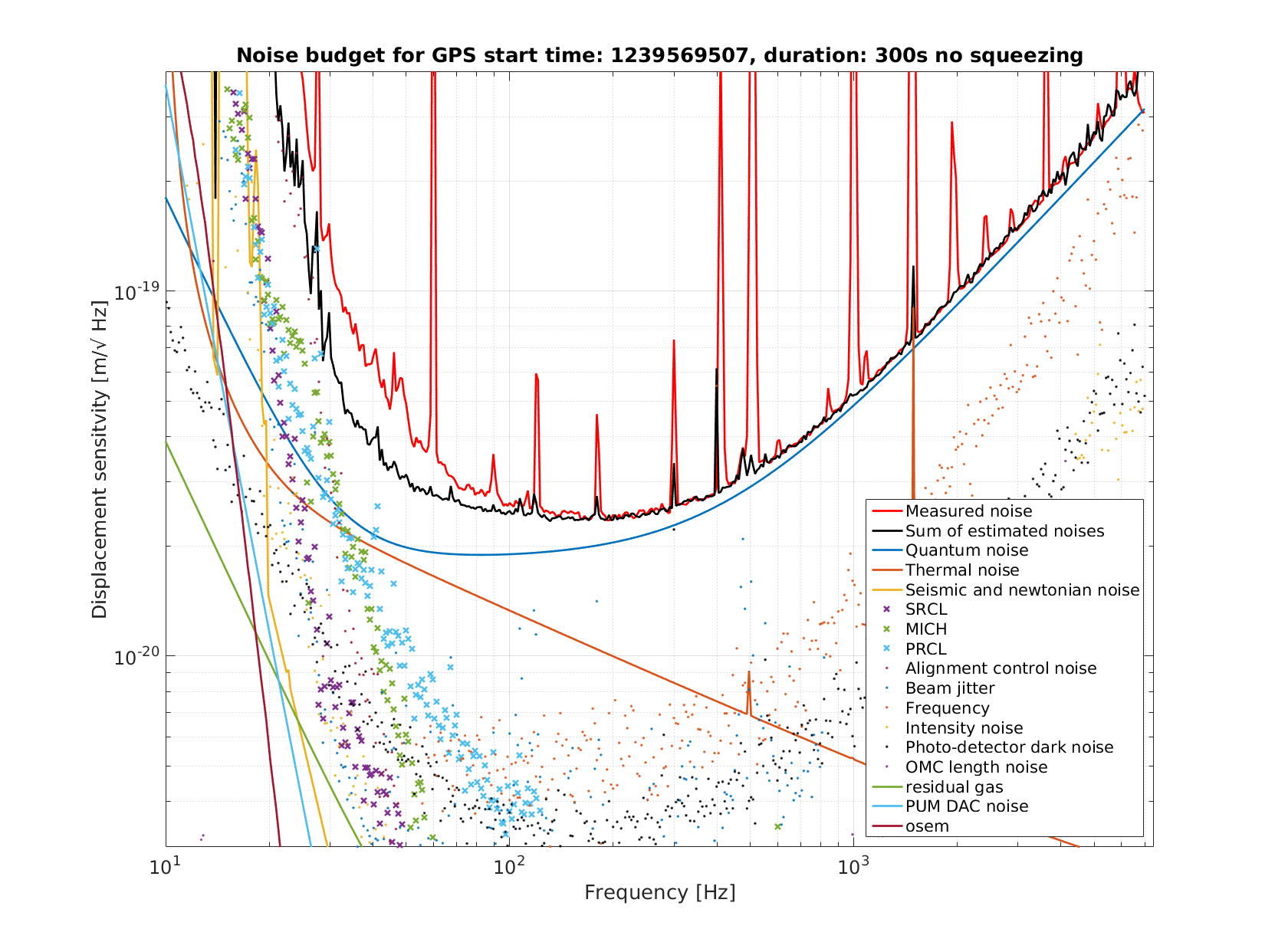
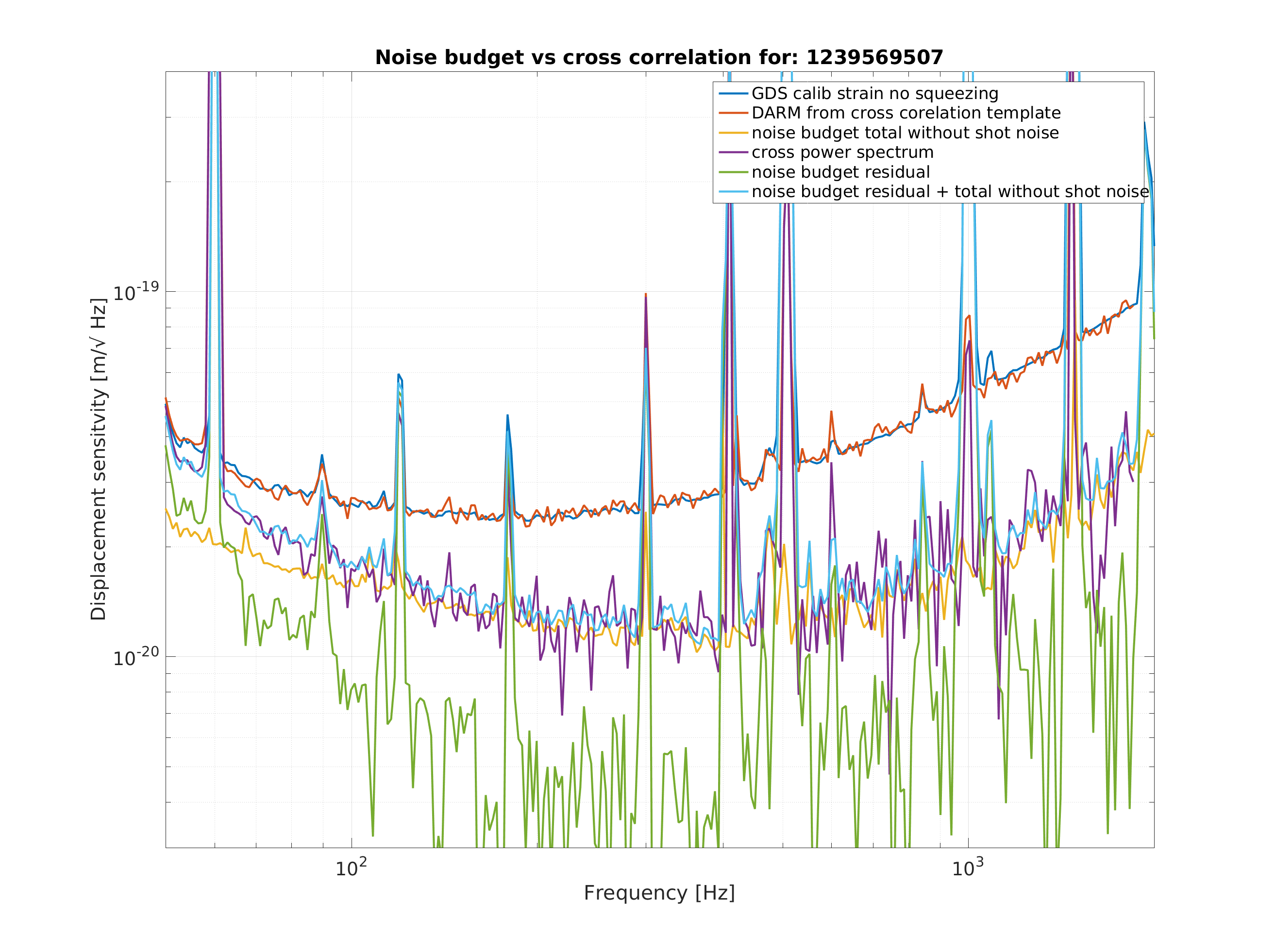
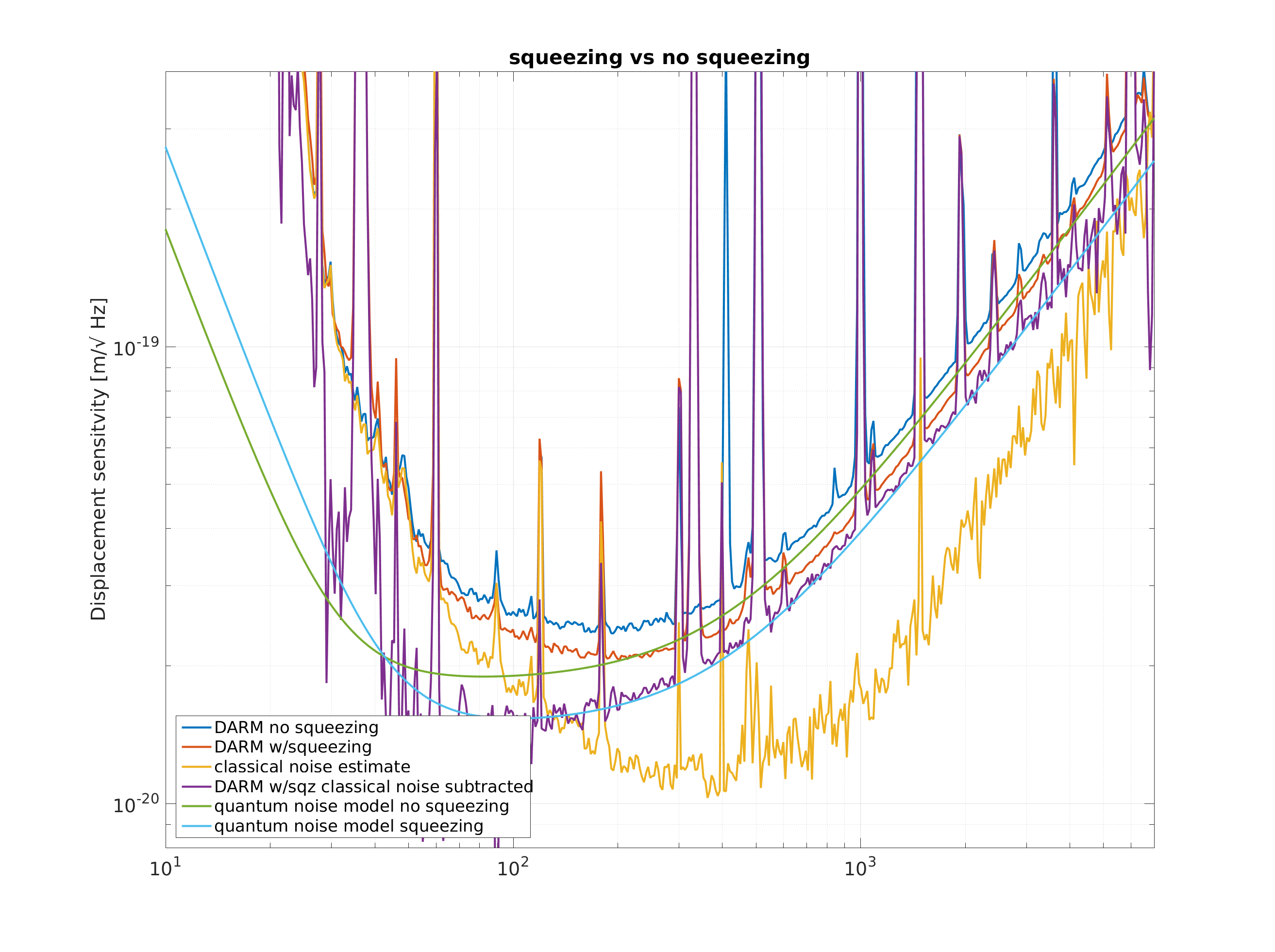
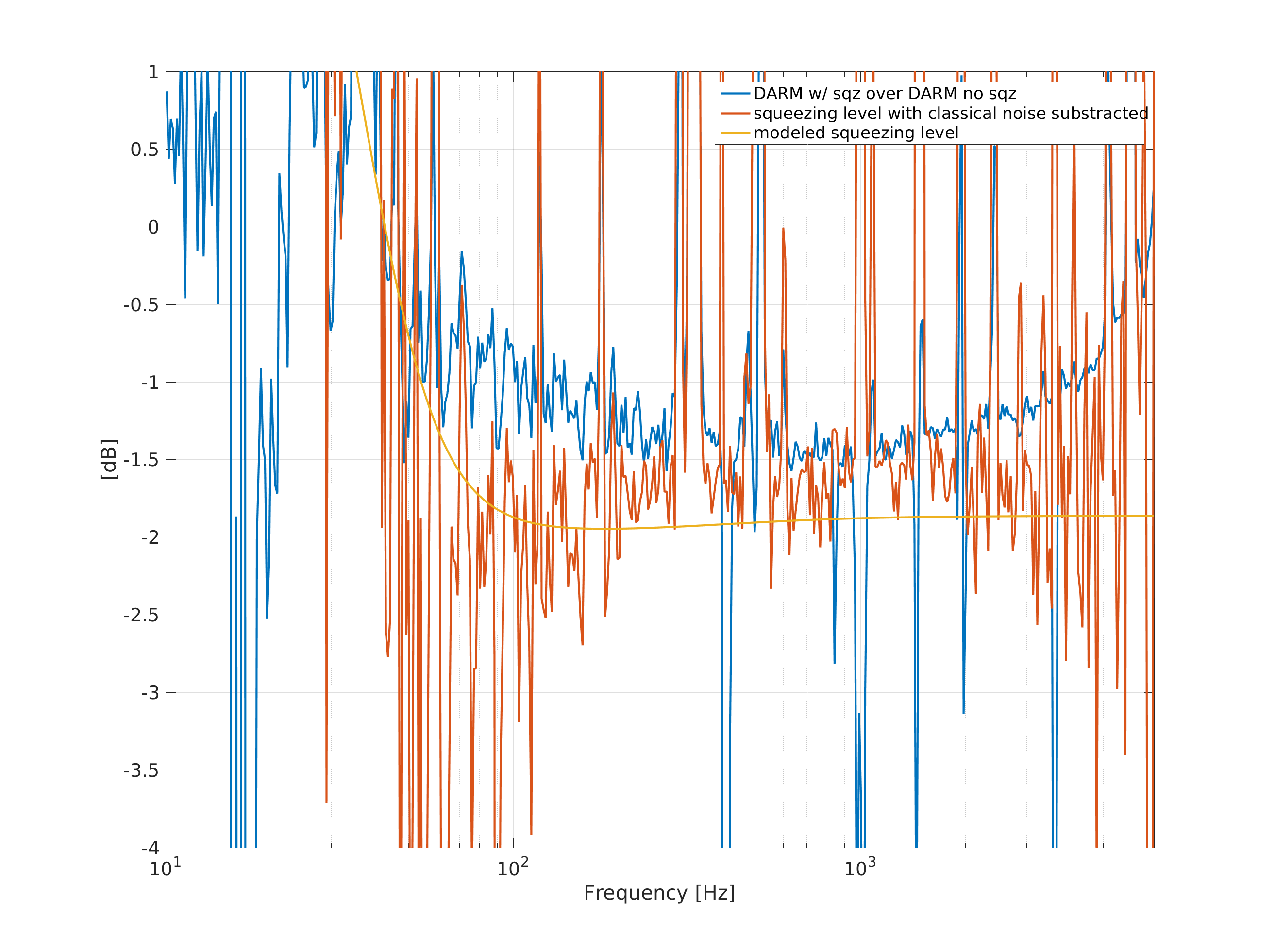
The first two plots in the comment above were mixed up, the correct plots are attached here.
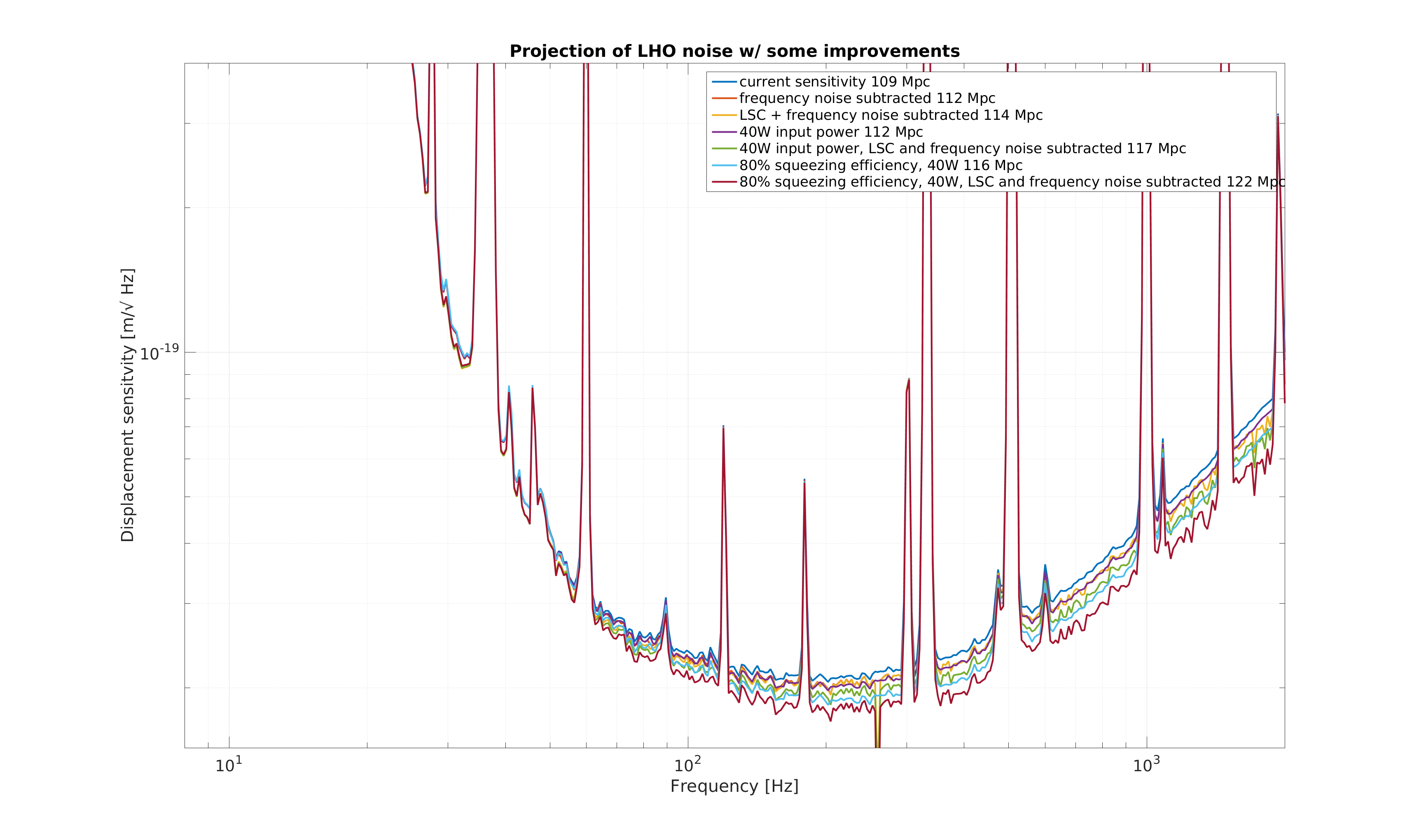
I estimated some of the improvements that we might be able to make to DARM in the third attachment, estimated ranges are in the legend.
We would gain a couple of Mpc each from improving our LSC feedforward (including PRCL which we aren't doing right now), and from reducing the frequency noise. The projection of 5MPc total for both of these is assuming that we can get rid of them totally, which is optimistic. We can get a similar improvement by increasing the power into the IMC to 40W, assuming that the circulating power continues to scale with the input power. Combining an increase in the input power and improvements in LSC and frequency noise, we can start to approach 120 Mpc.
I also estimated what we would get if we had 3dB of squeezing. I estimated this as an improvement in the losses, with our current nonlinear gain and phase noise of 150 mrad, we would need about 78% efficiency to reach 3dB of squeezing. This could also be achieved by a different route, which would result in slightly different anti squeezing levels. This would indicate that with 3dB of squeezing, 40W power into the IMC, improved LSC feedforward, and reduced frequency noise, we could reach just above 120 Mpc.