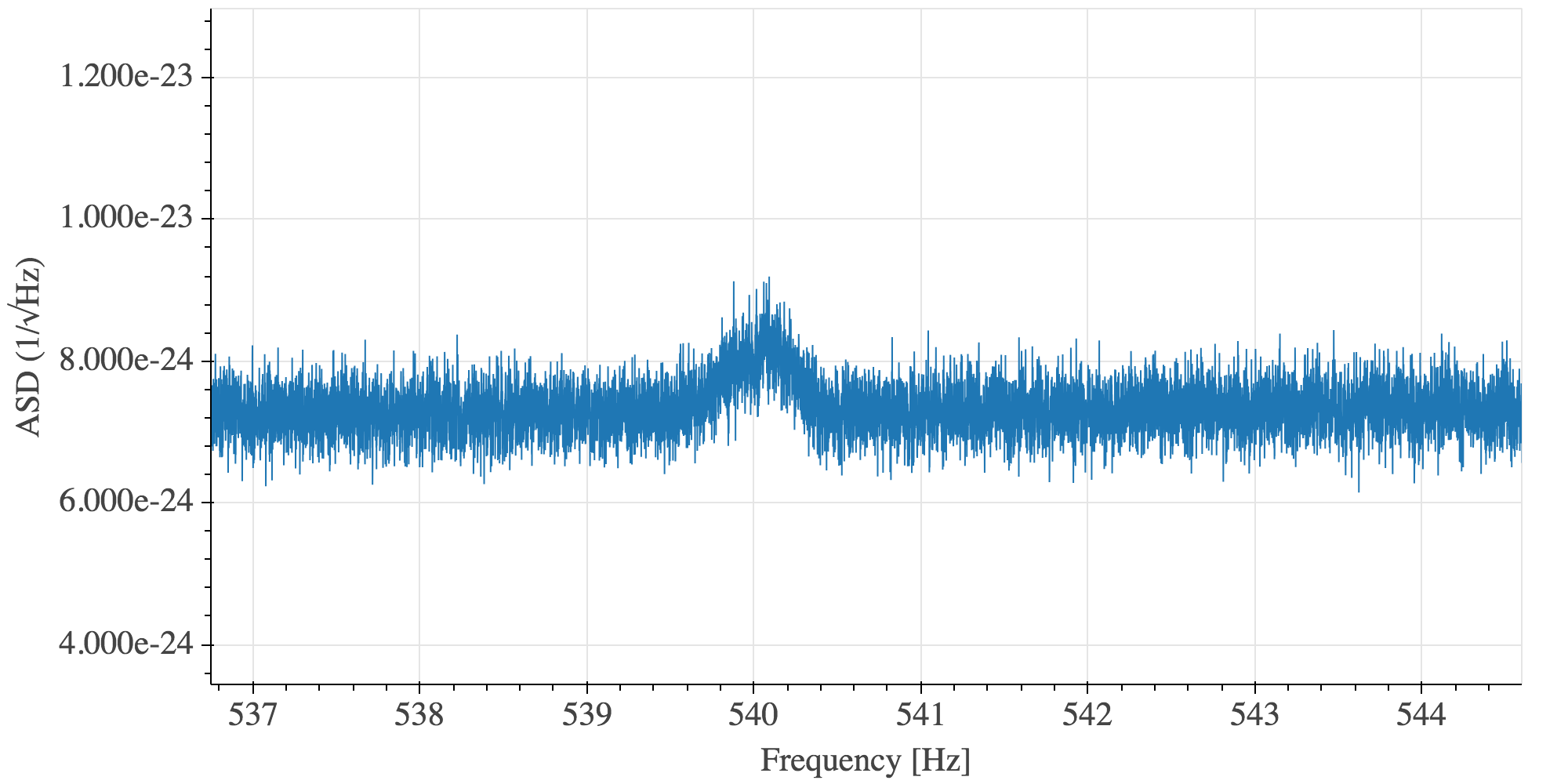
I've been looking at the bump around 540 Hz which can be seen with long integrations (1800 s), see first attachment.
I ran a BruCo job to try to find coherences (results here https://ldas-jobs.ligo-wa.caltech.edu/~pep.covas/bruco/bruco_1240272018/), and some channels related to PSL (ISS), HPI and ISI showed high values. These are the top 20 channels found by BruCo and their coherence:
| 540.12 | HPI-HAM1_TT _L4C_Z_DQ (0.79) |
ISI-HAM6_GS13INF _H1_IN1 _DQ (0.78) |
HPI-HAM1_TT _L4C_RX_DQ (0.78) |
ISI-HAM6_BLND _GS13RZ _IN1_DQ (0.77) |
PEM-CS_ADC _5_18_2K_OUT _DQ (0.77) |
PSL-ISS_PDB _REL_OUT_DQ (0.77) |
PSL-ISS_SECONDLOOP _RIN _CTRL_OUT _DQ (0.77) |
PSL-ISS_SECONDLOOP _OUTPUT _DQ (0.77) |
HPI-HAM1_TT _L4CINF_V2 _IN1_DQ (0.77) |
PSL-ISS_SECONDLOOP _RIN _ERR1_OUT _DQ (0.77) |
HPI-HAM1_TT _L4CINF_V3 _IN1_DQ (0.77) |
PSL-ISS_SECONDLOOP _ERR1 _DQ (0.77) |
ISI-ETMX_ST1 _L4CINF_V3 _IN1_DQ (0.76) |
ISI-ETMX_ST1 _MASTER_H1 _DRIVE_DQ (0.76) |
ISI-ETMX_ST1 _L4CINF_H3 _IN1_DQ (0.76) |
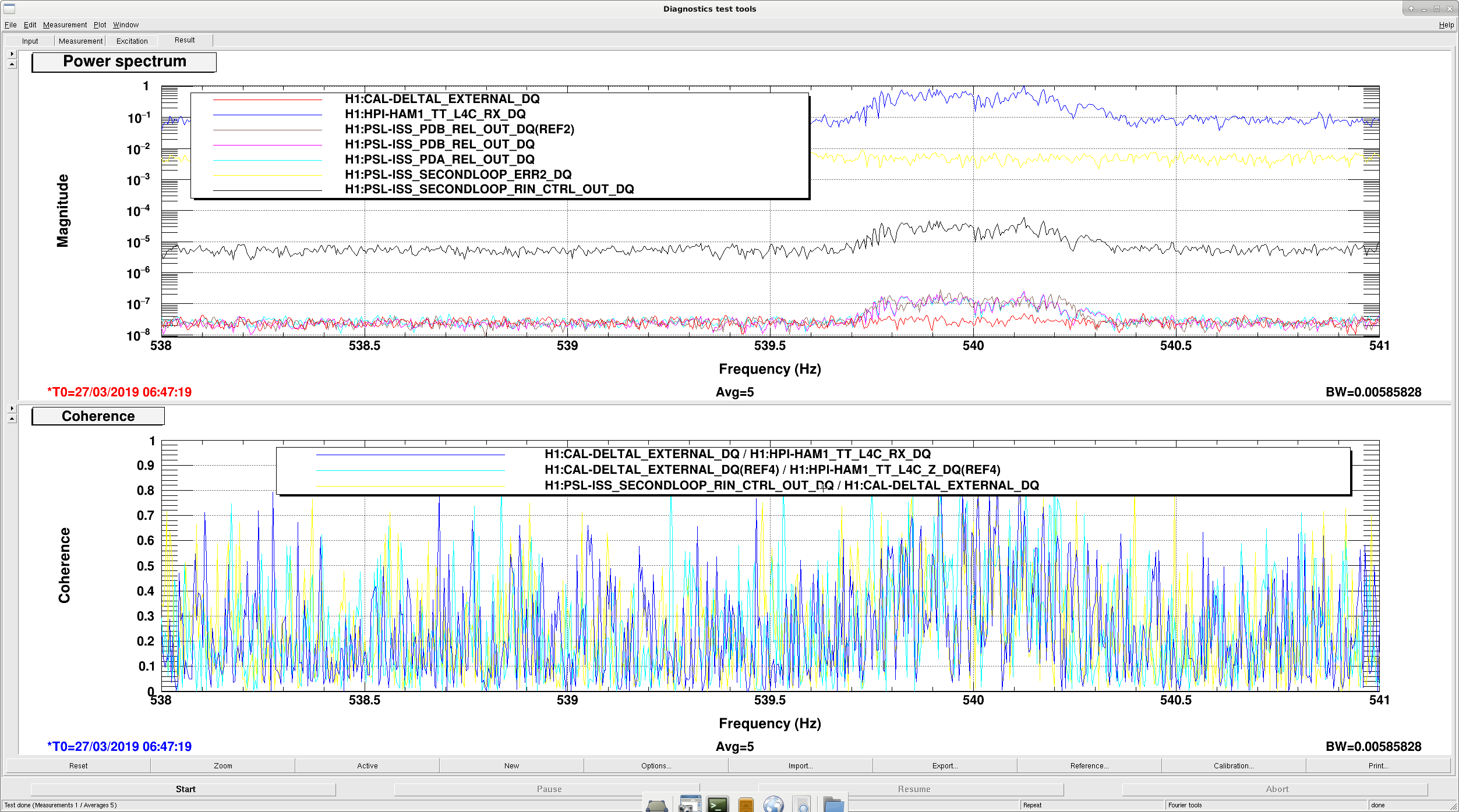
The second attachment shows a DTT plot showing some power spectrums and some coherence traces. A region of high coherence between approximately 539.7 and 540.3 Hz can be seen, and also a bump at these channels at the same frequencies as in DARM. It shows both curves from 27 March and 27 April (refs), which show very similar features. This bump seems to be a stable feature in DARM
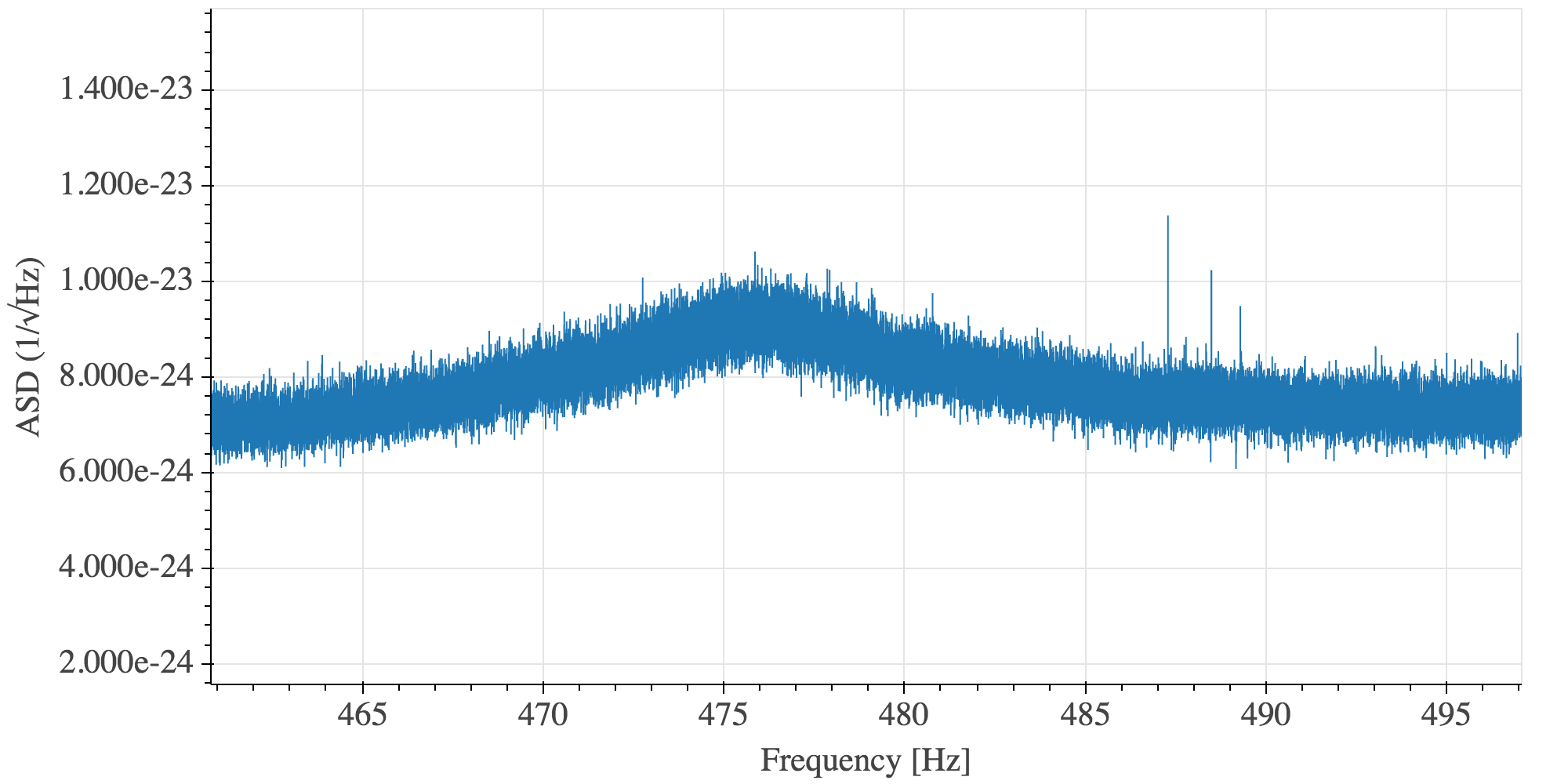
A similar but much wider bump between 465 and 485 Hz (first attachment) also has coherence with some other channels, for example:
| 476.62 | IMC-WFS_B_Q _PIT_OUT_DQ (0.70) |
IMC-WFS_B_Q3 _ERR_DQ (0.70) |
IMC-DOF_4_P _IN1_DQ (0.68) |
IMC-WFS_B_DC _PIT_OUT _DQ (0.68) |
IMC-WFS_B_Q4 _ERR_DQ (0.68) |
IMC-WFS_A_DC _PIT_OUT _DQ (0.68) |
IMC-WFS_A_DC _YAW_OUT _DQ (0.67) |
PEM-CS_ACC _PSL_PERISCOPE _X_DQ (0.67) |
IMC-WFS_B_Q _YAW_OUT_DQ (0.66) |
IMC-WFS_B_Q1 _ERR_DQ (0.65) |
PEM-CS_ACC _PSL_PERISCOPE _Y_DQ (0.65) |
IMC-WFS_B_Q2 _ERR_DQ (0.64) |
IMC-WFS_B_I4 _ERR_DQ (0.63) |
PEM-CS_ACC _PSL_TABLE1 _Z_DQ (0.62) |
IMC-F_OUT_DQ (0.61) |
| 476.75 | IMC-WFS_B_Q _PIT_OUT_DQ (0.78) |
PEM-CS_ACC _PSL_TABLE1 _Z_DQ (0.76) |
IMC-WFS_B_Q3 _ERR_DQ (0.76) |
IMC-WFS_A_DC _PIT_OUT _DQ (0.75) |
IMC-DOF_2_P _IN1_DQ (0.75) |
PEM-CS_ACC _PSL_PERISCOPE _Y_DQ (0.75) |
IMC-DOF_4_P _IN1_DQ (0.74) |
IMC-WFS_B_DC _PIT_OUT _DQ (0.74) |
IMC-WFS_B_Q1 _ERR_DQ (0.74) |
IMC-F_OUT_DQ (0.74) |
IMC-F_IN1_DQ (0.74) |
SQZ-OPO_FREQ _OUT_DQ (0.74) |
SQZ-PSL_FF _OUT_DQ (0.74) |
PEM-CS_ACC _PSL_PERISCOPE _X_DQ (0.74) |
IMC-L_IN1_DQ (0.74) |
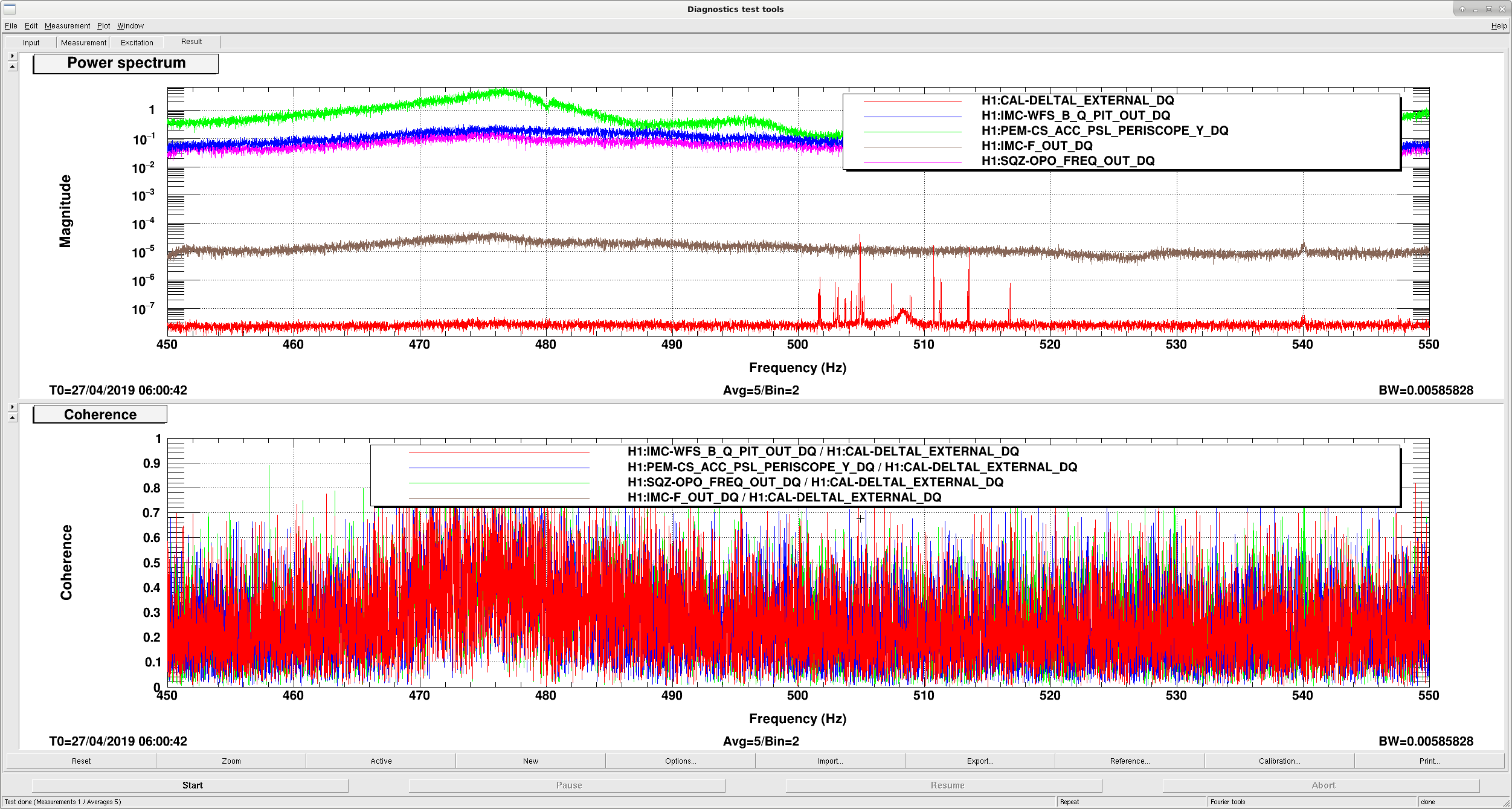
The second attachment again shows the power spectrum and coherence with some channels. You can see an increase in coherence around this same frequency range, with all channels compared showing similar behaviour.
This being a 20 Hz wide feature, it would be interesting to try to do more studies in order to get rid of this, if possible.
Particularly since the ISS channels are coherent with the ISI, Pep and I talked about this being potentially beam motion that is then coupling in to the ISS second loop, which is then putting it onto the 1st loop. The attached figure shows that while we're in lock, the second loop QPD is near one of the edges in pitch. Note however that when we have just the IMC and not the full IFO that the QPD doesn't look centered. So, I want to move the spot during an IMC-only time the amount that I think it needs for full lock - I don't want to actually center the beam while we have IMC only.
[Pep, Jenne]
We move the picomotors in front of the ISS second loop array by +0.8 in pitch and +0.47 in yaw, such that the beam should be centered when we're in full IFO 35W lock. On the HAM2+oplev picomotor controller, we mostly used the picomotor channel 8 (PSL ISS QPD/PD (PM5)) to do the centering, and then checked with channel 1 (PSL ISS QPD/PD (PM1)) that there was no change in the SUM if we moved a few fractions of a beam diameter. This check helped us feel more confident that the beam is not clipping. Pep will check if there is an improvement in this coupling, once we're relocked.
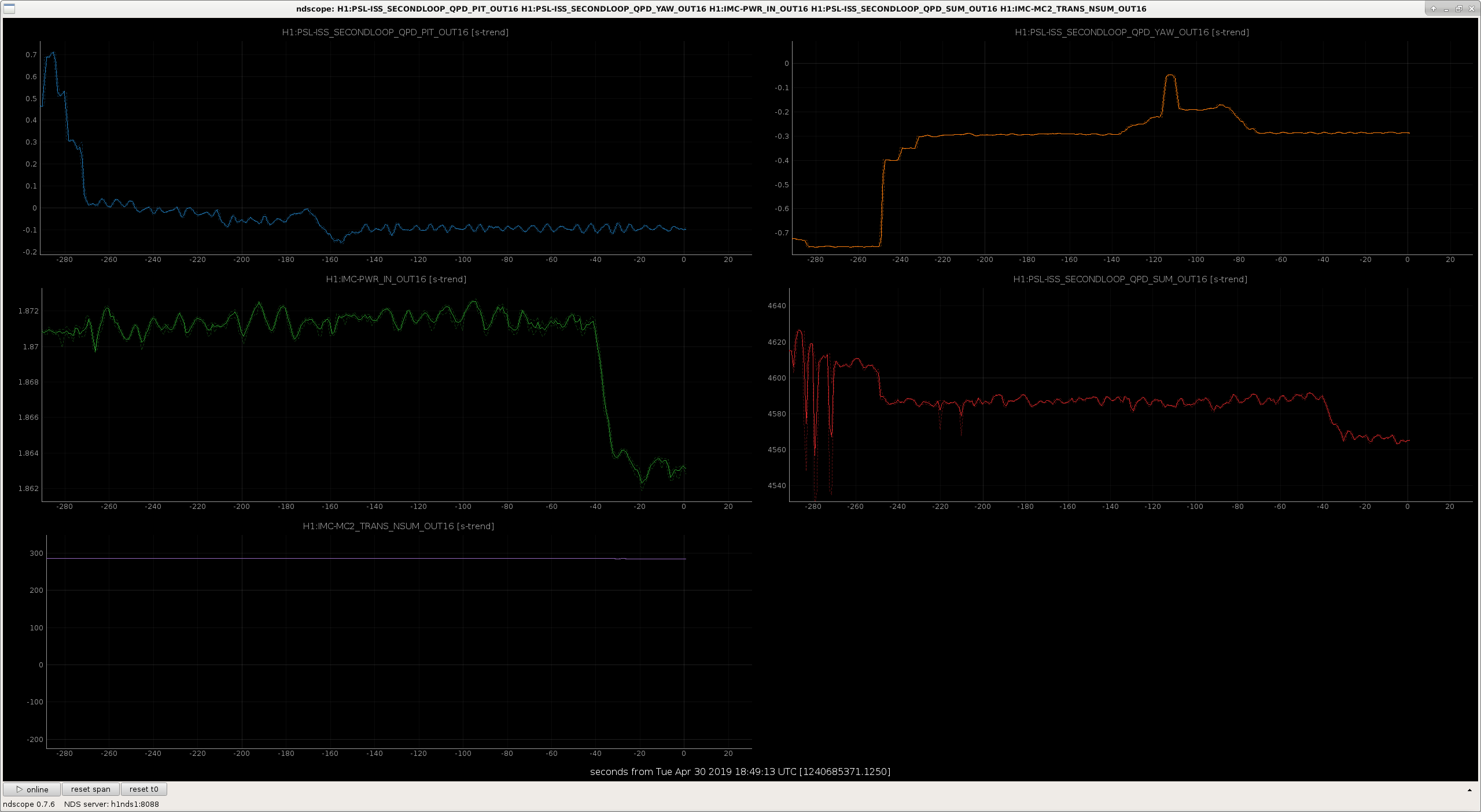
After the changes made this Tuesday, the noise floor has improved (see here https://ldas-jobs.ligo-wa.caltech.edu/~pep.covas/O3/AfterPSLPicomotor/Comparison.png), but it could be better. We have used again the picomotors (mostly in YAW) while at 35 W to try to make a better improvement.