About an hour and a half after lock acquisition we were still getting the yaw ASC oscillations. I looked at moving MICH ASC to the AS 72 MHz signals (which are in use for SRC alignment), but there is very little signal there. I did get a single-frequency transfer coefficient by driving BS in pitch quite hard and tried blending the RF72 signal in with the RF36 signal (with the idea of trying to turn off the RF36), but the noise increase in MICH ASC was quite dramatic. I unblended, and left MICH ASC on the nominal AS_A_RF36_Q signals.
I then moved the phase of AS_A_36 and watched the ASC yaw oscillations and circulating power buildups, and ended up with an answer 5 degrees different than Georgia's (alog 48857) when she checked the phase in full lock. This is good, although not so great if we can't reacquire lock with this phasing.
I also tried moving the SRC1 offsets in both pitch and yaw to see if I could further improve any buildups or the cavity pole. In the end, having no offsets seemed to be pretty close to the best I could find.
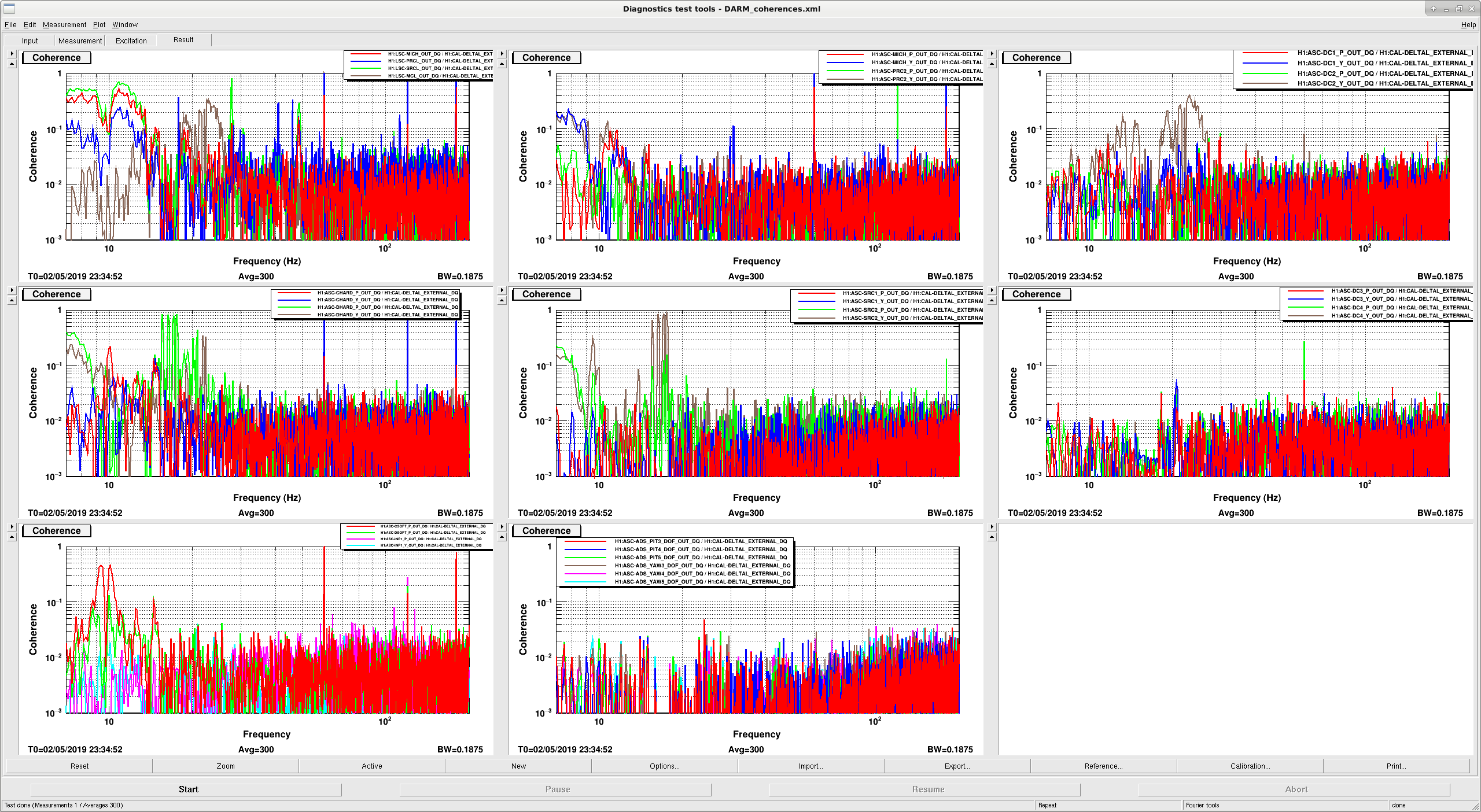
I see that the noise between 20 Hz and 30 Hz is slightly elevated, very similar to what Andy pointed out in alog 48881 after Georgia initially rephased AS 36 on Monday. I ran A2L on ITMX just in case it was some slight change in spot position on that optic, but that didn't improve things. I looked at Andy's bruco, but it shows coherences with REFL WFS signals, which I don't really see right now when I look at a dtt version of coherences (see attached figure). I do see coherence with LSC-MCL, which is a little bit surprising. And, we still have the old friend DC2 Yaw.
OPERATORS: If we lose lock, you'll likely need to change the phase of AS_A_36 by copying the following into a terminal:
-
z write H1:ASC-AS_A_RF36_SEG1_PHASE_R -175 H1:ASC-AS_A_RF36_SEG2_PHASE_R -190 H1:ASC-AS_A_RF36_SEG3_PHASE_R -170 H1:ASC-AS_A_RF36_SEG4_PHASE_R -175
Once we're locked, after about an hour and a half you'll likely see ASC yaw oscillations (most noticeably in the blue INP1 trace on nuc6). When this happens, copy the following into a terminal:
-
z step H1:ASC-AS_A_RF36_SEG1_PHASE_R +1,40 H1:ASC-AS_A_RF36_SEG2_PHASE_R +1,40 H1:ASC-AS_A_RF36_SEG3_PHASE_R +1,40 H1:ASC-AS_A_RF36_SEG4_PHASE_R +1,40 -s 1
-
This should step each segment's phase up by 1 degree, 40 times, with 1 second waits between each step. So, this will require about 1 minute out of observing time, but will help the IFO be more stable.
Can the RF36 phase change be deduced from the SUM channels, ie. atan (Q/I)?