sheila.dwyer@LIGO.ORG - posted 17:04, Thursday 09 May 2019 (49160)
some investigations into 2 minute ASC oscillations
This morning Jenne and I took the interferometer out of observing to look into the slow yaw oscillations that have been happening since we reduced the power on the the SR3 heater. The main thing that we learned is that it seems to be caused by refl WFS, or by a cross coupling between REFL WFS and something else.
- First Jenne changed the phase of AS36 to what it was intended to be set to last night, this reduced the oscillation amplitude but didn't fix it. We also looked at the AS36 signals while this was happening and saw that although it was a common phase shift, there were much larger responses to the phase shift in segments 2+4, which also have much larger signals than segments 1+3. The oscillations then slowly came back to be as large as before.
- Then we looked at alog 21083, where we phased the indivdual segments of AS36 with a well aligned PRMI beam steered onto each segment one at a time and found that the delays for each segment were verry similar. So we decided to replicate the relative phasing in that alog, they were up to 20 degrees different in relative phase. (We brought the phase of segment 2+3 to match segment 1, and segment 4 is 5 degrees larger). Again the oscillation was reduced when we made the change but came back after a few minutes.
- We rotated the phases in common to again zero the Q sum, this is not actually zeroing the signal on each quadrant, so it isn't accomplishing the goal of making the signal insensitive to centering. Again, the oscillation was reduced but came back after a few minutes.
- We put offsets in the BS yaw loop, and saw that there is a reasonable signal with SNR that seems similar to ASA36Q in the ASB72Q signal (right now we are using ASA72Q for SRM). We aso saw that there was a similar change in the signal in all 4 quadrants of ASA36Q, which is interesting because the DC signal level is larger on segments 2+4.
- We tried turning off one at a time SRC2Y, SRC1Y, but we continued to see the oscillation, somewhat smaller, in the REFL WFS and the REFL centering signals. It is interesting that this slow of an oscillation shows up in the REFL centering error ponits, because those loops should have ugfs around 1Hz, so they could be expected to suppress this low frequency of a signal.
- We turned off ADS, which had no impact on the oscillation as Georgia reported last week, so we turned it back on.
- The oscillation went away completely when we turned off INP1Y. The build ups slowly decayed over a few minutes and the ADS loops could not keep their error signals zeroed with this off, we turned INP1 back on when we started to see an oscillation in the DC centering loops.
- We decreased the gain on INP1Y to -0.5 (it is normally -1), but there was a sudden lockloss a mintue or so after we did this. There were no signs of trouble in the ASC loops before the lockloss.
In the most recent lock, the oscillation didn't show up until over 2 hours into the lock stretch.
- We tried increasing the gain of INP2Y by a factor of 2, this made the oscillation worse.
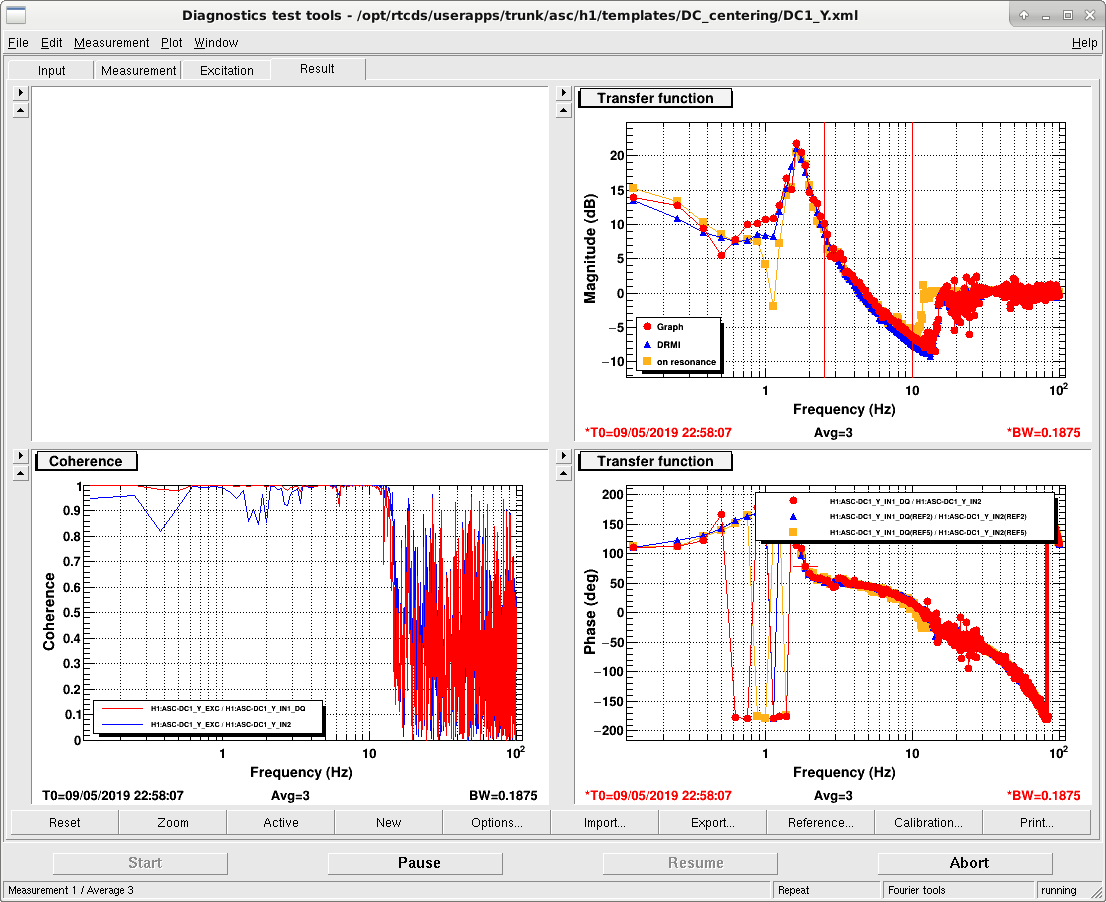
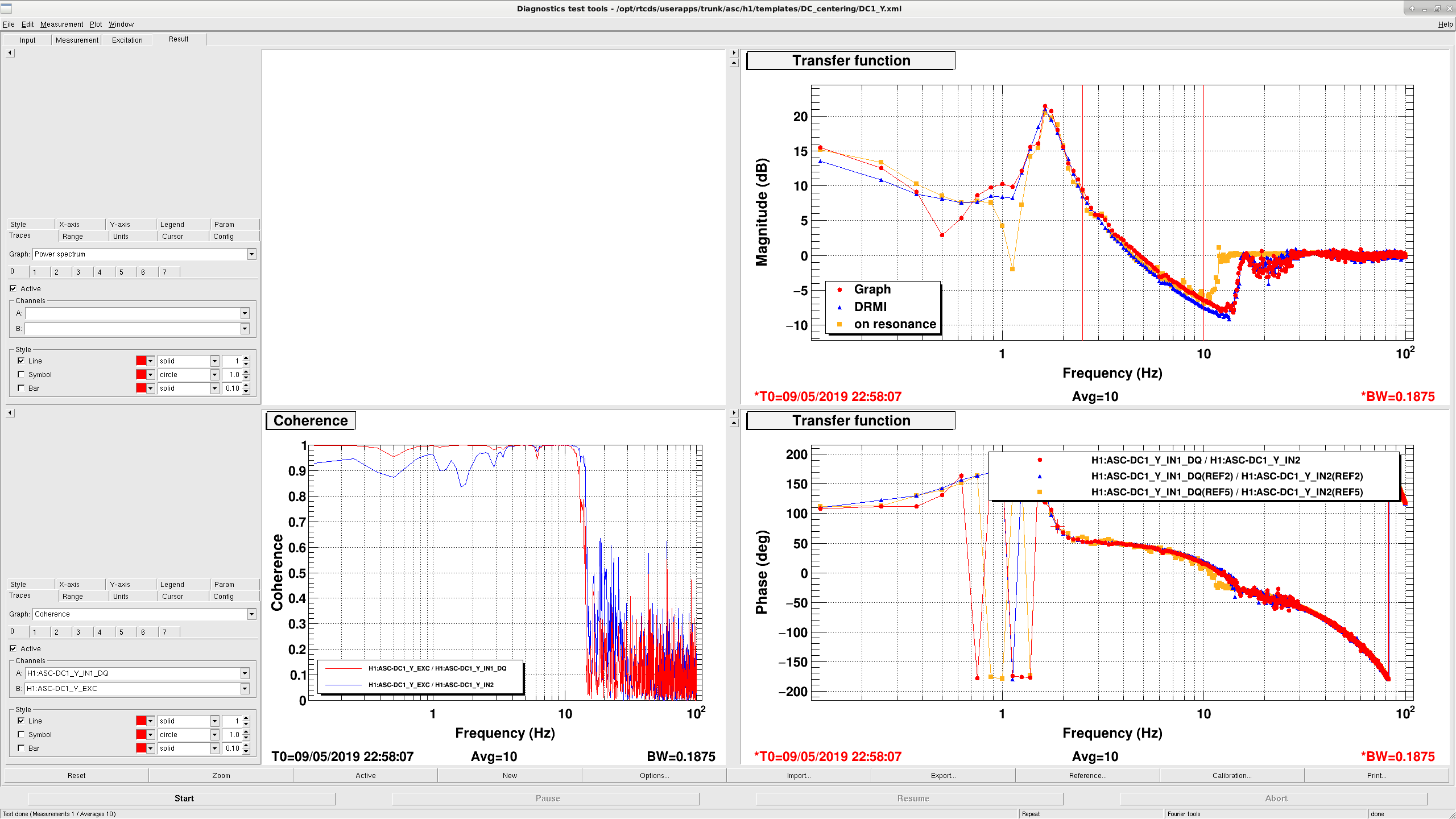
- We measured the yaw REFL centering loops (attachments), they match the references except for notches at 0.5Hz for both loops (these notches were added in March 47415). We've turned off the 0.5 Hz notches. Both loops have integrators in the suspension with 0.83Hz zeros, so we would expect they each have gains of 30-35dB at 0.008Hz where we are seeing the oscillation.
- Since there is plenty of phase margin in both of these loops, we added a simple boost 0.05Hz pole 1 Hz zero, the centering loop error points are suppressed better, but the oscillation in the REFL WFS isn't reduced.
It seems like the next step is to measure the sensing matrix for the REFL WFS.
Images attached to this report