
Sheila, Keita
We have been able to get back to observing after struggling with ASC problems since Tuesday maintence. We will need to wait for a few lock acquisitions to see if our changes have solved the problem consistently or not.
ASC work this morning:
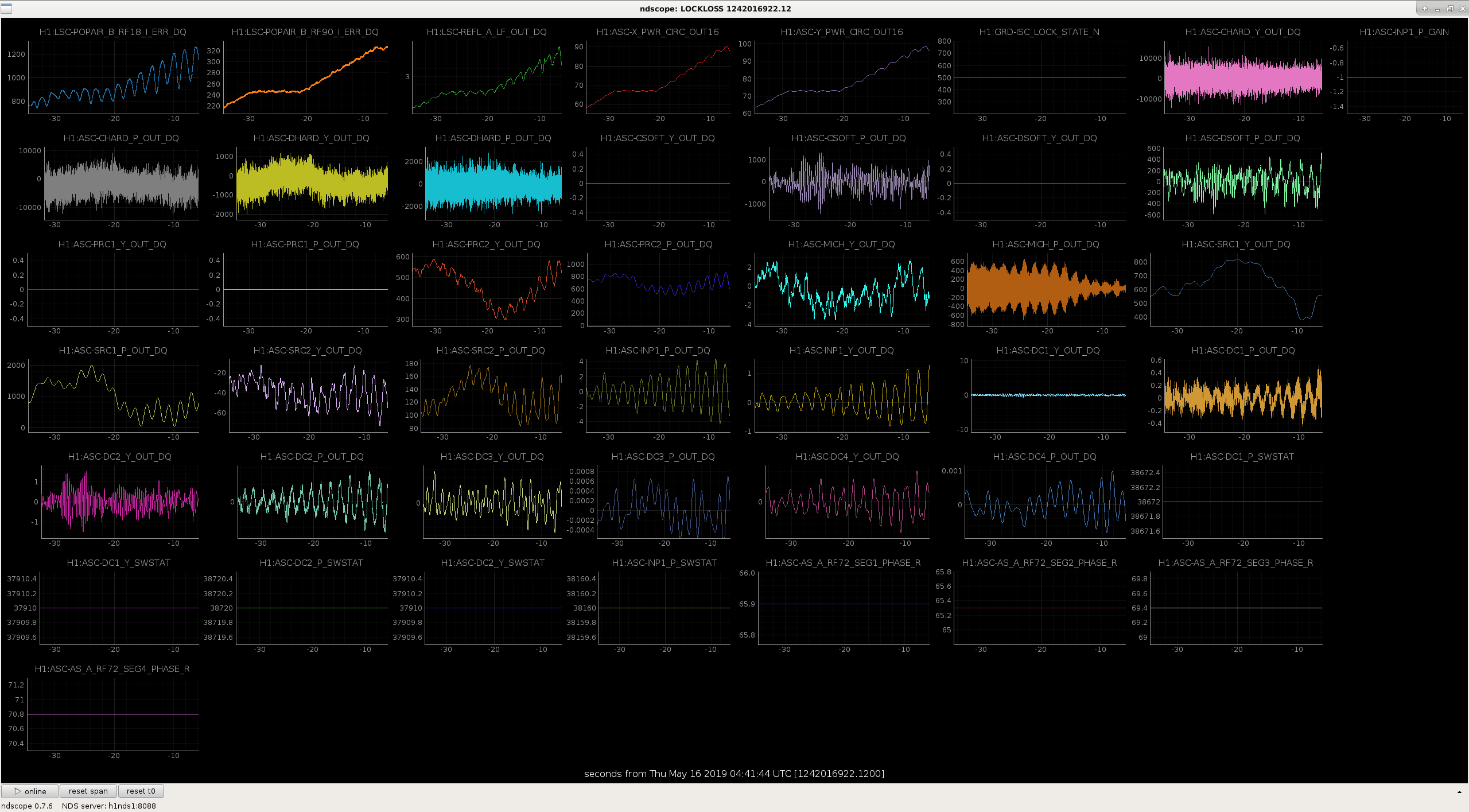
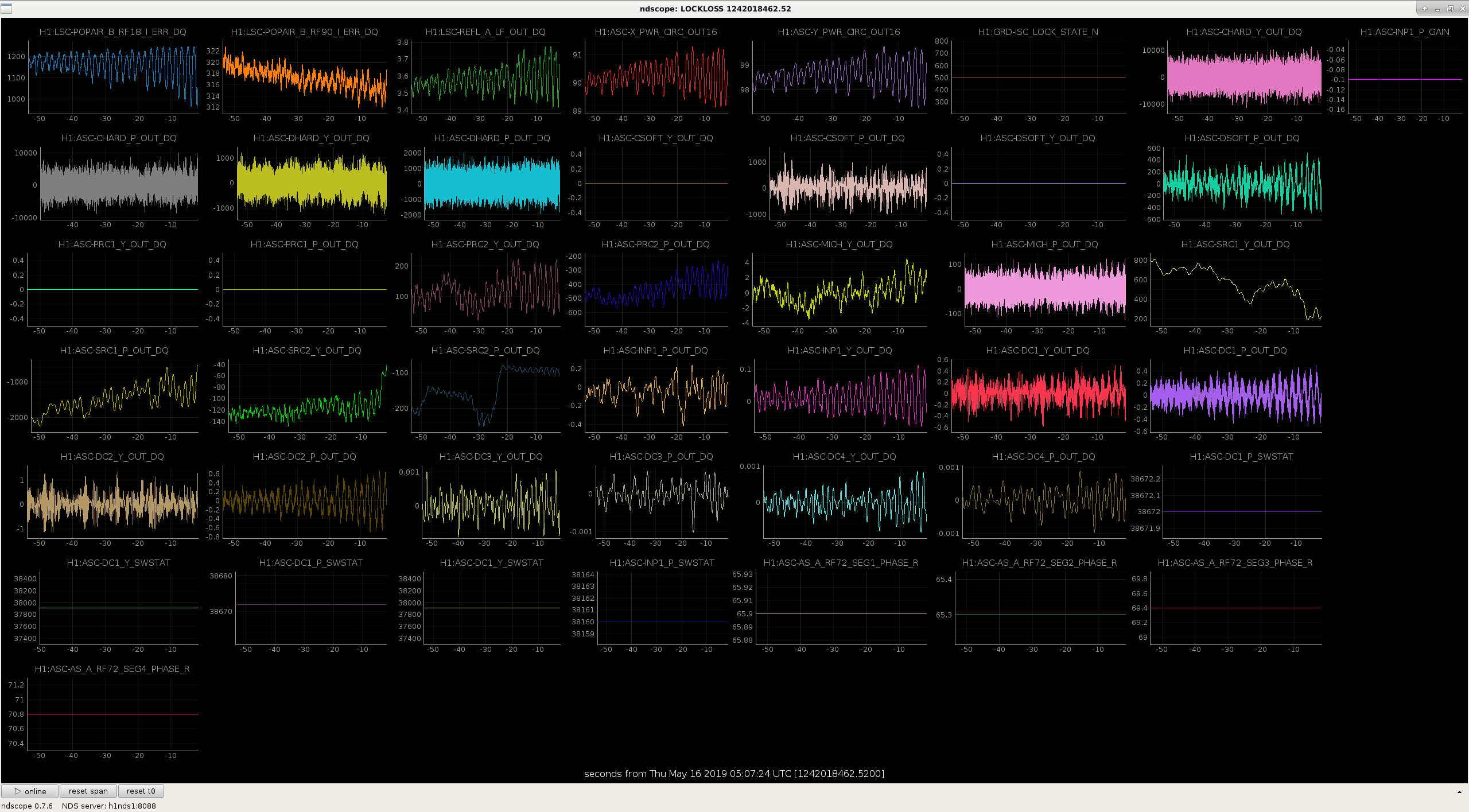
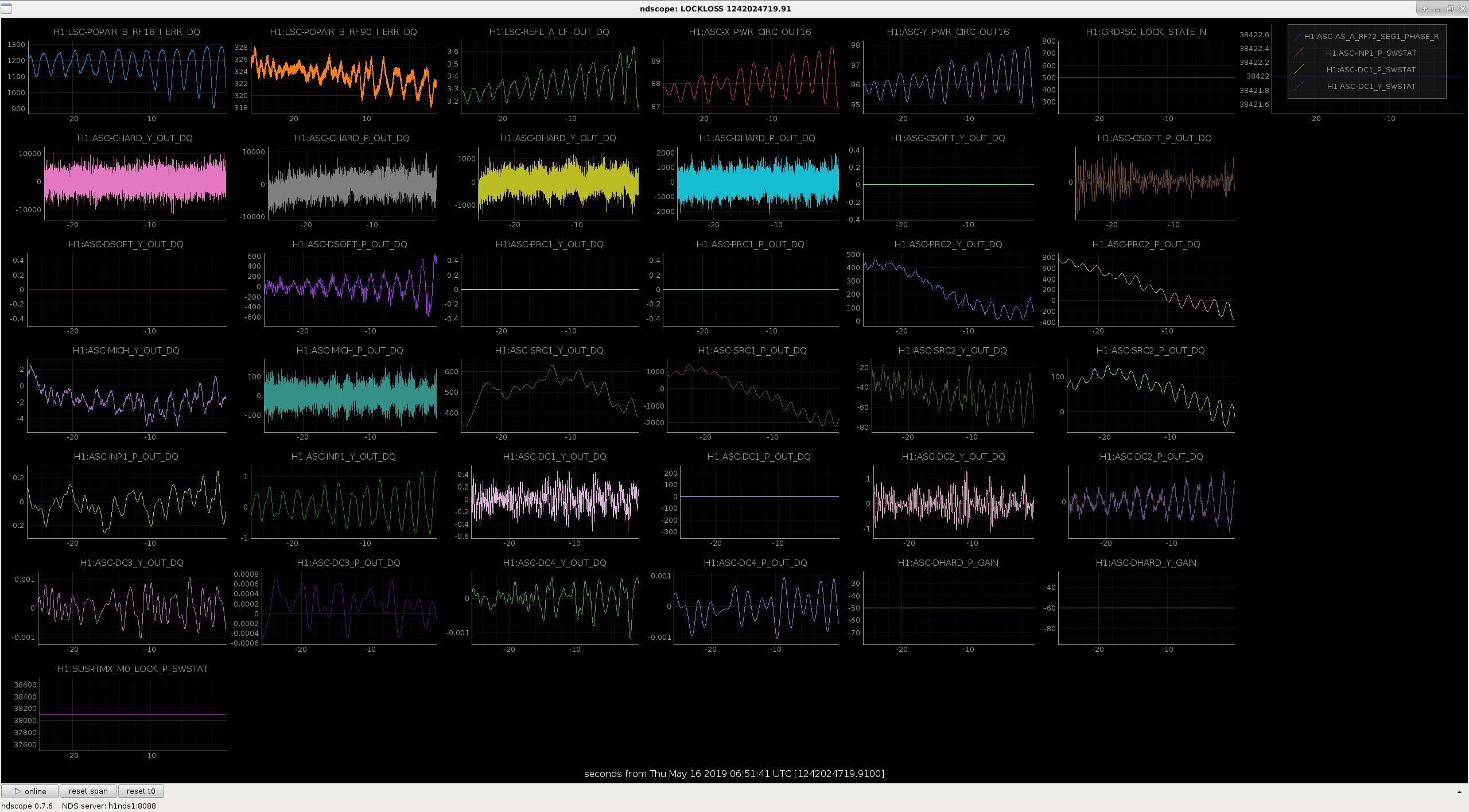
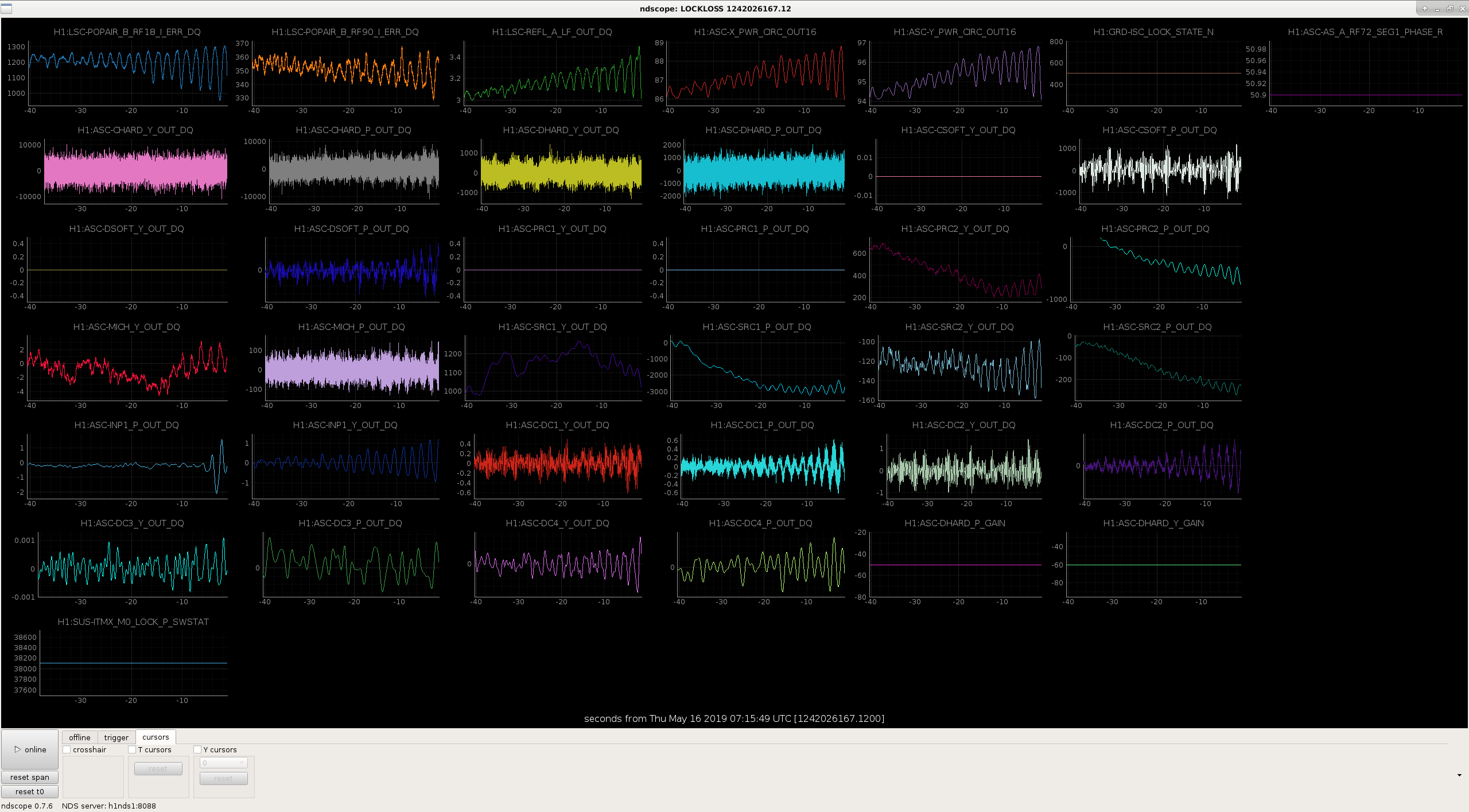
This Keita and I picked up where Georgia and Cheryl left off last night, 49273. We looked at 4 locklosses where there was a large 0.5 Hz oscillation in INP1 Y, DSOFT P, PRC2 P+Y, SRC2P and DC2 (REFL) P when the circulating power reached about 90kW in each arm. Screenshots of each of these locklosses are attached in chronological order, in each case INP1 Y seems to be the largest and earliest thing to run away. Georgia changed the configuration in each power up attempt, as she wrote in the alog.
4:41 UTC: REFL centering loops have notches for pitch, but not yaw. New AS72 phases from yesterday earlier in the evening, and INP1 P gain increased by 20dB from it's normal gain.
5:07 UTC: REFL centering loops have notches for pitch, but not yaw. New AS72 phases from yesterday earlier in the evening, and INP1 P gain at its nominal gain.
6:51 UTC: REFL centering loops have 0.5 Hz notches for pitch, and yaw notches added. New AS72 phases from yesterday earlier in the evening, and INP1 P gain increased by 20dB from it's normal gain.
7:15 UTC: REFL centering loops have 0.5 Hz notches for pitch, and yaw notches added. New AS72 phases reverted to old settings, and INP1 P gain increased by 20dB from it's normal gain.
This morning Corey locked the IFO, and rode out an earthquake that peaked at around 0.2 um/second in earthquake mode. After the earthquake passed I checked that the AS72 phases were really giving us an alignment that minimized the POP90 build ups once the arm dither loops were on (we tuned the phases last night before engaging the arm dithers). I then tried to revert to the configuration that we were able to power up with a few times yesterday, INP1 gain low, notches on in pit refl centering loops but not yaw. When I tried to revert the AS72 phases, the POP90 build up got worse and we lost lock suddenly (similar to the locklosses that were making it difficult to get to DC readout yesterday.).
In the next lock we turned off all the 0.5Hz notches in REFL centering loops, and manually reduced the gain of INP1 P back to its nominal after the ASC was engaged, keeping the new AS72 phasing. We saw no oscillations at all with that configuration, and that is how we are currently locked. We looked at the measurements of the refl centering loops taken last week when we were having 2 minute yaw oscillations 49160. While we had the slow oscillations the REFL centering loops weren't suppressing their error signals in yaw well, so after we turned off the notches we also added a boost. The loop is probably only marginally stable with both the boost and the notch on, although it should be stable with either one alone on. We are leaving the boost on and the notch off for now.
Summary of difficulties since Tuesday:
On Tuesday we started to have difficulty with locklosses when engaging the ASC after we came back from maintenance, clearly something had changed since turning the loops on was decreasing our build ups, although turning the dither loops on helped bring them back. We thought that this could be an issue with our initial alignment references, in part because of the move of TMSY M3. Since we haven't reset the green references since before moving the spot positions at the end of the ER, we decided to reset the green references 49245 We had lots of trouble acquiring lock with the spot positions set to be close to their full lock positions, loosing lock in the CARM transitions and transitioning DRMI to POP. It may be that we cannot have our spots as far off center before we engage the ASC as we have them in full lock now. This took us a few hours, after we reverted the references we were again able to lock, but continued to have difficulty engaging the ASC.
We were in this state were we were able to survive the ASC engagement maybe in every 3rd attempt from late Tuesday until yesterday evening, which has cost us a lot of time. We lost lock once on Tuesday because of a 0.5Hz pitch instability as we attempted to increase power, the next time we were able to attempt that the oscillation started and we engaged the pitch REFL centering loops 0.5Hz notches, which we had removed uneventfully last Thursday 49160. Since engaging them made the oscillation stop and allowed us to power up, we left them on. That lock was the one that gave us a few hours of observing time late Tuesday and early Wed.
Early Wed morning Cheryl had a lockloss caused by the glitch problems of the MC1 or MC3 osems, 49280. This also caused us one more lockloss on Wed, because of the existing alignment problems it took us a lot of time to recover from these on Wed. We made three attempts to increase the laser power on Wed, the first we lost lock because of an osem glitch, and the next two we lost lock because of a problem with the ASC that seems to start when we reduce the 9MHz modulation depth at 40W input power.
Yesterday afternoon we restored the TMS M3 pico according to it's counter (because we thought that a change in initial alignment references could be responsible for our difficulties) , but this didn't make much of a difference in the alignment problems, so we concluded that the issue probably wasn't related to the green references. We then watched which loops were slow to bring their error signals to zero as the ASC gets engaged, and saw INP1, SRC2P and SRC1P were all very slow. We speed up INP1 +SRC2P, but still had locklosses engaging the soft loops. After that Georgia and I phased AS72 WFS. I think that a combination of the changes we made yesterday afternoon are now allowing us to get to DC readout and be stable there better than we were yesterday, I don't see as many locklosses engaging ASC after the time when we made these changes.
However, after this we had the 0.5Hz instability problems when power up. The guardian is now set up to relock with the INP1 P gain increased, we think this should be good because the INP1P loop was incredibly slow (taking ~10 minutes to converge) without it. The notches in REFL centering are off, and will stay off unless someone manually turn them on.
A note for the next operators to lock H1:
We are leaving the guardian set up to relock H1 in a state that is slightly different from the one that worked for this lock, because we think that should work better than what we did this time. If all goes well, you will have no problems locking and an SDF DIFF in the ASC OBSERVE file next time H1 is relocked, which is that ASC-INP1_P FM4 is off.
If you do have trouble with an ASC instability (especially a 0.5Hz instability) while increasing the power, it may be that we need to reduce the gain of INP1 P by engaging this filter (H1:ASC-INP1_P FM4) while we power up. You can find the filter by SITEMAP -> ASC- > central_servo_overview, INP1P is in the upper left corner. Once you reach DC readout, you can turn on FM4 which is named -20dB to reduce the gain. It is OK to do this manually until someone has a chance to add it to the guardian if necessary.
Also, for now H1:PSL-ISS_SECONDLOOP_REFERENCE_PN_MTRX_1_4 is 110 and it is accepted in SDF, but it should be nominally 125.
Next time it locks it's changed back to 125 by the guardian, so make sure to accept that.