
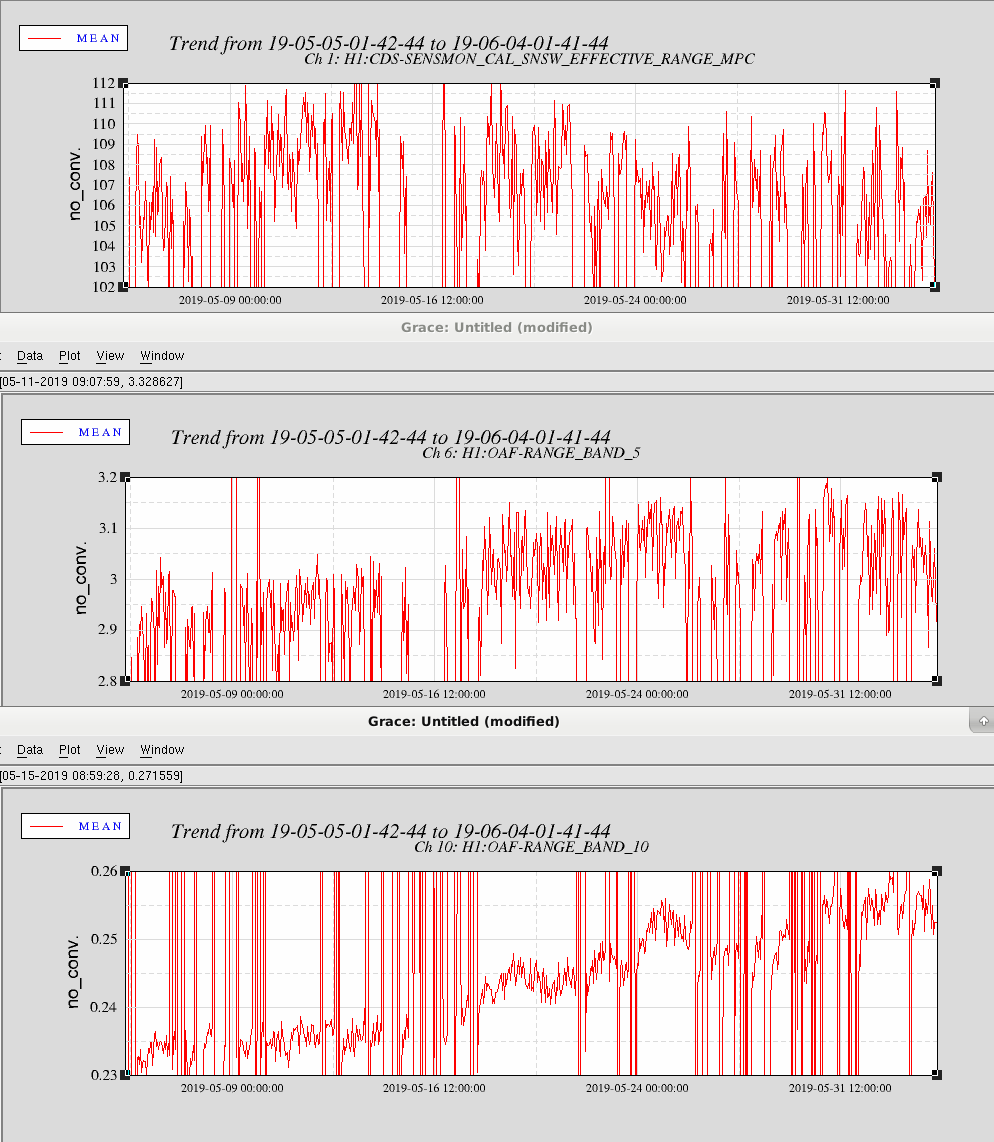
I looked at 30 days of H1 range and the BLRMS channels, and found a clear increase in the frequency range 100-450Hz (H1:OAF-RANGE_BAND_5), and 400-420Hz (H1:OAF-RANGE_BAND_10). I found 6 channels that have a clear decrease, and two channels that are either flat or jump around, making their contribution unclear with this first look.
PLOT 1: Increasing BLRMS:
- H1:OAF-RANGE_RLP_5_OUTPUT, 100-450Hz
- H1:OAF-RANGE_RLP_10_OUTPUT, 400-420Hz* (both RLP_9 and RLP_10 show 400-420Hz on the main medm)
PLOT 2: decreasing BLRMS:
- H1:OAF-RANGE_RLP_1_OUTPUT, 10-20Hz
- H1:OAF-RANGE_RLP_2_OUTPUT, 20-29Hz
- H1:OAF-RANGE_RLP_3_OUTPUT, 38-60Hz
- H1:OAF-RANGE_RLP_7_OUTPUT, 1K-2KHz
- H1:OAF-RANGE_RLP_9_OUTPUT, 400-420Hz* (both RLP_9 and RLP_10 show 400-420Hz on the main medm)
PLOT 3: flat/variable BLRMS:
- H1:OAF-RANGE_RLP_4_OUTPUT, 60-100Hz
- H1:OAF-RANGE_RLP_6_OUTPUT, 530-980Hz

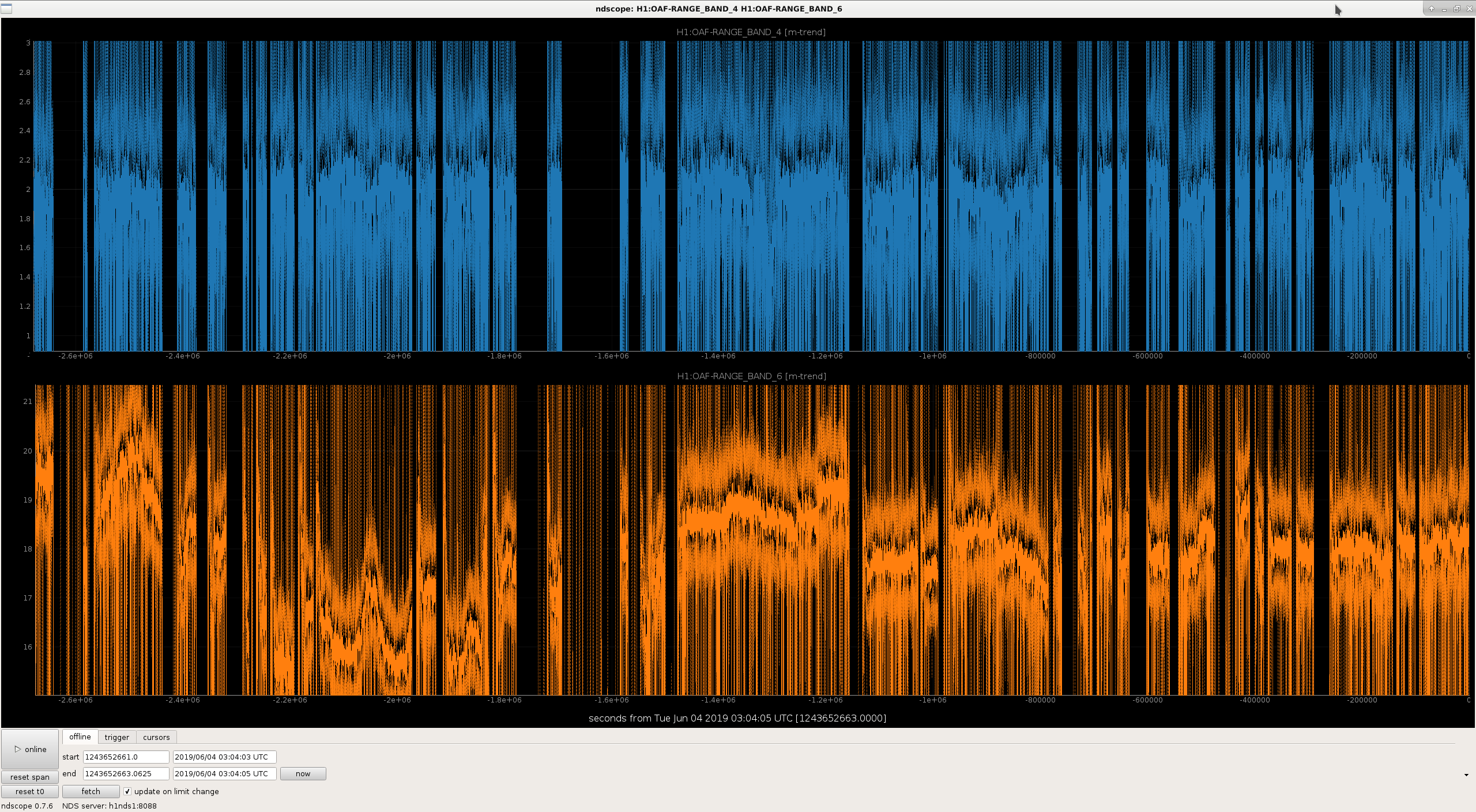
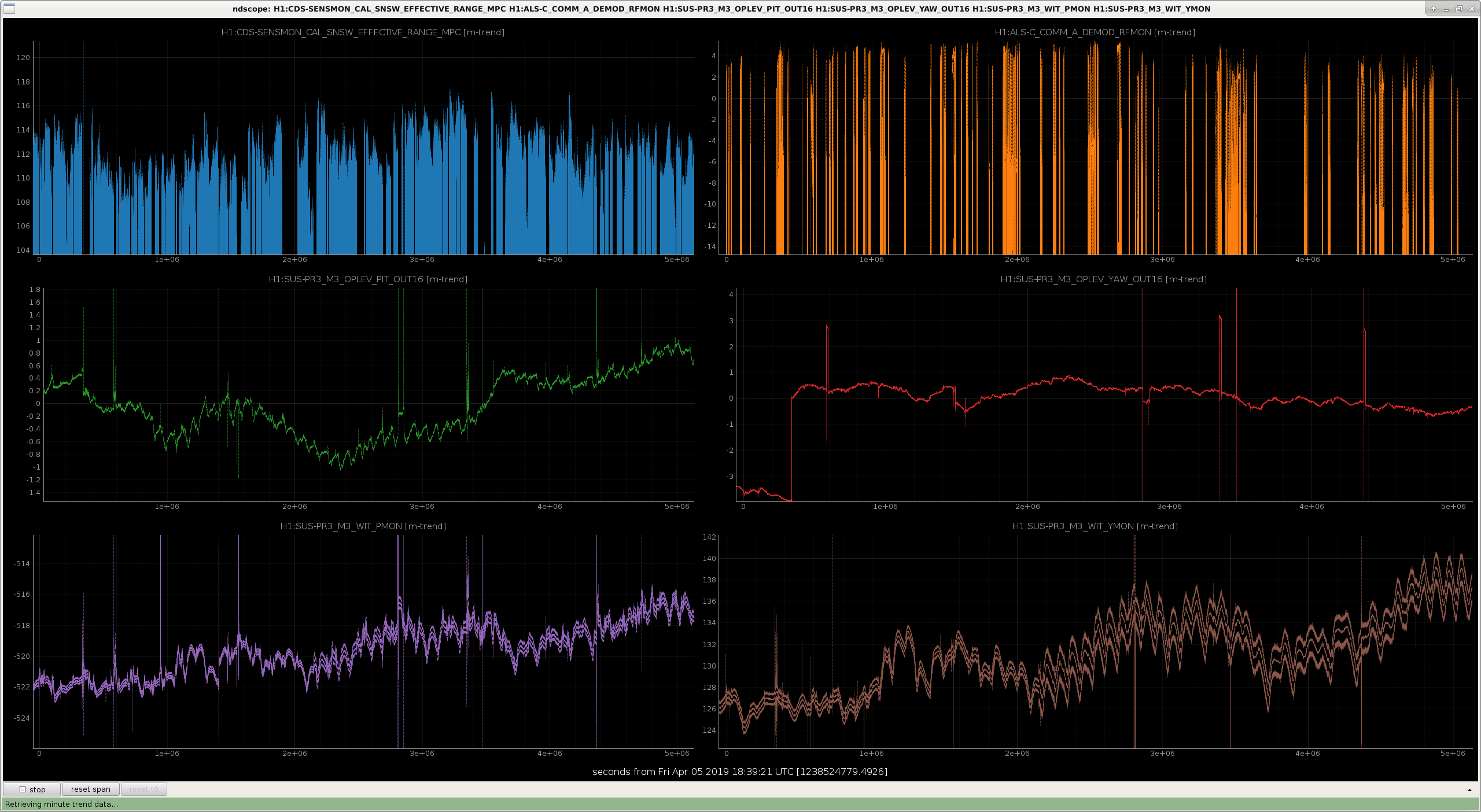
Another thing that I thought of was PR3 potential drift, since the COMM beatnote looks like it's been getting a little lower over time.
In the attached plot I have the range as well as the COMM beatnote on the top row, and then the PR3 oplev and PR3 osems on the lower two rows. The beatnote trace in orange is nearly impossible to interpret since the beatnote changes with alignment, and I haven't taken the time to plot only times when we're actually aligned, so nevermind. But, the oplev and osems don't seem to show any dramatic drift (good, and expected that PR3 shouldn't really move a lot), and certainly they don't seem to correlate with the overall shape of the range.
@DetChar: Isn't this the kind of study for which LASSO was designed? My impression is that LASSO would do this more rigorously, providing mathematically confirmed correlation (as opposed to "by eye"). I understand that there's a LASSO summary page (e.g. LASSO:20190603), but as is often the case, we're interested in trends over much longer time-scales than a single day...