jeffrey.kissel@LIGO.ORG - posted 15:09, Wednesday 12 June 2019 - last comment - 17:47, Wednesday 12 June 2019(49857)
Calibration Measurements Today: Sensing Function Sweeps and Broad Band Injections measured with PCALX and PCALY
C. Gray, J. Kissel

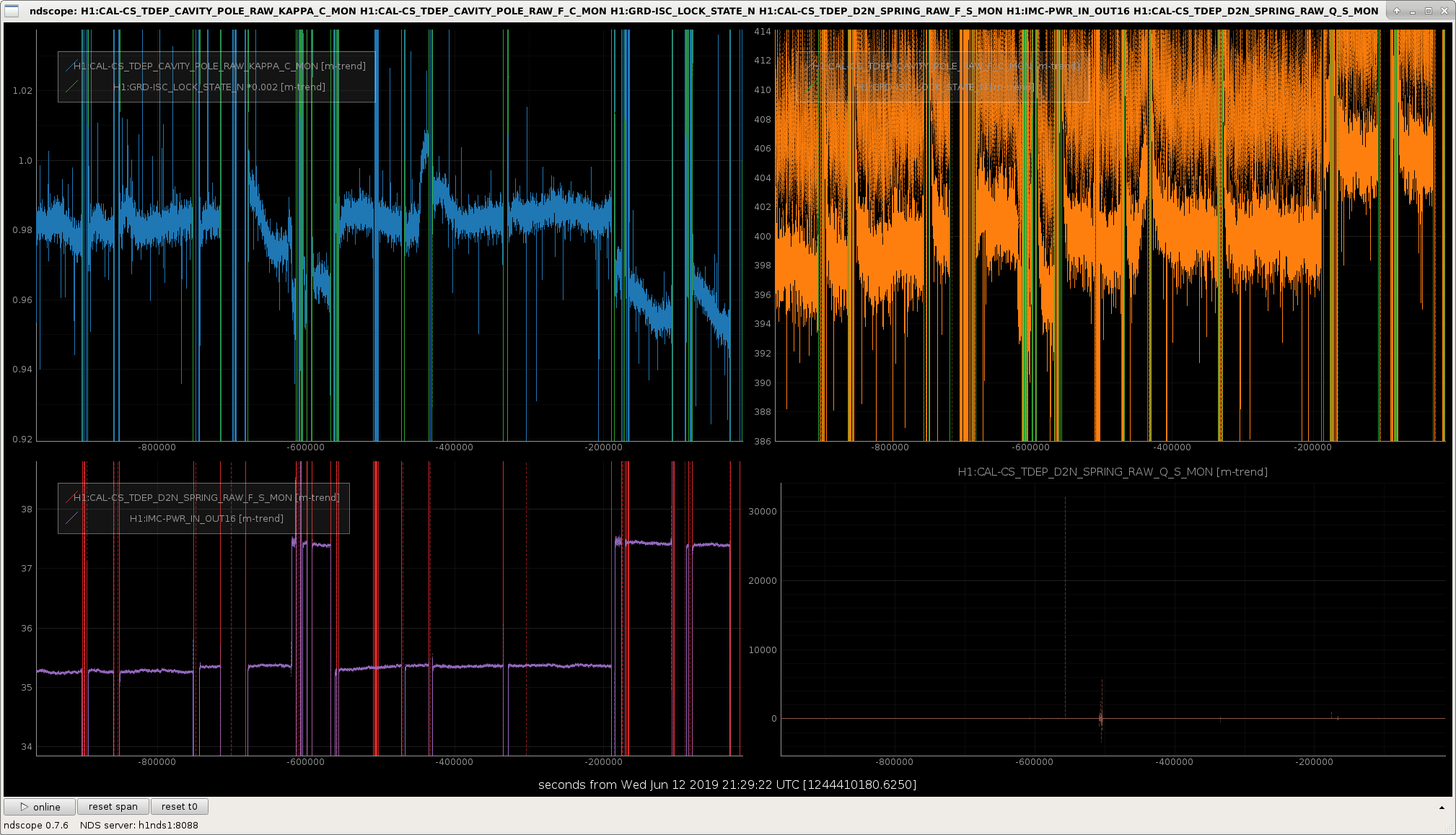
With Corey's help, we gathered regular calibration measurements of the sensing function today. This is the second sensing function measurement since we've (now permanently) powered up from ~35 W to ~37 W input into the IFO (see LHO aLOG 49783). Time dependent correction factors for the optical plant have shown a corresponding change -- namely that the optical gain has dropped from 0.98 to 0.96 the reference time w.r.t. to the optical gain at the reference time. The cavity pole appears to have improved a bit, changing from ~400 to 406, though this may have more to do with spot position change that corresponded to the power up than the power-up itself. (Both of these, compared against the input laser power, are shown in the attached ~1 week trend. Where the data is noisy, we are not observing, so mentally filter those out when you read the plot.)

Also, to continue the investigation as to whether the apparent acausality of detuned spring frequency response is nonsense or not (i.e. if its a result of L2A2L coupling in the actuator, rather than anything representative of what's really happening the with sensing function), we took the standard sensing function measurement set, a DARM OLG TF and a PCAL to DARM_IN1 sweep. But -- we gathered the PCAL sweep both with what we've been using as reference -- PCAL Y -- and also a sweep with PCAL X. The idea being, that if the PCAL spots are differently centered with respect to the IFO beam between the two PCAL excitations, the reported interferometer response may be different. This is not as good, but necessarily easier than moving the interferometer spot positions. For future analysis, it should be known that the A2L_SPOT position gains are identical for EX and EY, corresponding to a physical offsets of -16 mm in PIT (down, -Vertical) and 13 mm in YAW (in the +Trans direction).

Today's data was gathered by Corey, using instructions from LHO aLOG 49165, and he's saved those standard measurements are here:
/ligo/svncommon/CalSVN/aligocalibration/trunk/Runs/O3/H1/Measurements/FullIFOSensingTFs/
    2019-06-12_H1_DARM_OLGTF_LF_SS_5to1100Hz_15min.xml      # 1 / (1+G)
    2019-06-12_H1_PCALY2DARMTF_LF_SS_5t1100Hz_10min.xml     # C / (1+G) as measured by PCAL Y

The bonus measurements I grabbed are as follows:
    2019-06-12_H1_OMCDCPDSUM_to_DARMIN1.xml   # For converting from DARM_IN1 counts to mA on the DCPDs (roughly)
    2019-06-12_H1_PCALY2DARMTF_BB.xml         # For comparison with GDS

    2019-06-12_H1_PCALX2DARMTF_LF_SS_5t1100Hz_10min.xml     # C / (1+G) as measured by PCAL X
    2019-06-12_H1_PCALX2DARMTF_BB.xml         # for comparison with GDS

Leading up to today, here are the observation intent / analysis ready segments that are at 37W instead of 35W:
    2019-Jun-06 01:24:34 UTC to 08:16:22 UTC   -=- Brief observation segment at 37 W
    2019-Jun-10 23:55:38 UTC onward            -=- Start of continuous operation at 37 W

Note that we don't simply increase the laser power -- we also tune the angular and thermal control systems to account to compensate for this new amount of power in the IFO. Although we do not need to make any explicit changes to the DARM control loop, there will be cross-couplings and frequency response changes -- especially in the sensing function -- that will be impacted by these changes. The most obvious are what's mentioned above -- the 2% change in optical gain, and the slight increase in cavity pole frequency. In real time, we're sort of flying blind regarding the detuned SRC optical spring frequency, but analysis of these measurements should hopefully reveal interesting changes there as well.

Data processing and analysis to come.
Images attached to this report
Comments related to this report
To convert A2L_SPOT gains, e.g. H1:SUS-ETMX_L2_DRIVEALIGN_P2L_SPOT_GAIN, in to physical position, use the following simple matlab script
    /opt/rtcds/userapps/release/isc/common/scripts/decoup/BeamPosition/a2l_lookup.m
Time line of measurements for later comparison of broad band injections against GDS (all times on 2019-06-12 and UTC):
    20:01:03     DARM OLGTF
    20:17:07     PCAL Y SS
    20:28:28     PCAL Y BB
    20:30:33     PCAL X SS
    20:41:34     PCAL X BB
    20:44:38     Nominal Low Noise
    20:57:00     calibration done, commissioning starts.