evan.goetz@LIGO.ORG - posted 18:38, Monday 24 June 2019 (50156)
Possibly some H1 spectral lines due to HAM6 ISI motion; more investigation needed
Sheila asked if any of the H1 spectral lines below 100 Hz could be due to motion of HAM6 ISI (see LHO aLOG 50098, and LLO aLOG 46603). It's not enough to ask "are any lines coincident" because they could be just that, coincidence. A better measure is coherence because then one can make a more convincing argument.

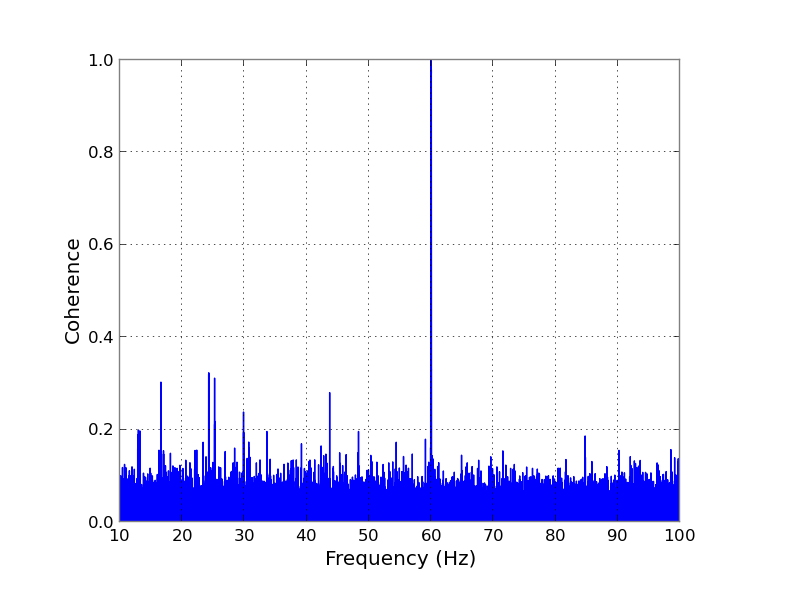
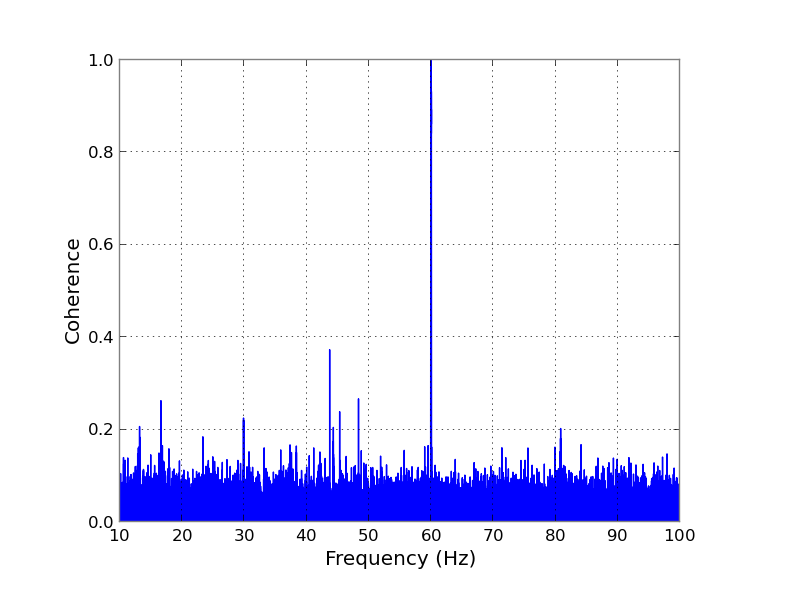
I took a recent 17+ hour lock stretch from June 15, 2019, and measured coherence between H1:GDS-CALIB_STRAIN and the channels H1:ISI-HAM6_BLND_GS13X_IN1_DQ, H1:ISI-HAM6_BLND_GS13Y_IN1_DQ, H1:ISI-HAM6_BLND_GS13Z_IN1_DQ, H1:ISI-HAM6_BLND_GS13RX_IN1_DQ, H1:ISI-HAM6_BLND_GS13RY_IN1_DQ, and H1:ISI-HAM6_BLND_GS13RZ_IN1_DQ. The coherence was calculated using GWpy with 1800 s long, 50% overlapping, Hann windowed FFTs. I attach the coherence results below. Long FFTs are used because the spectral artifacts in DARM are weak but clearly exposed with long averaging.

While all figures show coherence at 60 Hz, there are only a few other peaks in each of the degrees of freedom. It's not a convincing argument that a few lines may be caused by HAM6 ISI motion since there are not a lot of other strong peaks aside from 60 Hz. Still, there are some statistically significant peaks worth further investigation and possible mitigation. One caveat: this is just a 17 hour average, so it may be more convincing with increased averaging over many more lock stretches. This is something that should be investigated further.

Figure 1: H1:GDS-CALIB_STRAIN coherence with H1:ISI-HAM6_BLND_GS13X_IN1_DQ
Figure 2: H1:GDS-CALIB_STRAIN coherence with H1:ISI-HAM6_BLND_GS13Y_IN1_DQ
Figure 3: H1:GDS-CALIB_STRAIN coherence with H1:ISI-HAM6_BLND_GS13Z_IN1_DQ
Figure 4: H1:GDS-CALIB_STRAIN coherence with H1:ISI-HAM6_BLND_GS13RX_IN1_DQ
Figure 5: H1:GDS-CALIB_STRAIN coherence with H1:ISI-HAM6_BLND_GS13RY_IN1_DQ
Figure 6: H1:GDS-CALIB_STRAIN coherence with H1:ISI-HAM6_BLND_GS13RZ_IN1_DQ
Images attached to this report