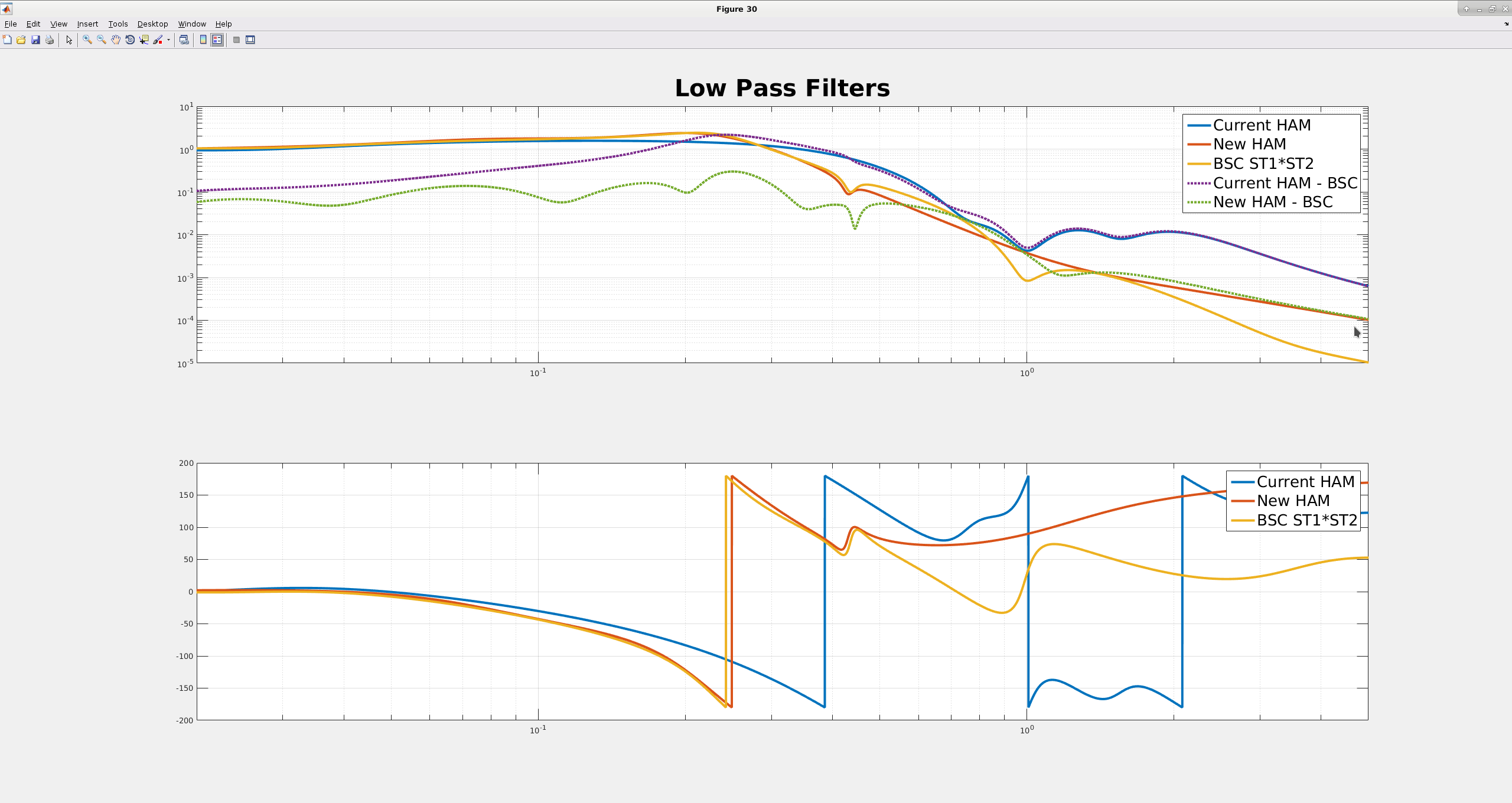
In the SEI log there is a thread about differences in HAM and BSC blend filters creating differential motion between the chambers in the corner. I've tried to come up a new blend for the HAMs to better match their motion to the BSCs by fitting a HAM blend to the product of the BSC ST1 and ST2 blends.
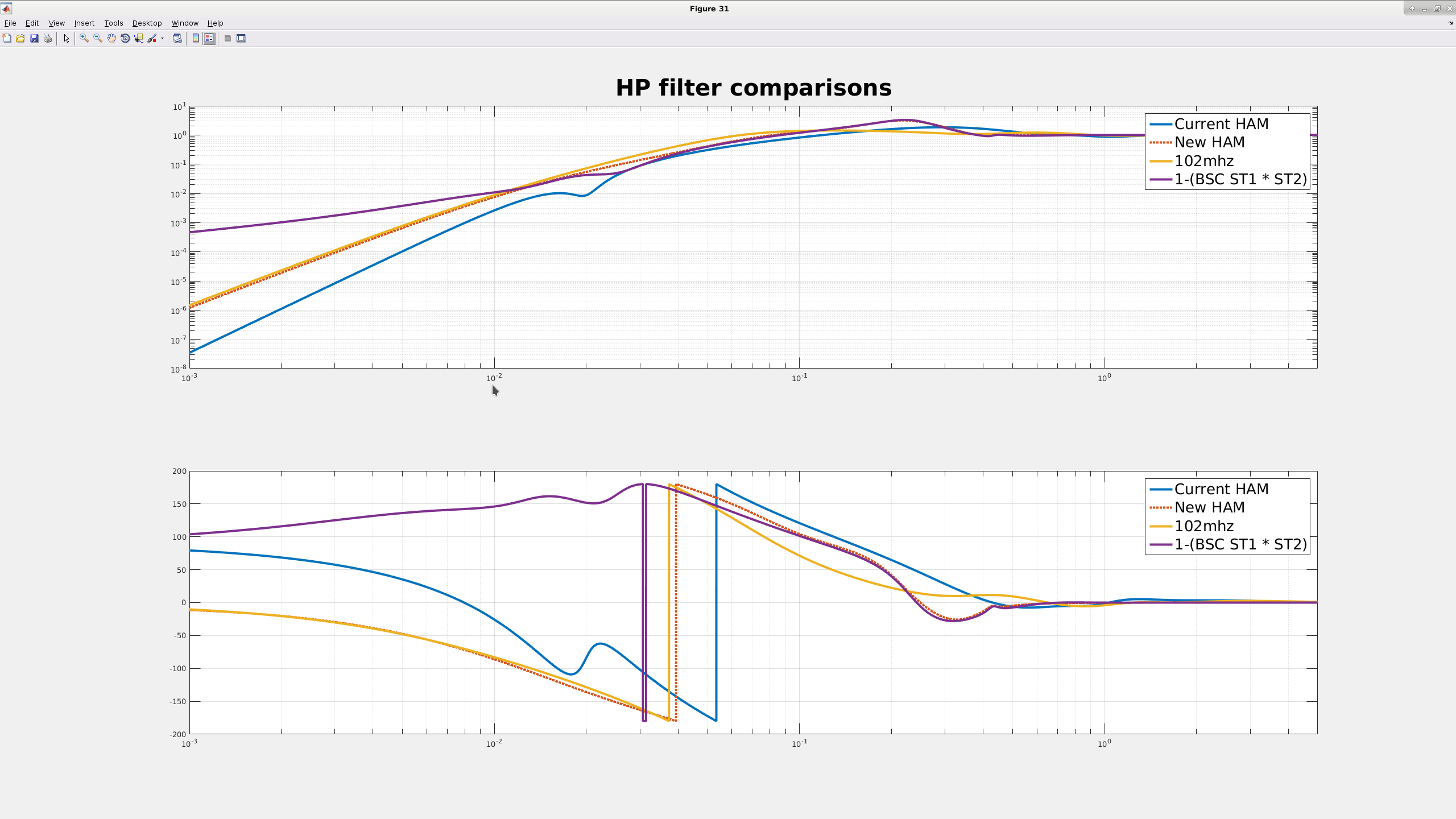
The current HAM blend, my new blend and the product of the BSC ST1 and ST2 blends are compared in the first attached image. The dashed lines are each HAM cps blend - BSC ST1*ST2 cps blend. The new blend has slightly more gain peaking around .2 hz, but rolls off faster above .3 hz, so it should give better absolute isolation. Comparing the dashed lines shows the new blend follows the BSC "total" blend much better below .5 hz. At these frequencies the ground motion is common in the corner, so the close the HAM blend is to the BSC blend, the less differential motion there should be.
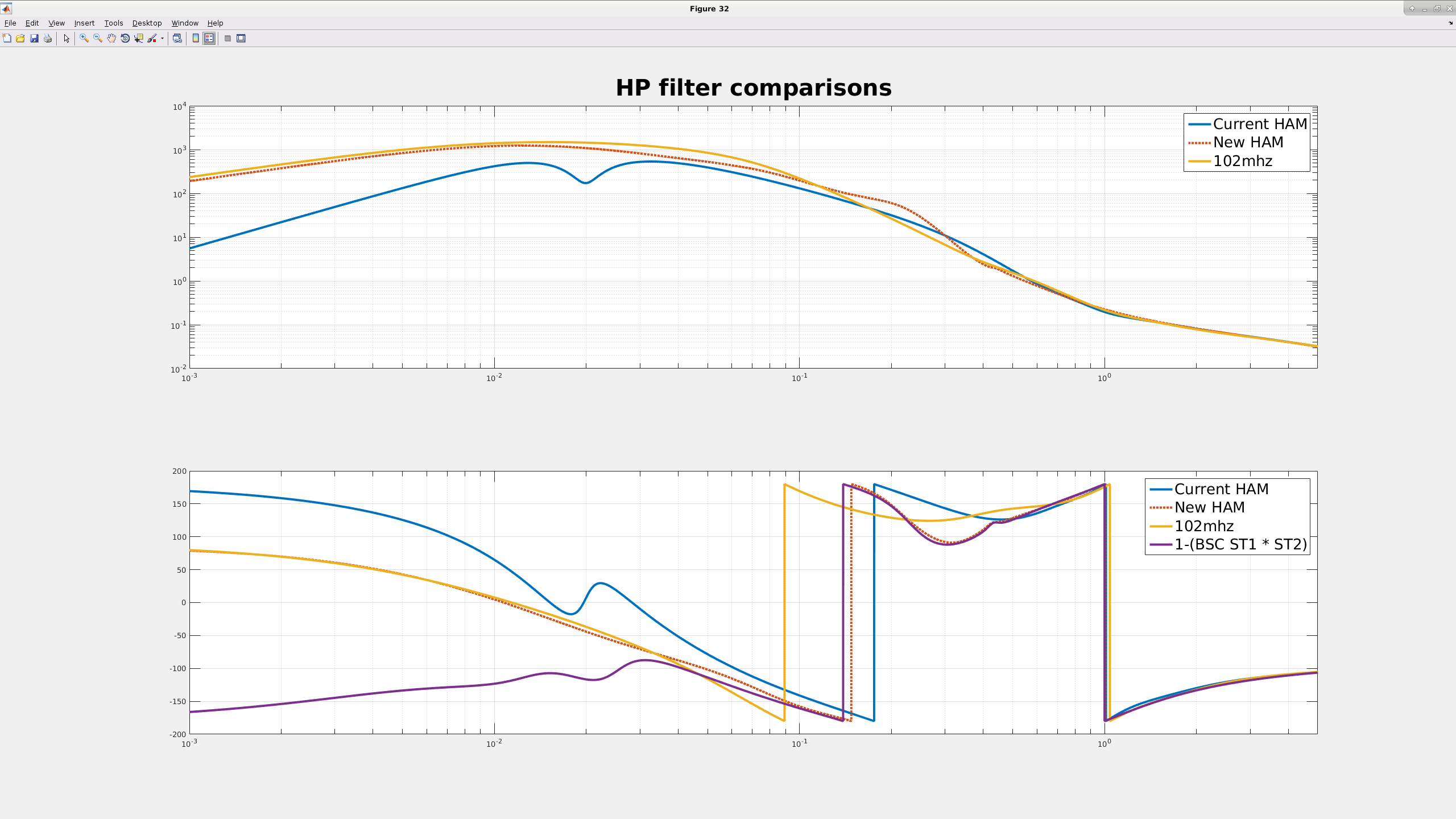
The second image compares the complementary high passes for each HAM filter, which determines how much GS13 noise and tilt gets injected into the table motion. The new blend (dashed) is roughly the same as the current blend below .1hz down to 40mhz, but is worse below that. The gold line is the high pass for a blend that LLO uses during high microseism, which I'm using as an upper limit. It also similar below .1 hz to the complement to the BSC ST1 & ST2 product, but this may not be the right way to compare to the BSC blends. Again, more gain peaking for the new blend around .2 hz.
The last plot compares the "install" high pass filters which have to include the GS13 inversion and integration to get the GS13 signal into nm. Again, the new blend is higher magnitude on than the current blend, but is slightly below the blend LLO uses.
My plan currently is to install these filters, work with TJ on adding HAM blend nodes to SEI_CONF guardian and make a test configuration so it will be easy to test this when it is convenient. Probably need some DRMI time to really test if this helps, but maybe this is something that can be done during a maintenance day.
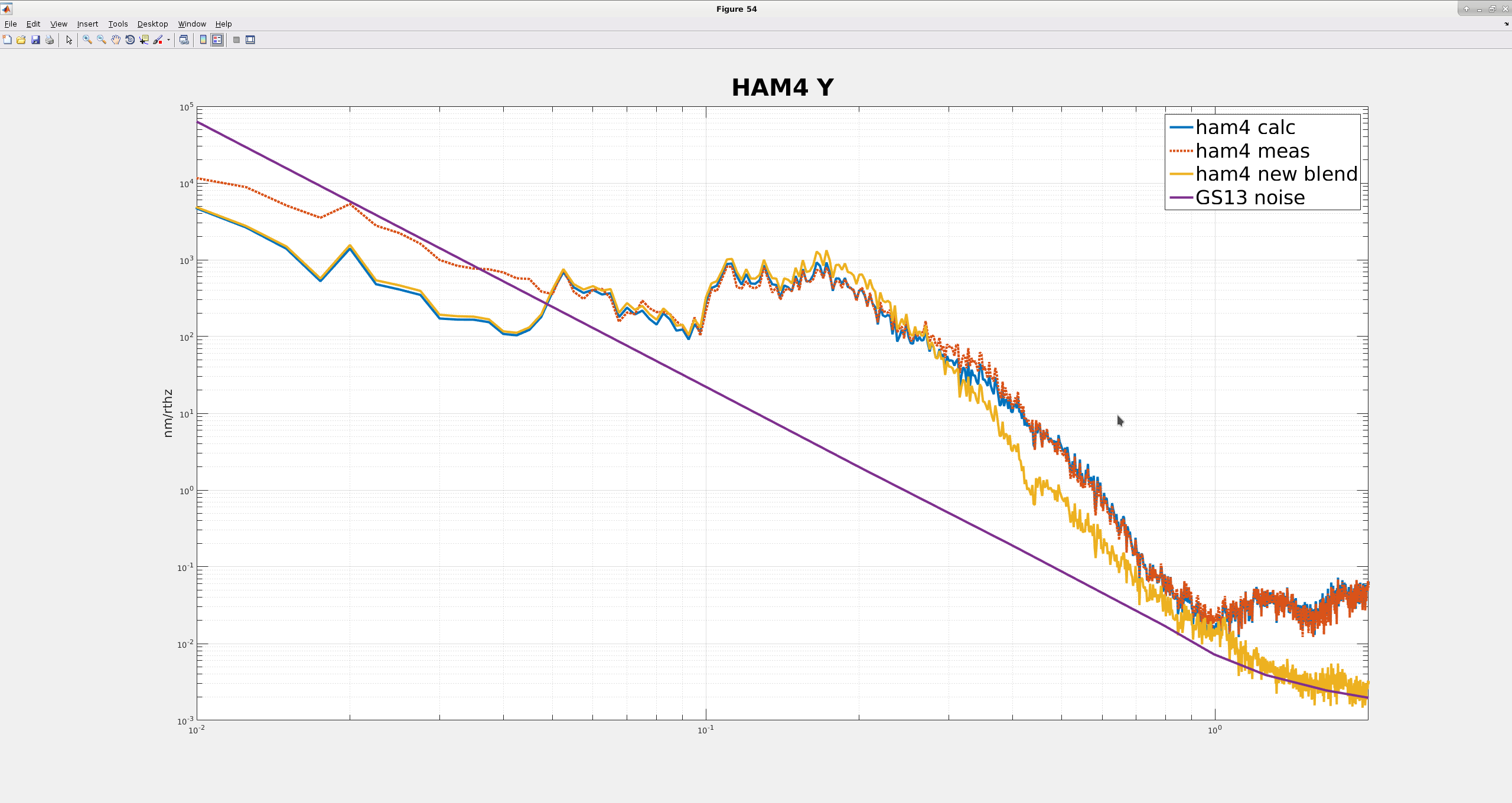
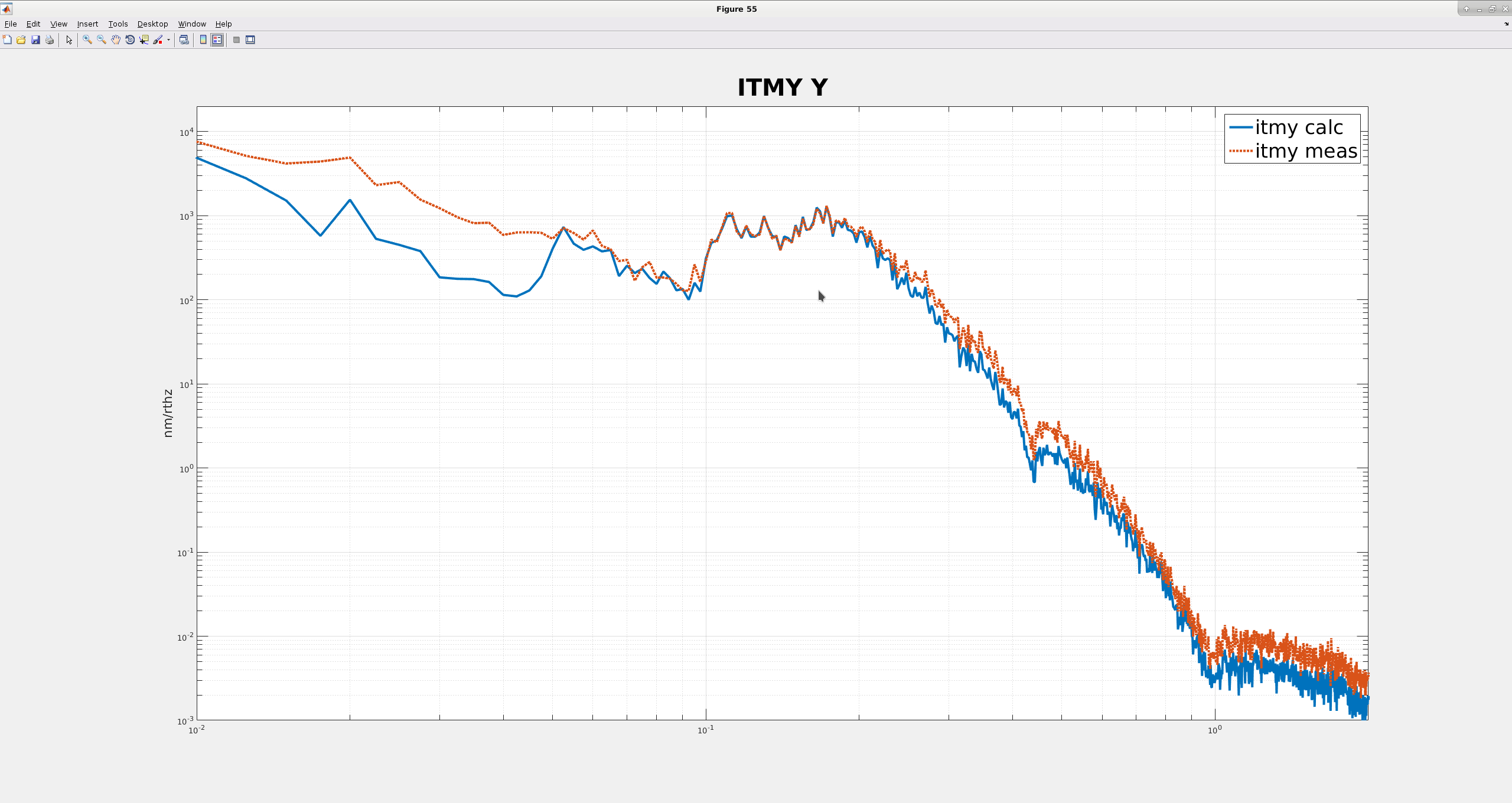
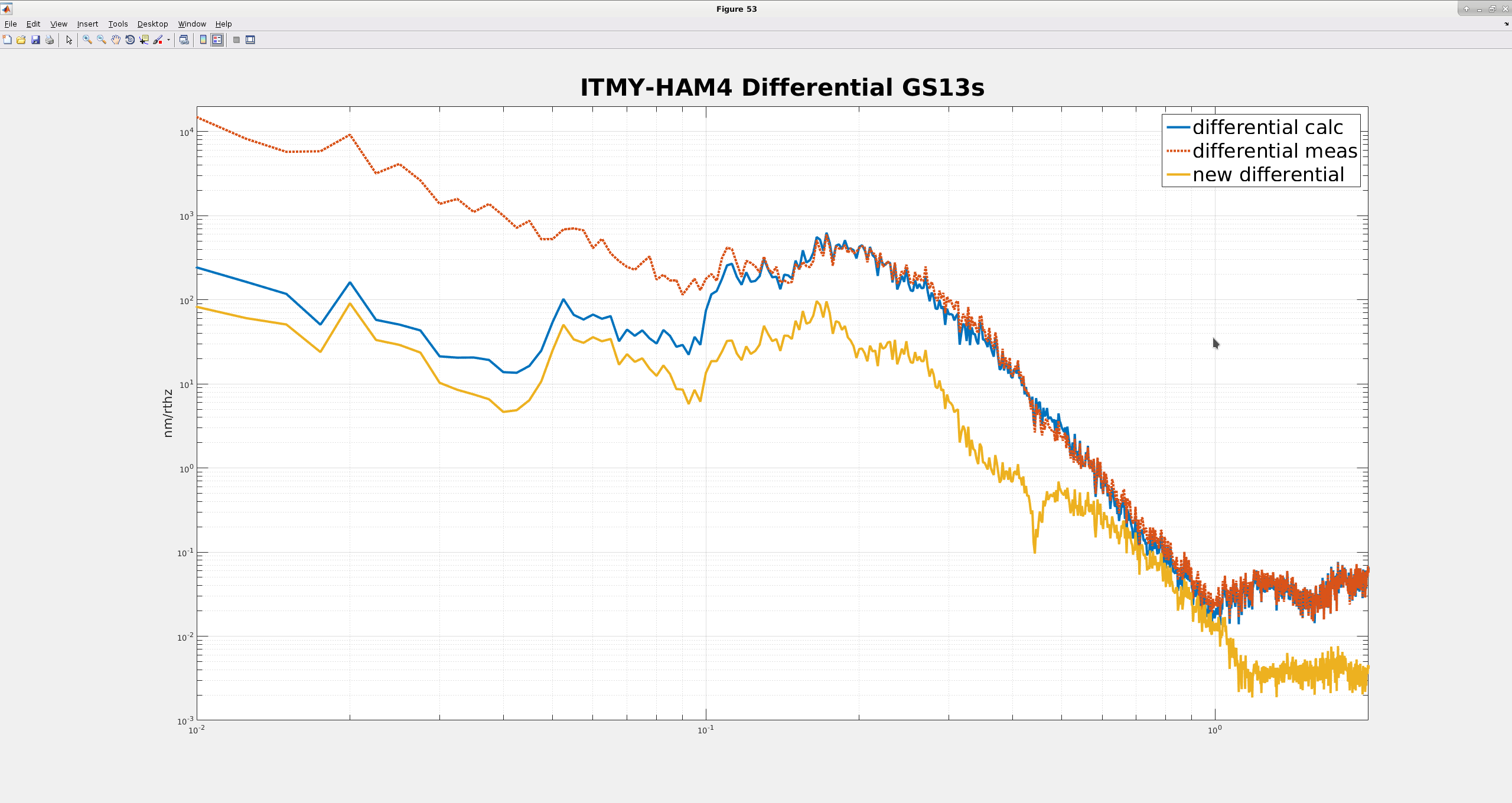
I'm attaching a couple plots of the estimated performance of these blends. I don't include sensor correction in any of these plots as the sensor and filters are common to all chambers, so shouldn't change the results here too much.
The first plot compares the measured motion of the HAM4 ISI in the Y direction during a time when the sensor correction was off to just the current and new lowpasses * the ground. For the current blend this is a pretty good estimate of the GS13 signal, except below .1 hz, which I expect because this won't include platform tilt. Comparing the gold to the blue line, the new blend is slightly worse at ~.2hz, better above .3 hz. This is probably not valid above 1hz, we'll start being limited by loop gain at some point. May also affect the feedforward design for the HAMs.
I've done this for ITMY as well, in the second plot, and it's a little more complicated, but still fairly accurate. No new blend here, so only comparing the measured ST2 GS13 Y (red dashed) motion to the calculated (blue solid) motion on this plot.
The third plot compares the GS13 measured differential between the ITMY St2 Y and HAM4 Y. The red trace is the measured differential motion, blue is the calculated motion and is pretty accurate above .1hz, below that the GS13s are dominated by platform tilt. The gold trace is the calculated differential motion, and looks pretty good, improving the differential motion by about a factor of 5. I don't think we'll get that kind of improvement, mostly because of tilt, but I think this is encouraging. Cavities like SRCL are not just ISI beamline motion, and I'm not proposing any other changes at this point, but if this will make corner ISI motion more common around the microseism, that should be a good improvement.