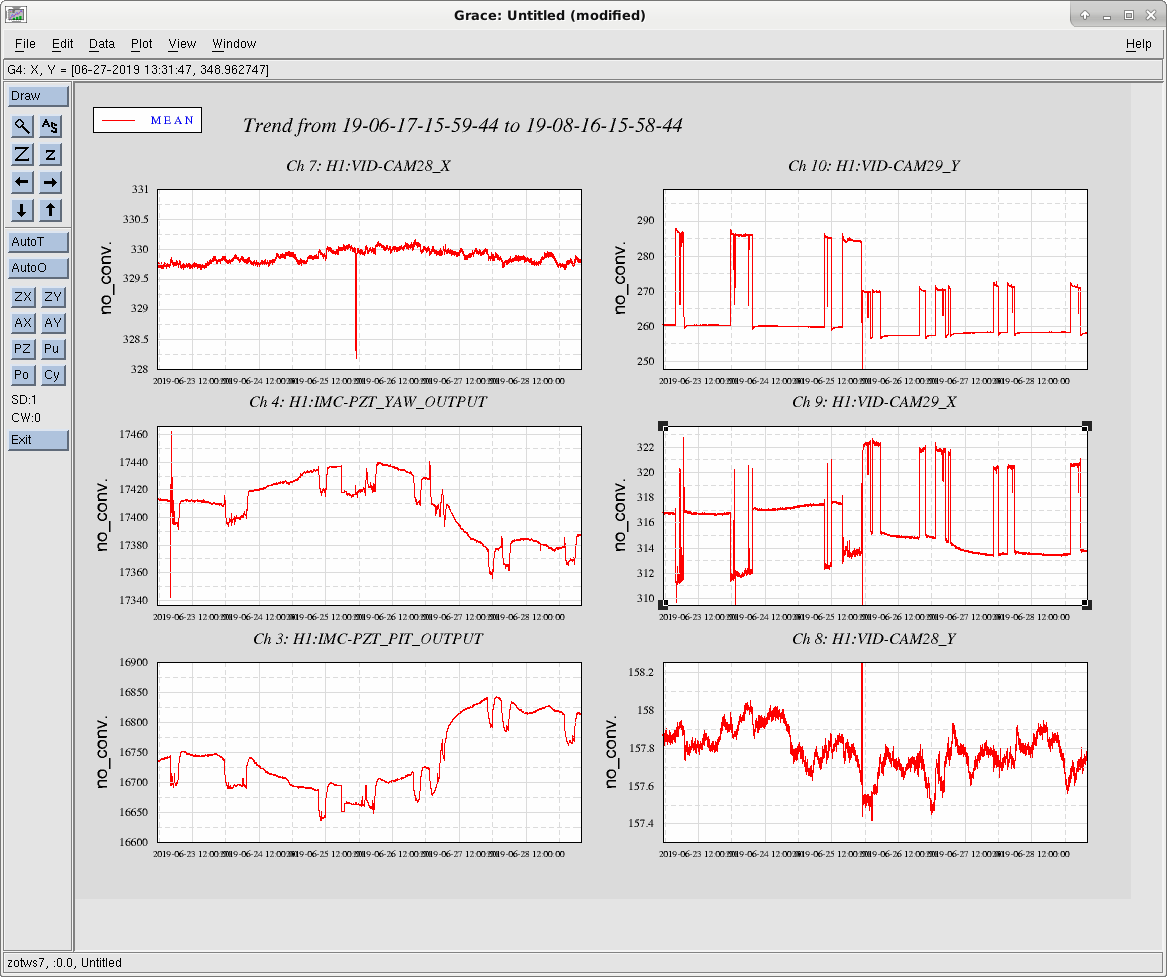
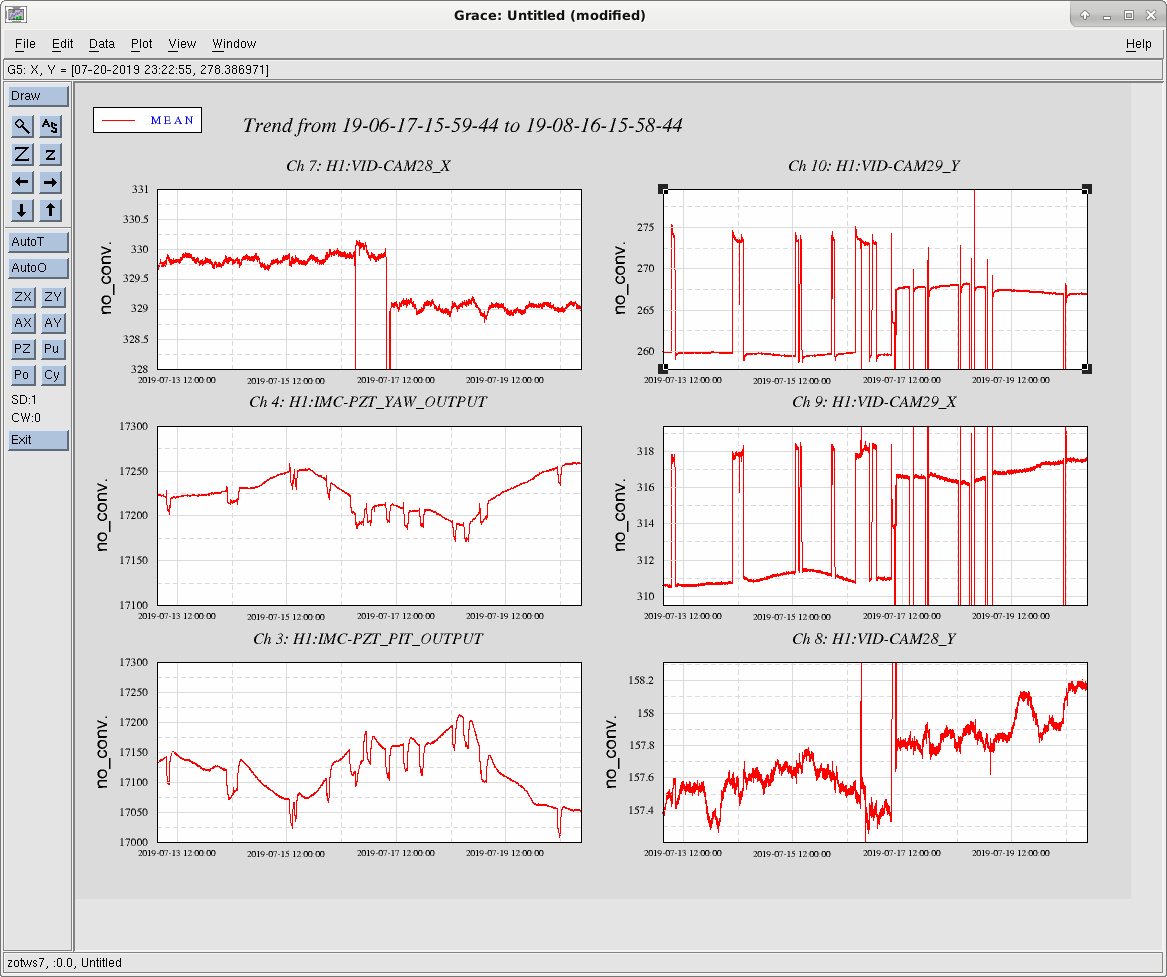
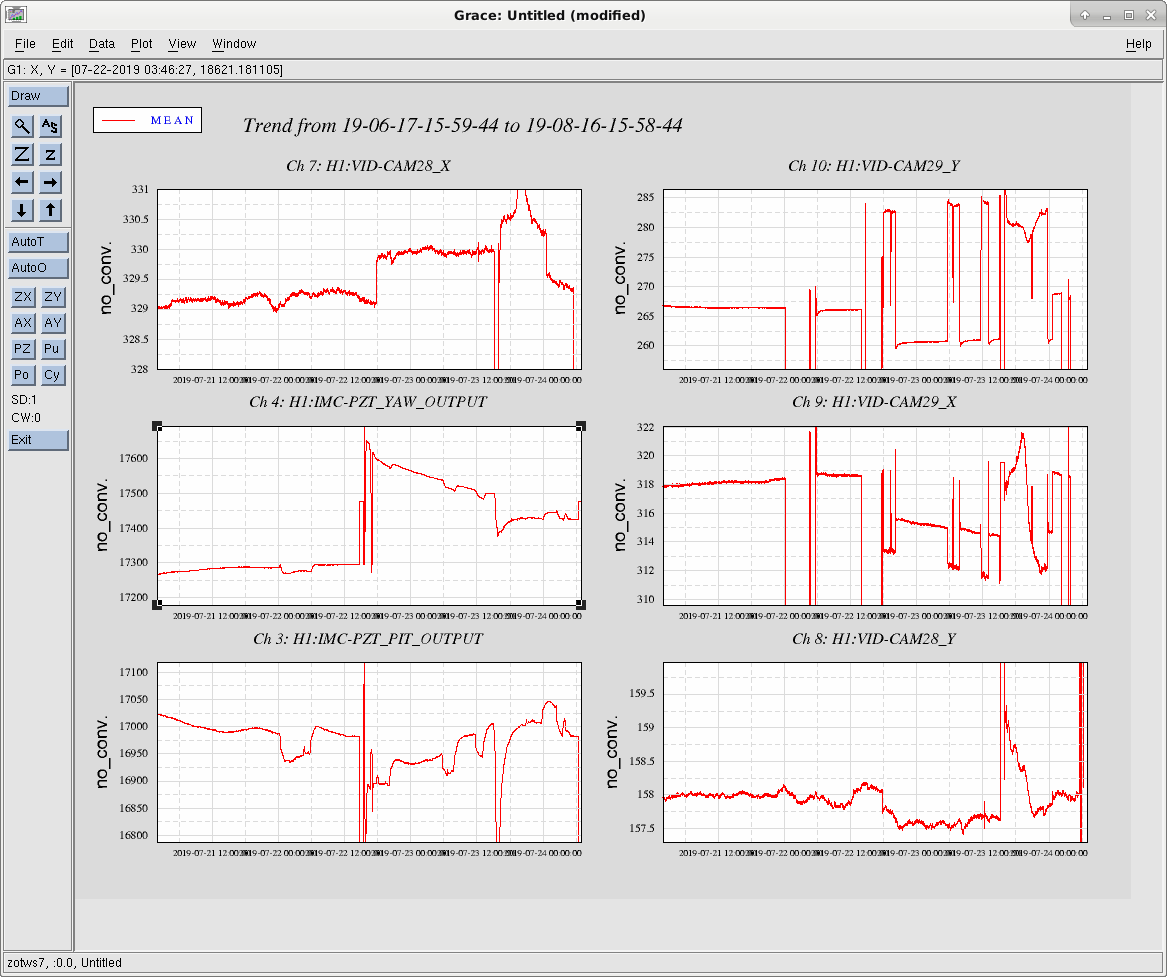
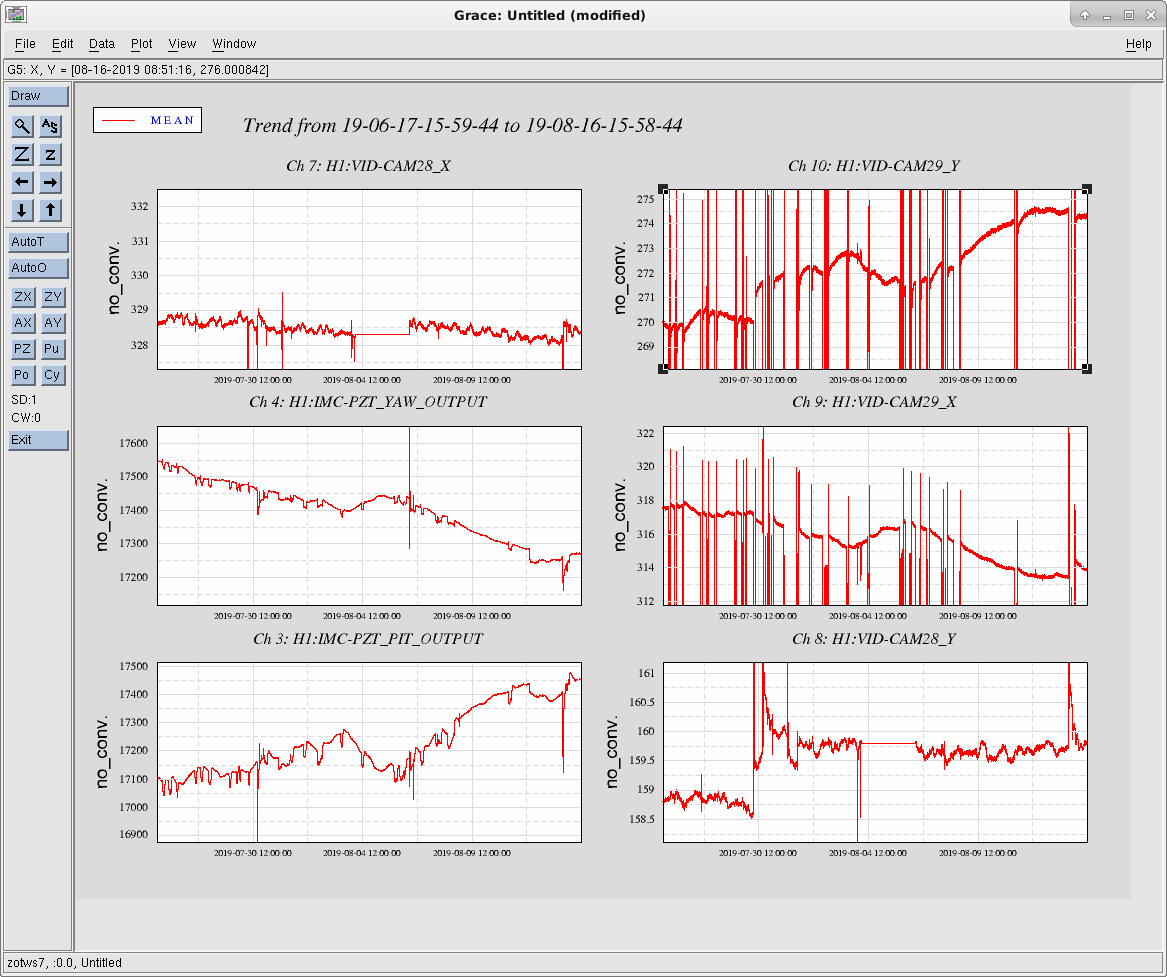
plots of the PZT, Camera 18 (PMC Output), and Camera 29 (IMC_IN), from 15 July 2019 to 16 Aug 2019.
- CAM28 X total change: 330 to 328 = -2
- CAM28 Y total change: 157.8 to 159.7 = +2
- CAM29 X total change: 316 to to 310, then 317 to 314 = -6-3=-9
- CAM29 Y total change: 261 to 274 = +13
So Camera 28 changes with the output of the PMC. In throey this beam should not change, however, the calculated centroid does, which is likely that the centroid of the PMC trans beam changed, however it can't be ruled out that the beam itself also changed.
Camera 29 sees the IMC_IN beam, and it can change with changes of the beam into the EOM, alignment changes of the EOM (who's mount loosesn over time, and it's been over a year since we checked these screws), and changes of the beam after the EOM, which can come from PZT power outages, and manual alignment.
Plots attached in the order of these dates of the changes seen on the PZT, camera 28 and/or camera 29:
- 15 July to 16 Aug: all changes
- 26 June 2019 - Camera 29, X and Y
- 17 July 2019 - Cameras 28 and 29, X and Y
- 22 July 2019 - PZT, Cameras 28 and 29, X and Y
- 23 to 25 July 2019 - PZT, Cameras 28 and 29 in Y
- 30 July 2019- Cameras 28 and 29 in Y


We were having trouble locking with these "new" restored IO pointings, so we reverted them back to the previous lock values.
Don't use the camera trend for comparison purposes when the exposure setting and/or power changed.
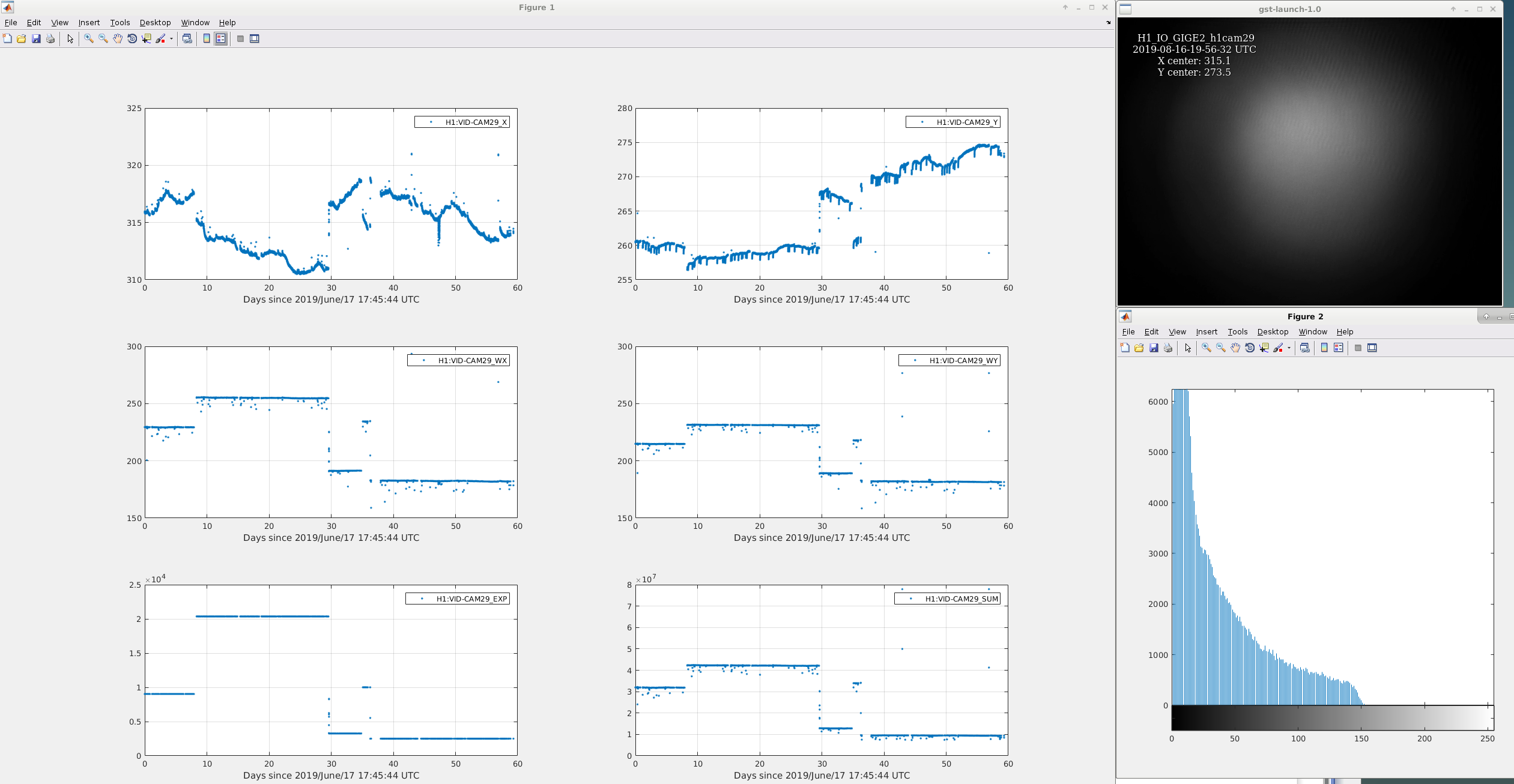
Attached shows the 2-month trend of CAM29 channels. The data are plotted only when IMC_PWR_OUT>30W to avoid confusion.
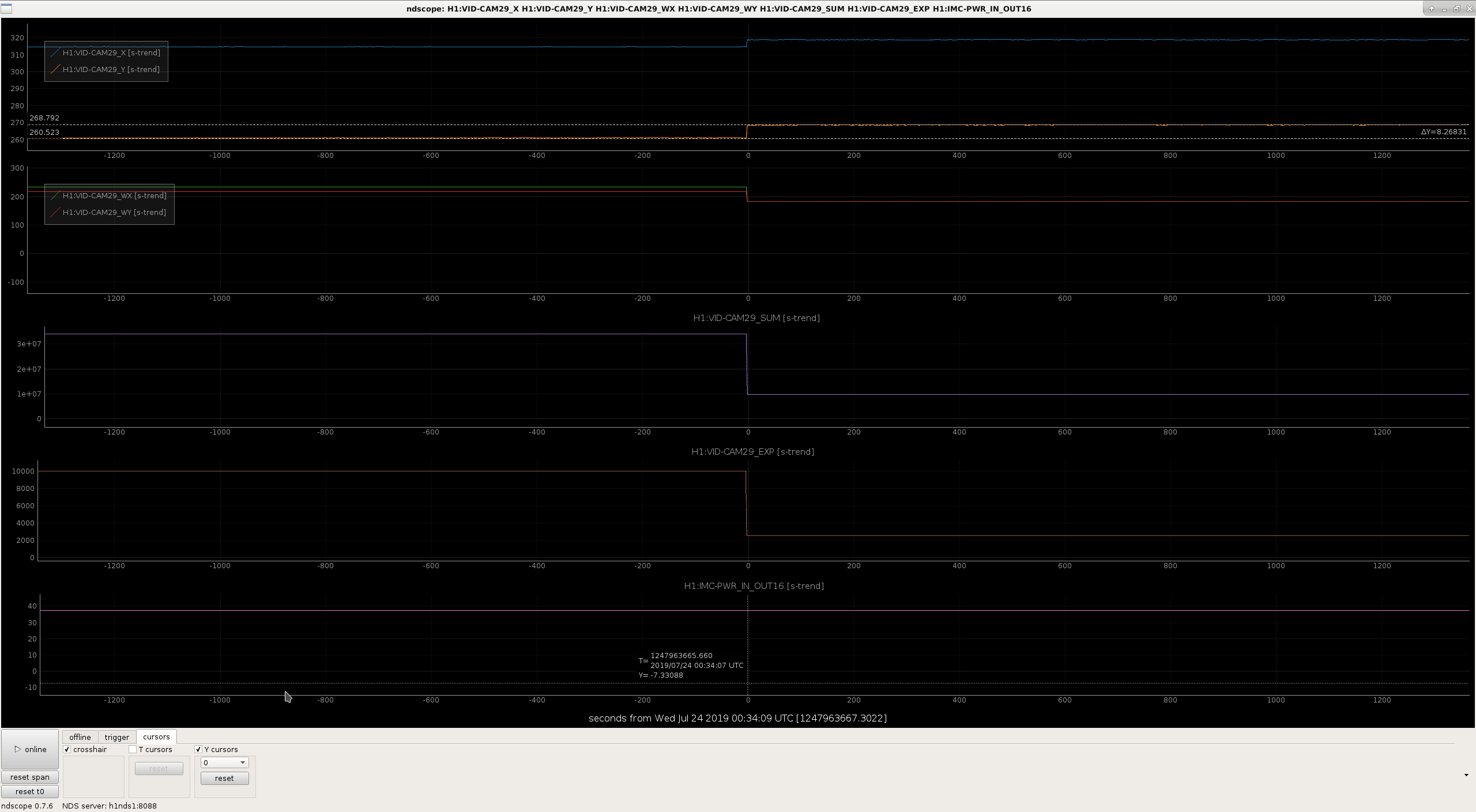
CAM29 X and Y "jumped" for example by [+5.6, +8] pixels on July 17 (~day 29 on the attached, things are plotted only when IMC_PWR_IN>30W to avoid confusion), that's not a physical change, it's an artefact caused by changing the exposure setting of the camera. 2nd attachment shows that the exposure change alone can make this kind of jump when nothing else is going on.
In the first attachment, bottom left is the exposure setting (EXP), bottom right is the sum of all pixels (SUM). At SUM=1E7 nothing really saturates. Video image to the right of the plots was taken at 37W today when SUM was ~9.5E6, the historgram of the image shows that there was no saturation. But 2E7 would already be a serious saturation. Solid white disk with 200 pixels radius gives us SUM=3.3E7.
Looking at how badly this camera was saturated before July 17 and how it's not saturating any more, anything older than July 17 is not really usable for now-then comparison.
In addition, when the beam isn't really dark on the picture at the edge of the camera (aka the beam doesn't fit), even without saturation nor beam motion, the beam position estimate could change when the power and/or exposure setting change. And the beam doesn't fit, look at the image especially at the top edge. So July 17-July 22 data where the EXP was 3264 might be offset compared with post July 24 data where EXP is 2500.