
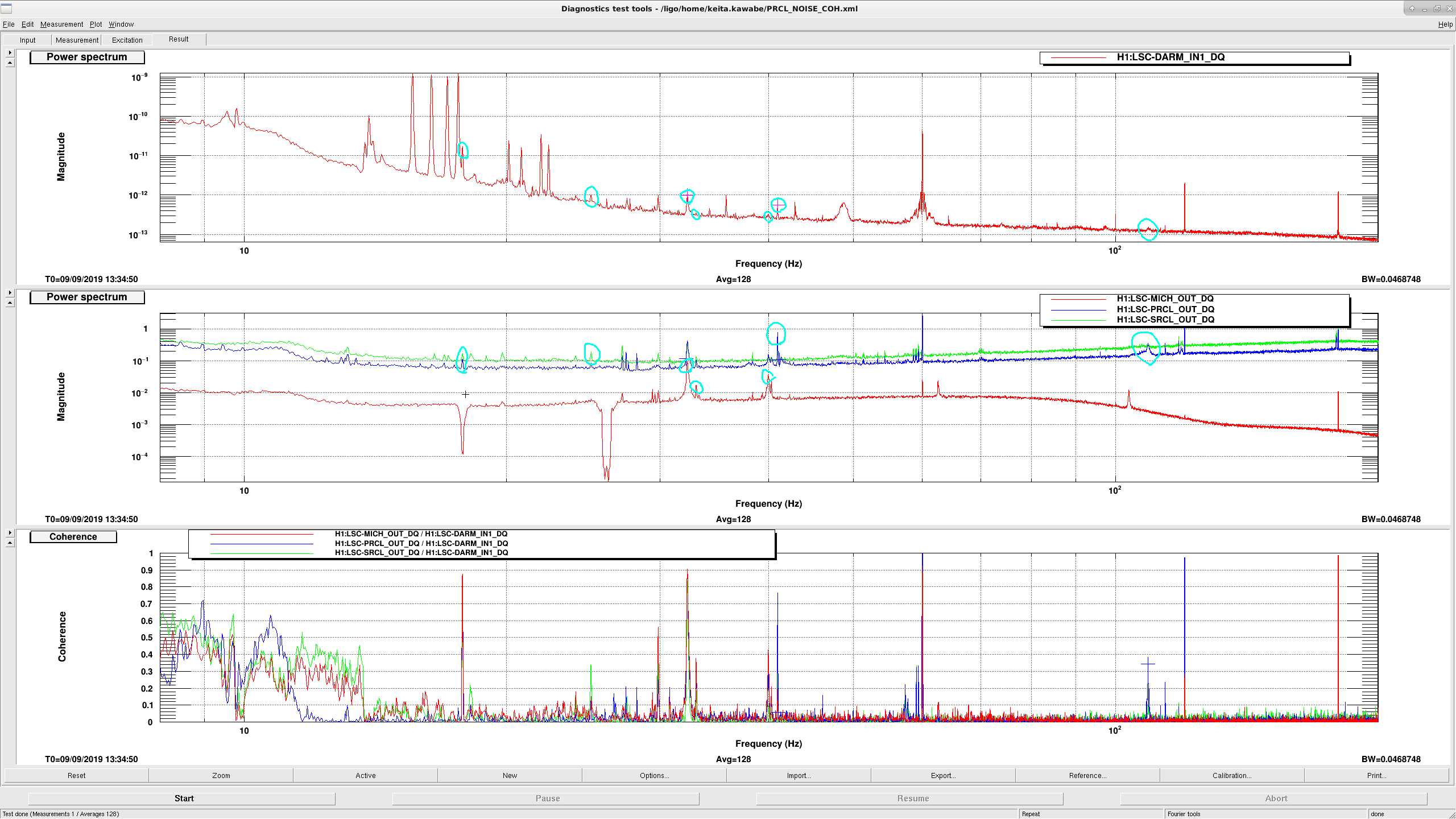
As the attached shows, there are many peaks/bumps in DARM that are highly coherent with LSC auxiliary control outputs. Low frequency behavior is not good either. I used a glitch-free segment of about 2000 seconds in observing. (It's yet to be seen if the noise transfer function would be stable over longer time scale.)
Anyway, this could be improved. Circled in cyan are the ones that look easier than the others.
BS: 17.8Hz, 32.2Hz and a tiny bump right next to it, ~40Hz.
PRCL: 40.9Hz, a tiny bump around 108.9Hz.
SRCL: ~25Hz
All: Behavior for f<15Hz or so is not good and I believe could be improved without making lower frequency behavior much worse.
Note that 17.8Hz peak which is next to EX L3 17.6Hz calline is BS bounce (https://alog.ligo-wa.caltech.edu/aLOG/index.php?callRep=49643). We should move the band stop from MICH filter to SUS-BS, that way it's easier to finesse the MICH feed forward at this frequency than e.g. using PRCL as a poor man's sensor for feed forward.
I don't have time to work on this but I'll work with Kara/Jenne. This kind of work has been done routinely before, but not in O3, it's just that obtaining long glitch-free observation segment has been difficult in O3.
Tagging @DetChar, in hopes that it reaches the CW group.