jeffrey.kissel@LIGO.ORG - posted 18:31, Tuesday 24 September 2019 - last comment - 15:28, Thursday 26 September 2019(52112)
Automatic Adjustment of Radiation Pressure Compensation (RPC) Gains on HARD ASC loops Based on Arbitrary Threshold of PSL Power Causes Gains Different From Normal
E. Hall, J. Kissel, E. Merilh

While clearing SDF DIFFs for the first observation ready segment after maintenance, we noticed that 4 channels on the h1asc model,
    H1:ASC-RPC_DHARD_P_GAIN
    H1:ASC-RPC_DHARD_Y_GAIN
    H1:ASC-RPC_CHARD_P_GAIN
    H1:ASC-RPC_CHARD_Y_GAIN
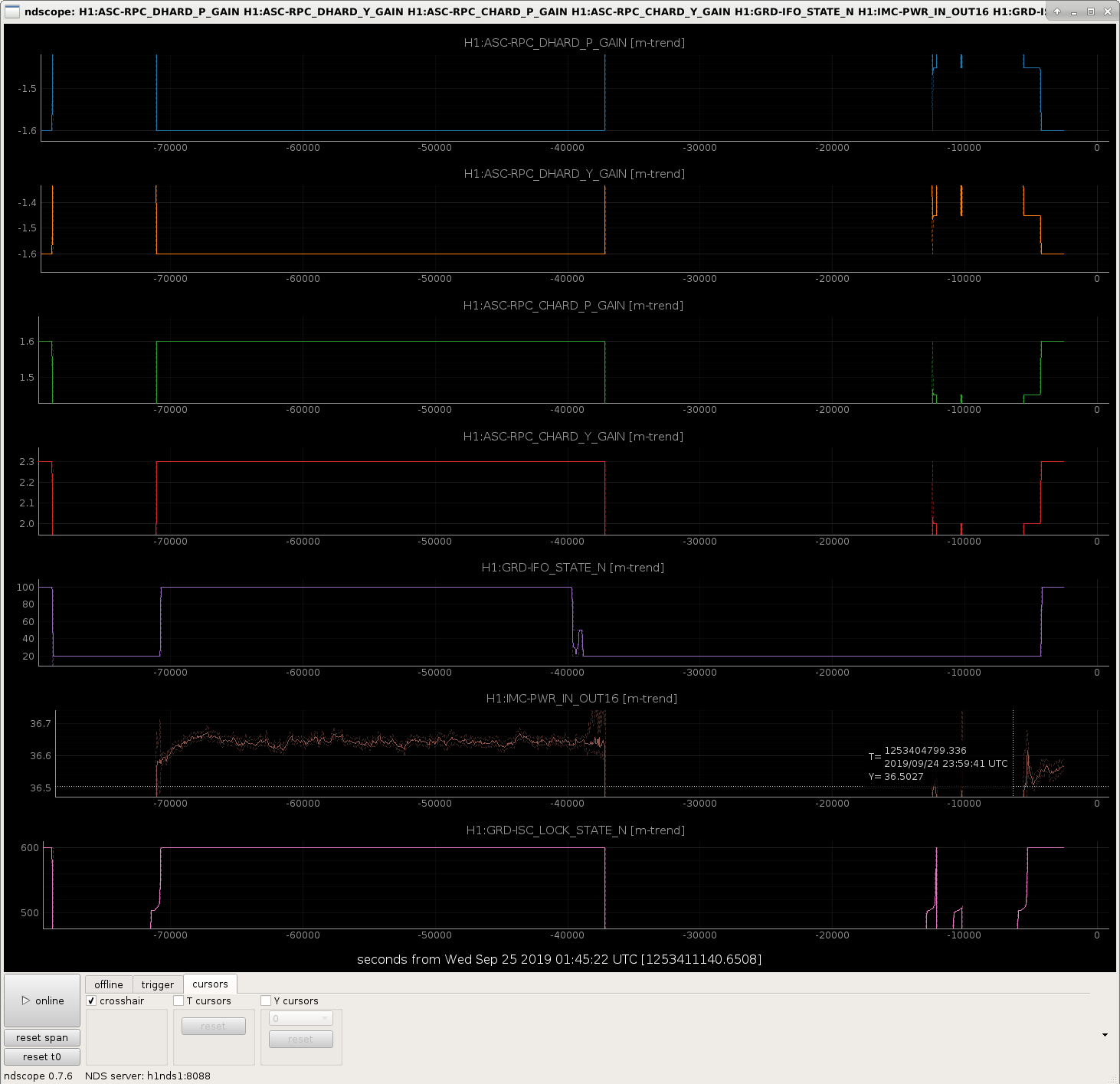
had diffs. These channels (loop gains) are a part of the radiation pressure compensation (RPC) system that Hang Yu designed (T1800077), to help compensate the arm angular degrees of freedom (CHARD and DHARD, Pitch and Yaw) for the change in response of these loops' at various 1064 nm arm power levels inside the arm cavities. Because the loop response depends on arm power, these gains are set based on the input power (as a proxy for arm power) by a function inside the ISC_LOCK guardian's ISC_library -- adjust_radiation_pressure_compensation (defined on line 305 of the current svn rev). Inside *that* function, there are human-set, hard-coded, input power thresholds set at 29.5, 33, 36.5, and 40 W, compared against the power in to the IMC (H1:IMC-PWR_IN_OUT16). As we know, (see e.g. LHO aLOG 51734), the input power is dropping slowly over time, and *today* for the first time, this power dropped below the 36.5 W at the time of measurement.

Thus, while cruising through the "run" portion of the INCREASE_POWER state -- just before MAXIMUM_POWER -- these gains were set based on the 33W configuration, instead of the 36.5W configuration we've running in throughout O3, i.e. some ~10% lower. This rightfully triggered the SDF warning in the h1asc comparison against its OBSERVE.snap later during NOMINAL_LOW_NOISE. However, it happened to occur in the middle of the automatic acquisition sequence when no one was otherwise touching the IFO, let alone this sophisticated, known to be carefully tuned, part of the ASC system.

Just because the PSL laser power has just so happened to drop the tiniest hair under exactly 36.5 W during the power up and this check, it didn't seem to us like a reason to change these gains.

All that context to say that when we found this, we reverted the gains, but did it slowly and simultaneously:
    - increased the ramp time on these banks to 30 seconds
    - used a simple command line "caput" to push the gains up to their 36.5W values
    - reverted the ramp time
This went smoothly.

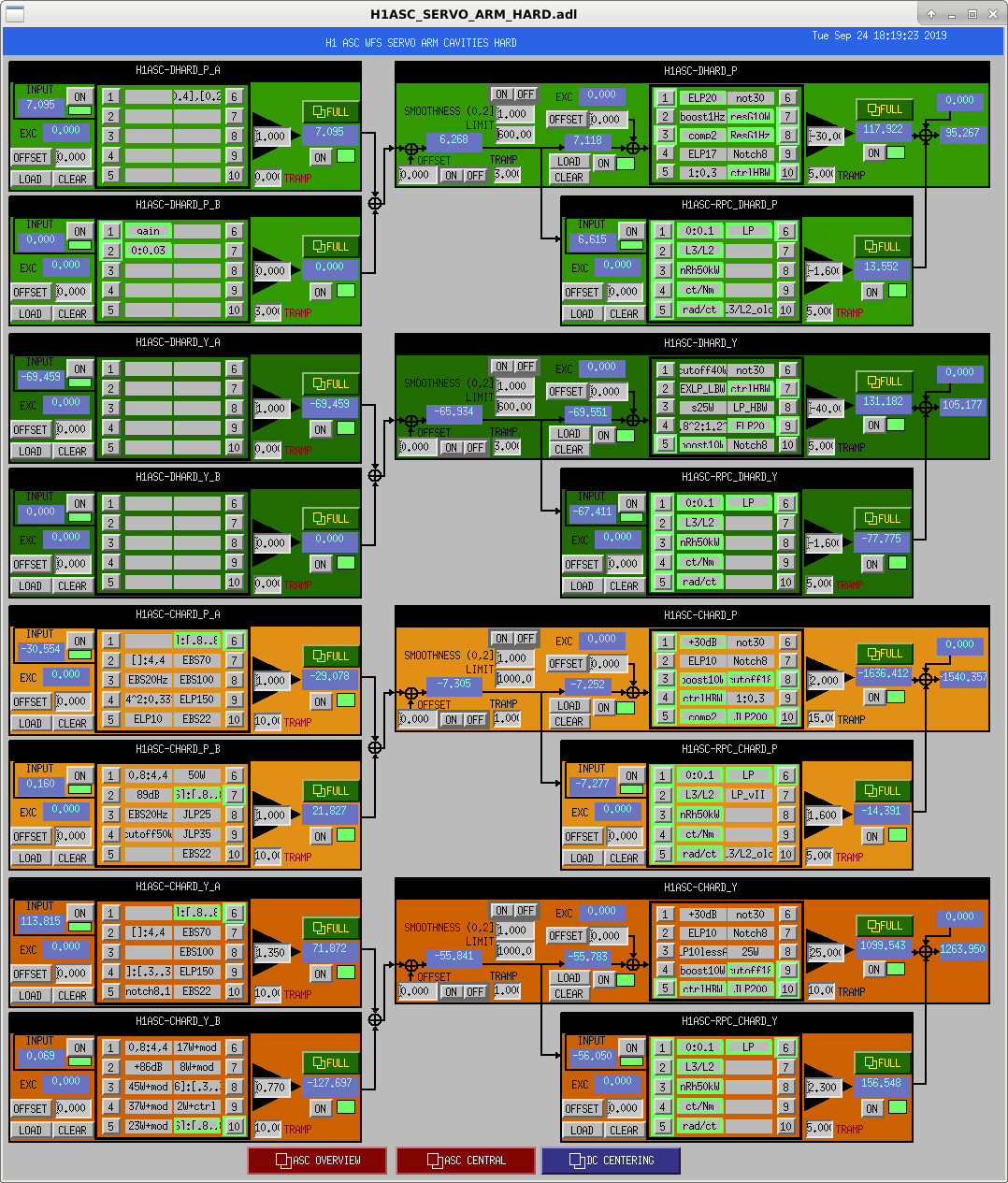
The screen on which these filter banks live is a little tough to find. From the sitemap, go to ASC > Overview > "ASC ARM CAVITIES" for PITCH (in the top middle of the overview) > "HARD loop detail (rad press, blends)" button (in the middle left). This will pull up the attached screen.

All this aLOG is just in case it stumps operators again -- with the intent that one does not ACCEPT the values just because they're different, but REVERT them, slowly, with the above procedure.
Images attached to this report
Comments related to this report
Jenne updated the lscparams.py for a quick/temporary fix for this. Basically we now request 38W (which gives us an Output Power of 37.5W).
So now we do not have to change ASC HARD gains which were coming up as diffs due to PSL power dropping.