sheila.dwyer@LIGO.ORG - posted 14:56, Friday 11 October 2019 (52420)
HAM6 fibers check out OK after all
Nutsinee, Sheila, TJ, Daniel, Betsy
Main message: Both the squeezer fibers are working OK now, although the red transmission was very low earlier today it is reasonable again after a few rounds of disconnecting the in air fiber from the feedthrough.
More details:
After Jim adjusted the fiber routing to avoid rubbing issues on the ISI 52419, we went to laser hazard in the squeezer bay to check that the fiber transmissions are OK one last time before closing HAM6.
Green fiber 39% transmission through the entire chain
- digital readbacks from October 3rd after fiber was replaced :16mW green launch, 1+6 = 7 mW of refl +refjected green = 48%
- digital readbacks today: 13mW launch 3.5 +0.14 rejected = 28% transmission today according to readbacks
- Nutsinee checked with power meter 10mW gren launch into coupler, 3.9 in reflection in front of refl diode, 39% transmission today
Red fiber was bad, is now 25-33% total transmission
We noticed that the transmission of the entire red chain was bad:
- using a power meter Nutsinee found 50% transmission from the input to the coupler to the output of ISCT6 feedthrough, because the transmission to SQZT6 was very bad we decided to garb up and check powers in the chamber.
- We also noticed that the CLF launch diode is not a reliable monitor since the half and quarter wave plates that adjust the polarization into the fiber are upstream of the pick off beamsplitter, which is polarization sensitive.
- In the chamber we measured that for 850uW into the coupler on ISCT6 (infer 425 at ISCT6 feedthrough) we measured 390 uW at the in air fiber right before the HAM6 feedthrough, although we only had 67uW after the collimator in HAM6, and 50uW in front of the CLF refl diode on SQZT6.
- We noticed that the in air fiber was loosely connected to the mating sleeve on the in air side, and the mating sleeve was also only loosly connected to the feedthrough. The first time that I tried to reconnect the in air fiber to the the feedthrough I had put the key in the slot, but had difficulty threading the ferrule onto the mating sleeve. We didn't see any better transmission to SQZT6.
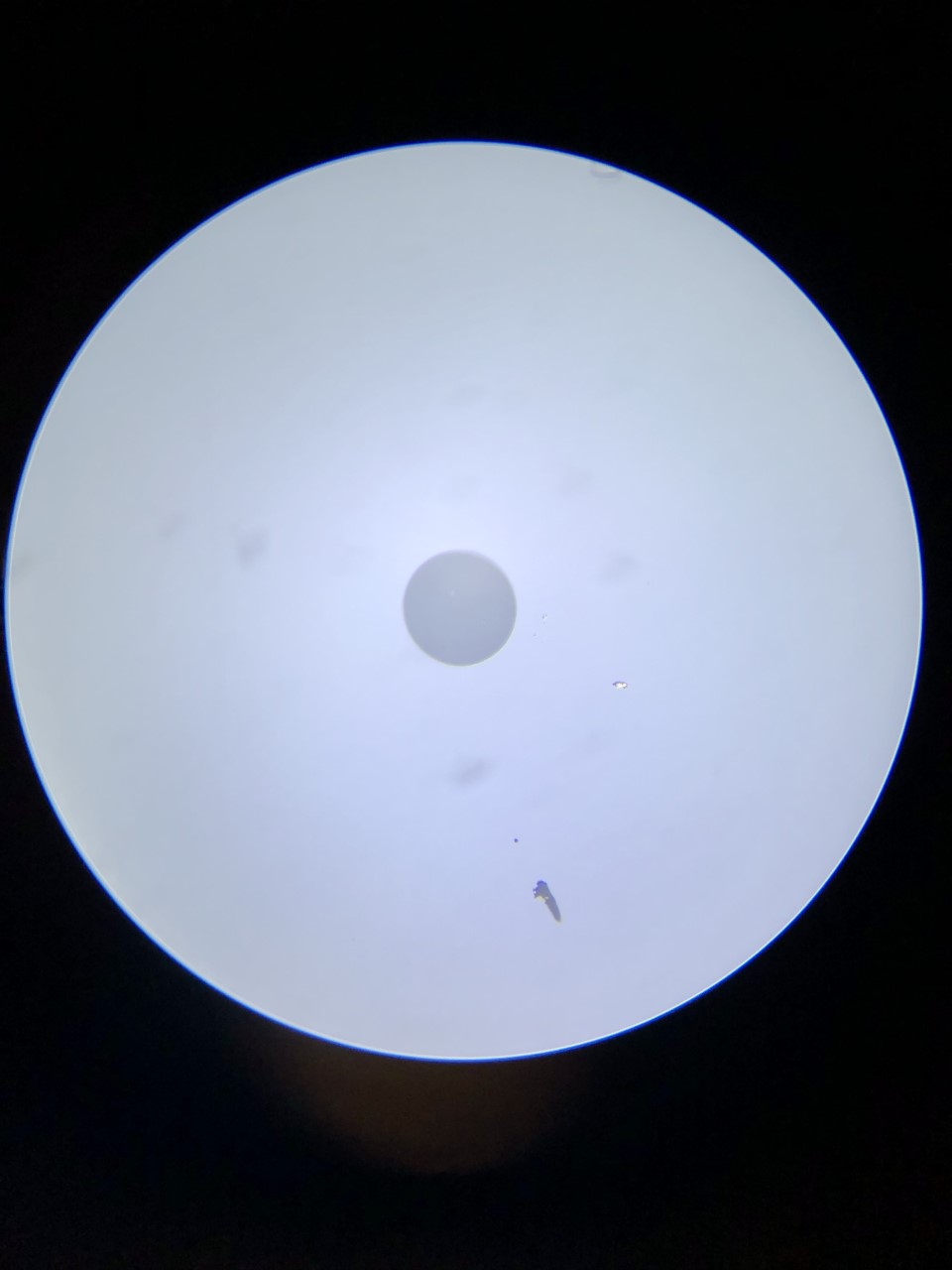
- We disconnected the in air fiber again, turned off the laser, and inspected it with the fiber microscope. There was a small while speck in the core, so we decided to try to clean the fiber. We tried to clean once with a dry vectra alpha wipe, the white speck didn't move but there were some specks elsewhere on the fiber (around 5:30 in the photo) that were new. Next we tried a IPA vectra alpha wipe, followed immediately by a dry wipe, this time the white spec remained but the rest of the fiber looked clean so we decided to stay with that. In the attached photo you need to zoom in on the core to see the white speck at around 11 o'clock.
- I loosened then tightened the mating sleeve connection to the feedthrough before trying to reconnect the fiber, since that connection seemed to wiggle.
- We reconnected the in air fiber to the mating sleeve, threading the ferrule was easier this time. I threaded the ferrule until the connection wasn't loose but I didn't apply much torque at all. This time we had more light: for 1.5mW into the coupler on ISCT6 and 0.37mW out of the collimator in HAM6, so we are getting at least 25% through the entire chain, with 50% losses on ISCT6 which can potentialy be fixed. Our notes become a little confusing at this point, because Nutsinee also has a measurement of 0.5mW on SQZT6, which would give us a trasnsmission through the entire chain of 33%. Part of the confusion might be that the launch power is dependent on the state of the two waveplates, which Daniel was adjusted between the two measurements to reduce the rejected power.
Images attached to this report