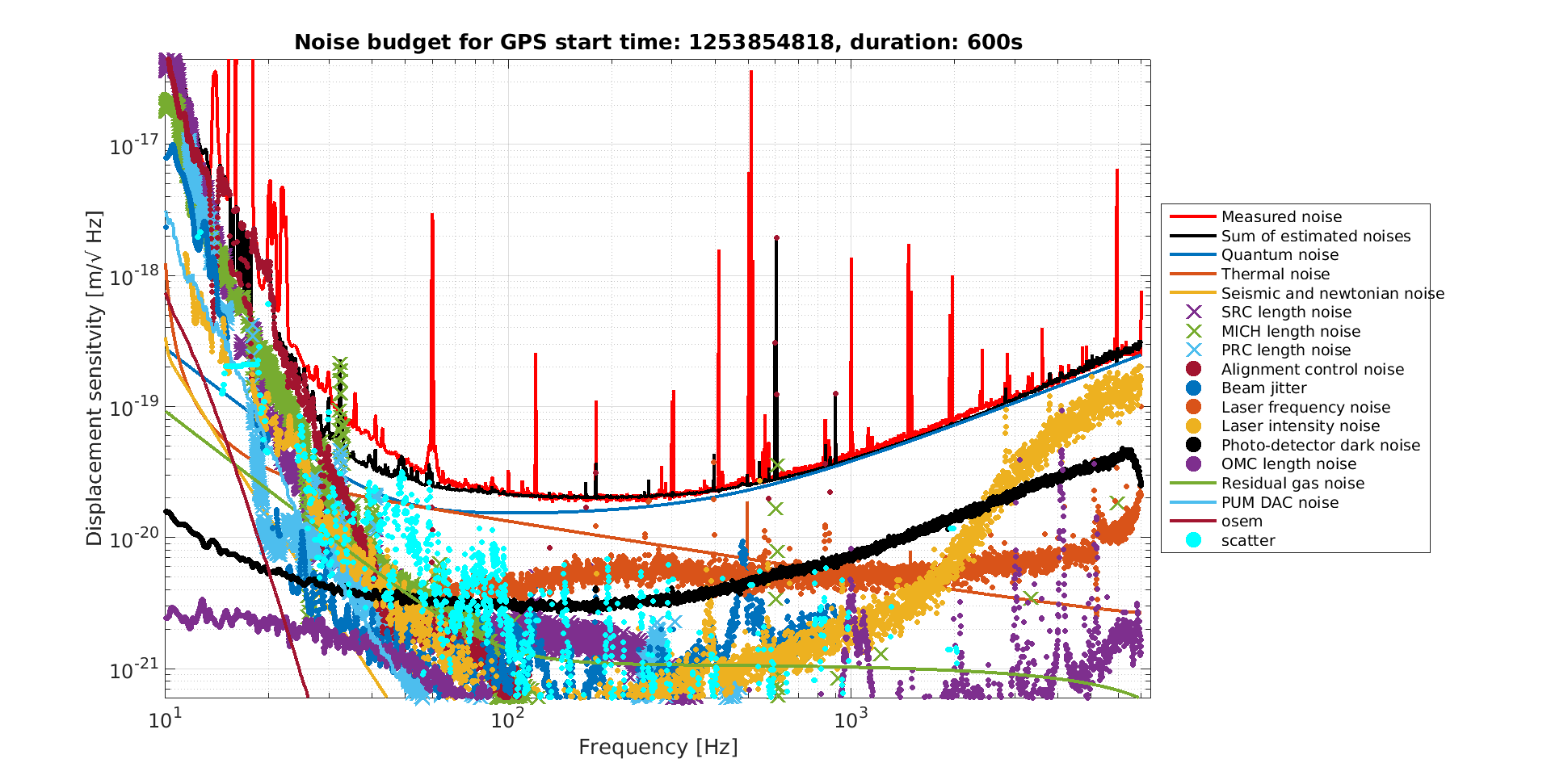
I re-ran the noise bugdet using a reference time after the 48 Hz peak was fixed, which is the same as the BRUCO posted here. I did not re-run any of the coupling or excess power measurements, I only updated the reference time so only traces which have a "live update" are actually changed compared to the previous time we ran the noise budget 51779 The first plot here just shows the noise budget plot for context with the 48Hz peak gone.
The coil driver noise in the noise budget is based on measurements done at LLO of the coil driver noise, propagated by a quad suspension model to DARM. We have been interested in validating this model by leaving the coil drivers in their most noisy state. The second attachment is a projection of how that would impact the DARM noise, the purple trace shows where we would expect that coil driver noise to show up if we were in the highest noise state, which is similar to the level of ASC noise we have (ASC noise is shown for reference). By comparing the blue and yellow traces you can see that if the projection is correct, we should be just able to tell that there is a change in noise when we put the coil drivers into their noisiest state, so this test is worth a try.
The third attachment contains projections of the DARM noise and range gains possible by improving some known noises in our noise budget. The upshot is that we could improve by a few MPc by increasing the input power (if recycling gain and cavity pole stay the same) and by a few more with improved squeezing. Reducing LSC and ASC noise don't help much in range but the ASC noise is probably still worth working on because it may not be too hard to get back to ASC noise levels similar to what we had in O2. The main message is that we need to keep working on candidates for low frequency noise that aren't in the noise budget, (scattered light, output jitter).