NCal Test Purpose
This is a brief report on NCal test demonstrations, with observations primarily from the perspective of operational safety.
Summary
Test operation was observed on two occasions and vibration levels were observed both subjectively and via crude measurements. The outcome is that Site Safety agrees with moving forward with operation in the end station, after successful completion of the Hazard Analysis
Test Oct 11
Timesh had recently made changes to the NCal apparatus, including a new coupling and care in alignment during re-assembly. In todays test, he gradually increased the rotation rate, allowing for observations at various rotational frequencies. Here is my subjective, qualitative account.
Photo of apparatus:

The rotor was slowly spun up to 10 Hz. I couldn’t detect any vibration with my hand on the table, but could detect some vibration with my hand on the boxed enclosure – far less than a DVD spinning in a laptop.
The rotor was then slowly spun up to 20 Hz. I could detect vibration with my hand on the table, and also significantly more on the boxed enclosure than at 10 Hz, but still somewhat less than a DVD spinning in a laptop.
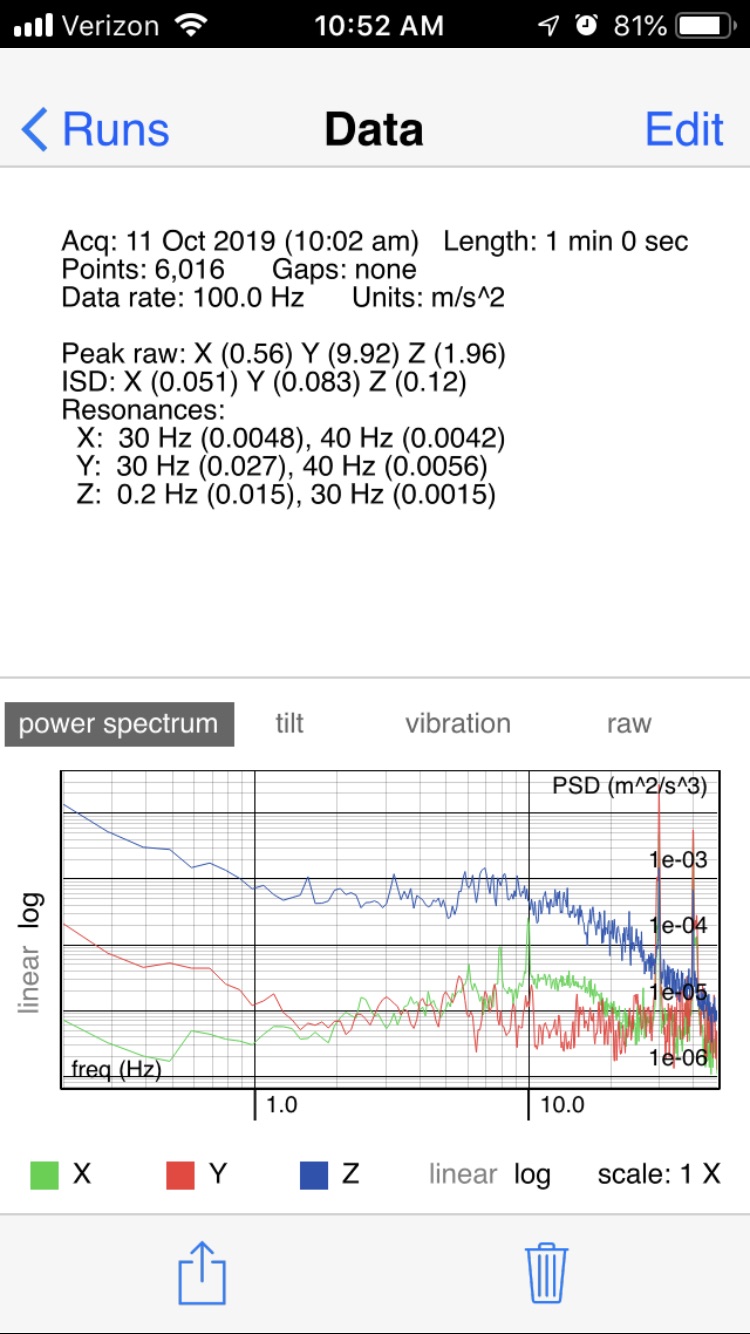
The rotor was then slowly spun up to 30 Hz. This felt about the same as at 20 Hz. Below is a power spectrum obtained while the apparatus was spinning at 30 Hz, using my VibSensor app (NOT calibrated, NOT NIST traceable), run time 1 minute, with unsheathed phone placed vertically on the front center of the enclosure, display facing towards the viewer in the photo above, and held in place by holding the phone sheath in contact with the top of the phone:
[see image attached]
Test Oct 16
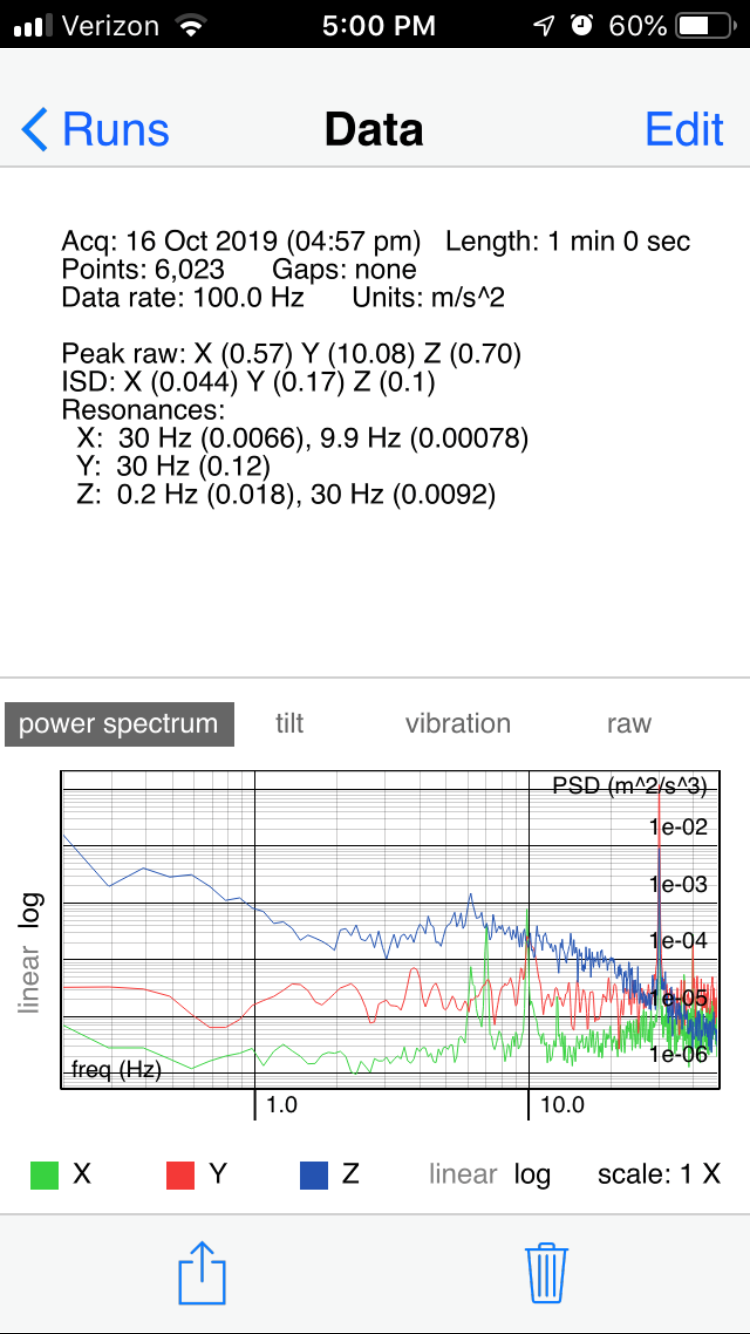
After further refinements to the apparatus, another observation was performed, this time at 30 Hz. Any differences using the “touch” test were too subtle to describe. Power spectra, taken as described above, is included below. From the plots, it appears that Z-direction vibration (the highest magnitude component of vibration) has been reduced slightly.
[see image attached]