jeffrey.kissel@LIGO.ORG - posted 12:13, Friday 01 November 2019 (52883)
Quick DELTAL_EXTERNAL Comparison between Just Before vs. Just After the Break
J. Kissel

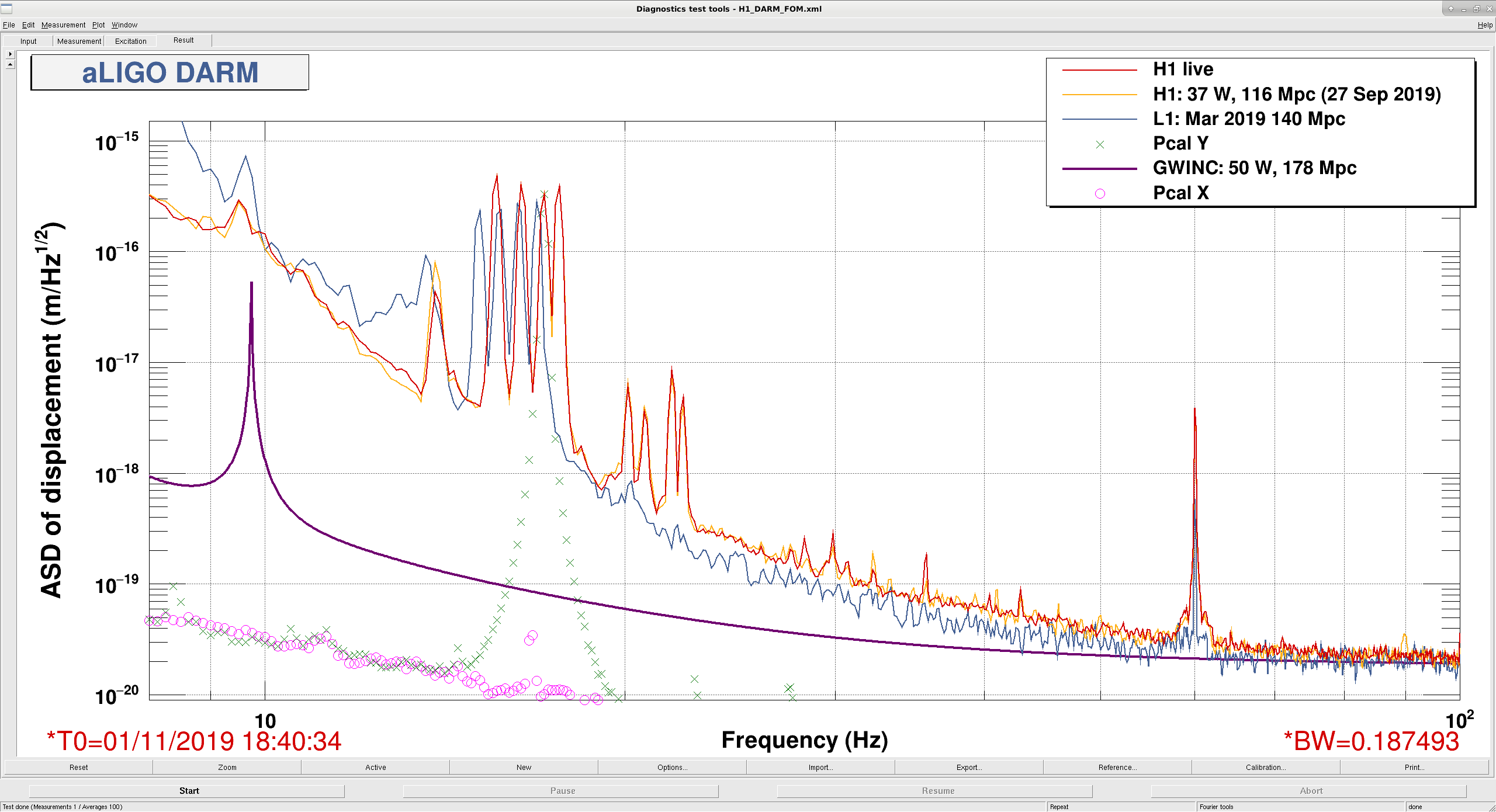
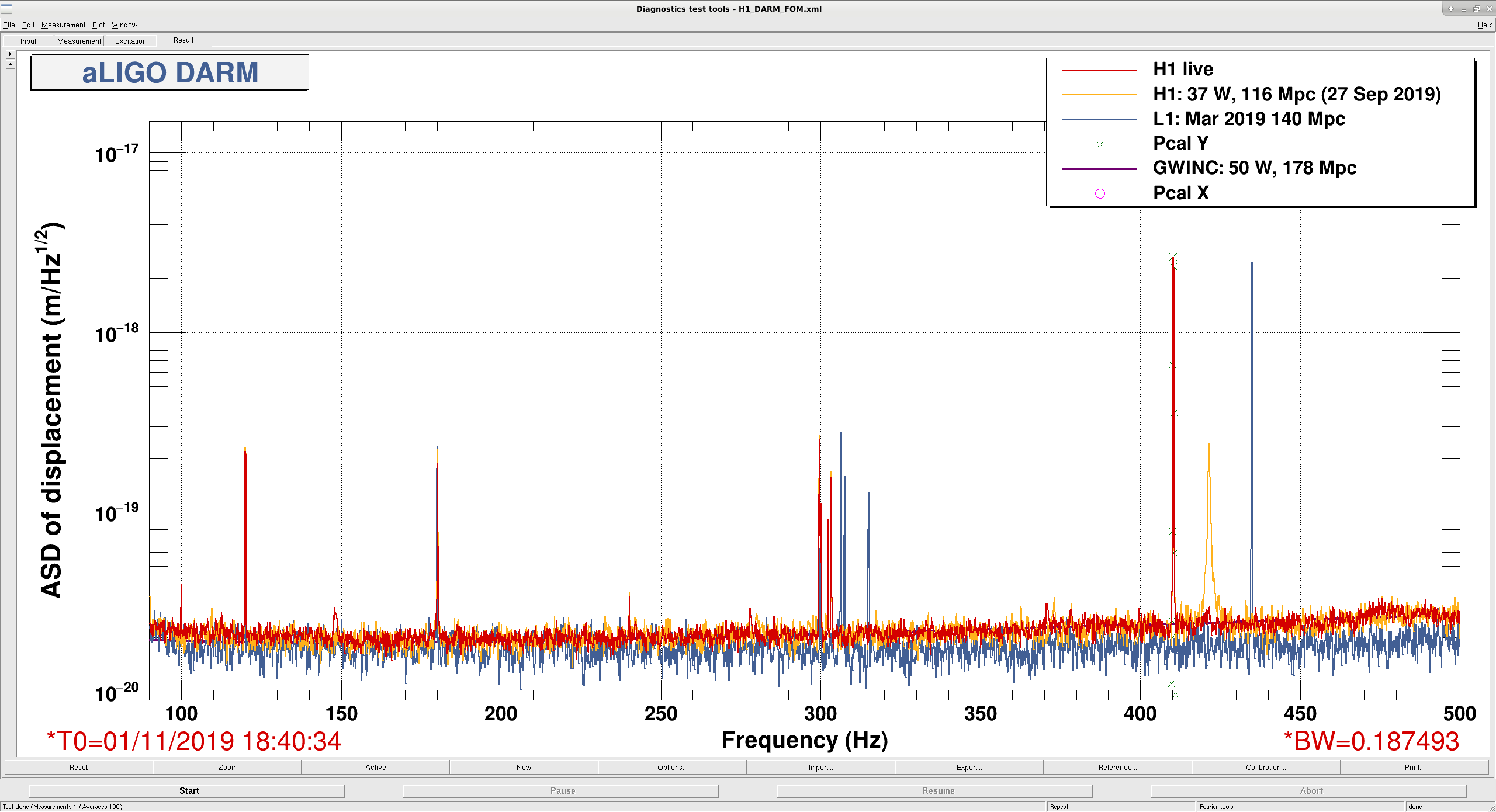
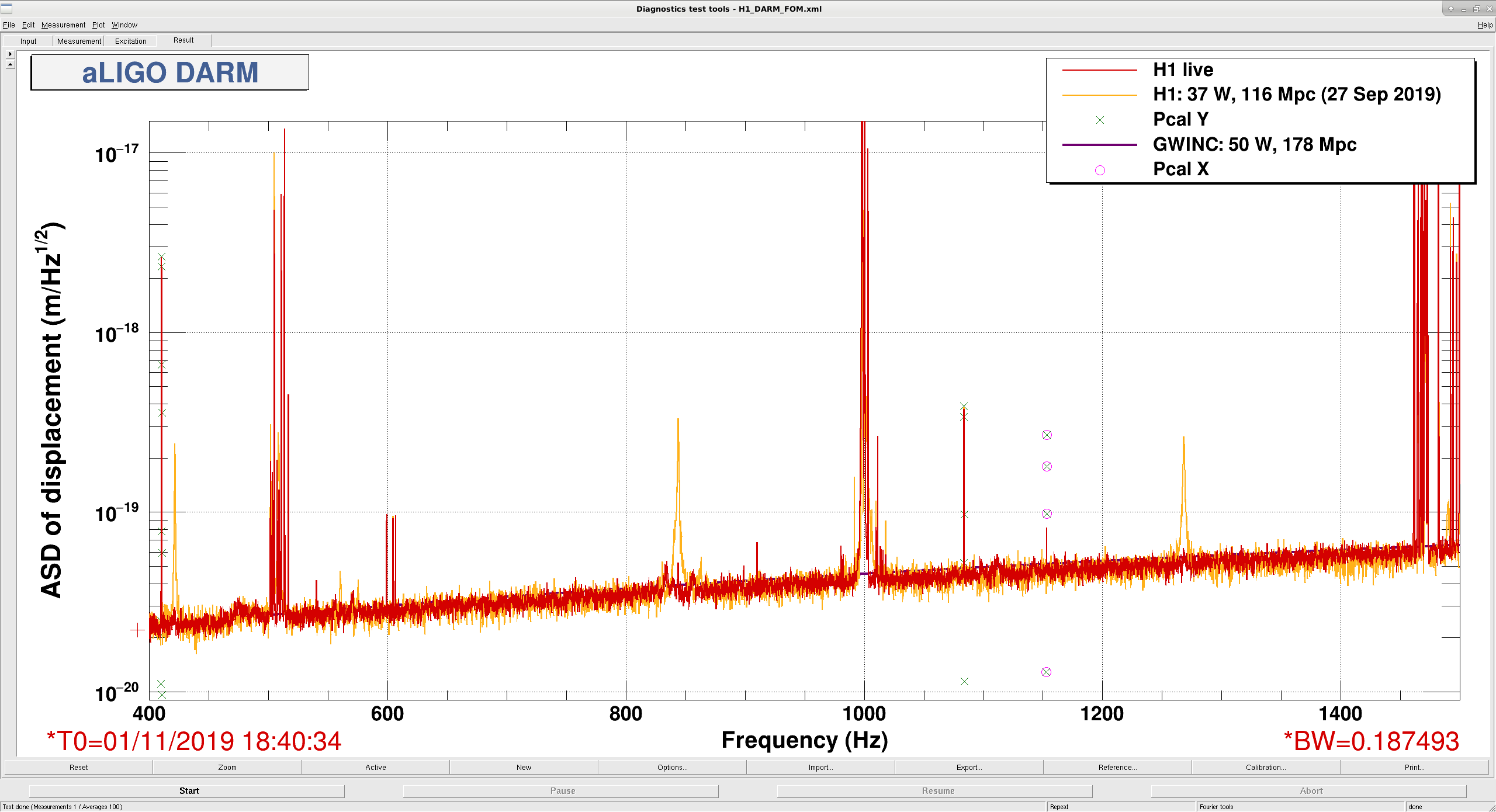
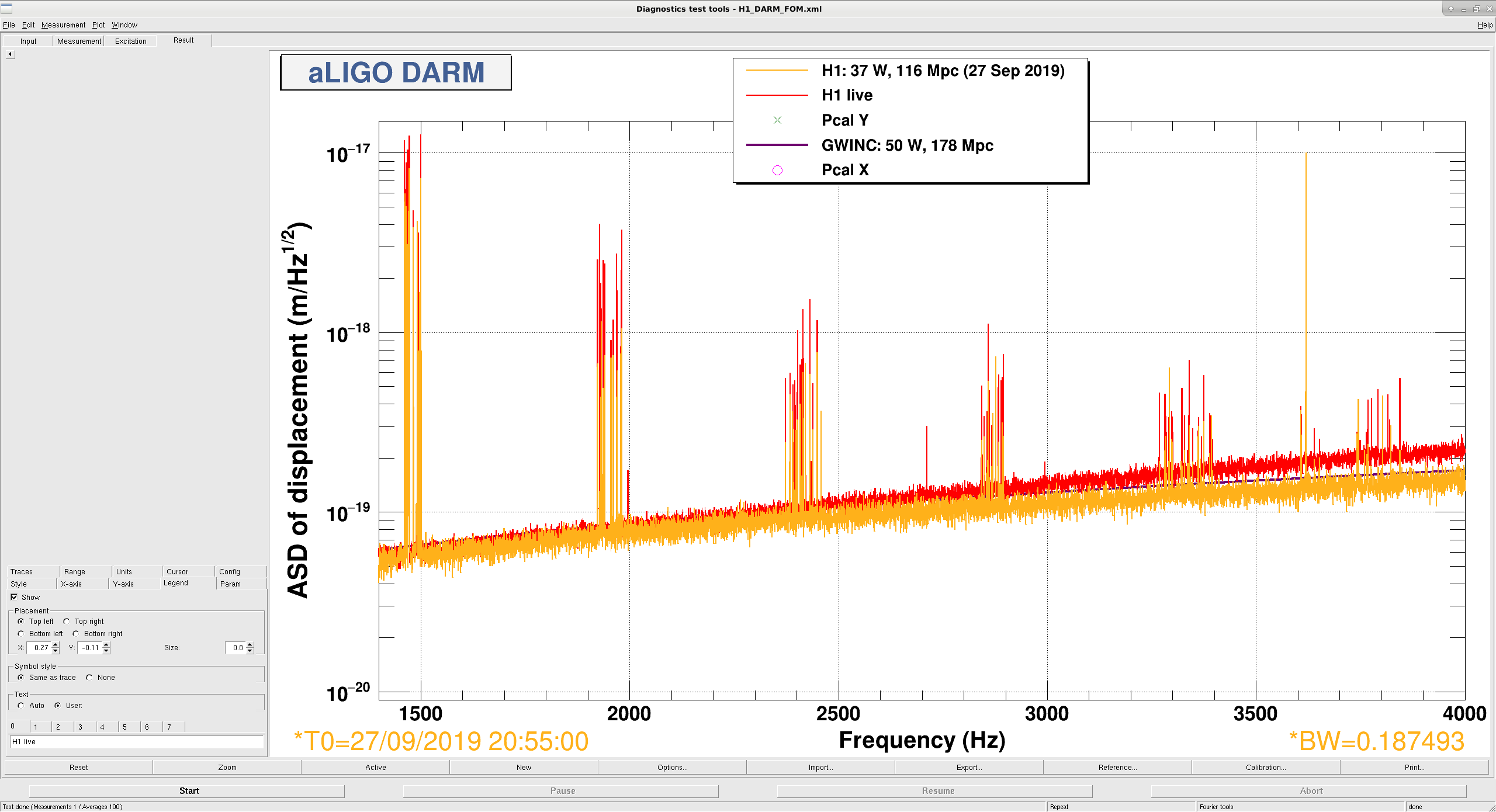
We're still in the earliest stages of understanding the differences between the O3A and O3B interferometer, so wanted to call some attention to the major spectral features that we see which are different:
 Broadband:
    (1) First and for most, above 1.5 kHz, the noise is a factor of a few worse. We're still investigating as to why, but we suspect the usual culprits at these frequencies: intensity and frequency noise. Craig has already reduced this noise by increasing
        the common FSS gain last night to improve the frequency noise impact, and I suspect there will be more work to come.

 Sharp Features:
    (2) There is a particular collection a features that have a low enough Q that they're likely mechanical at 421.45 and roughly harmonic frequencies of 843.79 Hz, and 1267.77 Hz. These are now gone from the ASD. No one has a good idea yet what these were (we didn't pay too much attention to improving the damping on any major item during the break).

    (3) The only other features that are "gone" are at 89.875 and 373.125. Similarly no known (ok, "immediately remembered" even with Robert in the room) physical mechanisms for these.

    (4) There are *new* features that were not there before at 35.75, 100.0, 148.125, and 370.875 Hz. One might argue that 373.125 Hz has *moved* to 370.875 Hz.

Attached is a comparison between DELTAL_EXTERNAL amplitude spectral density just before the break (Sep 27 2019 @ 20:55 UTC) against now (Nov 01 2019 18:40:34 UTC) broken up into various frequency zooms such that you can better read the changes in features.

Note: We've made no changes to the calibration of the instrument. The optical gain, relative to what it was for the 20190909 model is 0.98 (i.e. a bit lower), and the cavity pole is cruising around 412 Hz (i.e. also a bit lower than the 417 Hz that's in the reference model).
Images attached to this report