jeffrey.kissel@LIGO.ORG - posted 23:09, Wednesday 27 November 2019 - last comment - 23:57, Wednesday 27 November 2019(53540)
Instructions on how to revert UIM Coil Driver Filter Change, if need be
J. Kissel

We're continuing to have trouble acquiring lock after the SEIB3 computer crash (LHO aLOG 53533). I'm reasonably confident it's because of the obscene amounts of constant wind, but I'm nervous that it may also not be helping that we've decreased the effective range of the H1 SUS ETMX UIM/L1 actuators with the recent "permanent" change to turn on one stage of low pass (LHO aLOG 53528).

In order to make the call as to whether you *need* to revert it, watch a live time series of the ETMX L1 requested DAC output on an ndscope, over a ~80 second timescale during any acquisition sequence:
    ndscope -s H1:SUS-ETMX_L1_MASTER_OUT_UL_DQ H1:SUS-ETMX_L1_MASTER_OUT_LL_DQ H1:SUS-ETMX_L1_MASTER_OUT_UR_DQ H1:SUS-ETMX_L1_MASTER_OUT_LR_DQ

If these channels are regularly spiking above 2^18 ~ 131000 counts at various points during the acquisition sequence, then we need to revert.

Here's how one would revert it:
(1) Upon the next lock loss, hold the ISC_LOCK guardian in DOWN.
(2) Change the coil driver state, using the following terminal command:
    caput H1:SUS-ETMX_BIO_L1_STATEREQ 1.0
(3) Resume lock acquisition as normal, but
(4) Make it "permanent" by editing line 50 of the ALS_DIFF guardian code:
    change
    ezca['SUS-ETMX_BIO_L1_STATEREQ'] = 2 # Switched to requesting "one low pass on" from "no low passes on" (JSK 2019-11-27)
    to
    ezca['SUS-ETMX_BIO_L1_STATEREQ'] = 1 #Jeff's change didn't work, back to the drawing board.
(5) Save the changes, and load the modified ALS_DIFF guardian code.
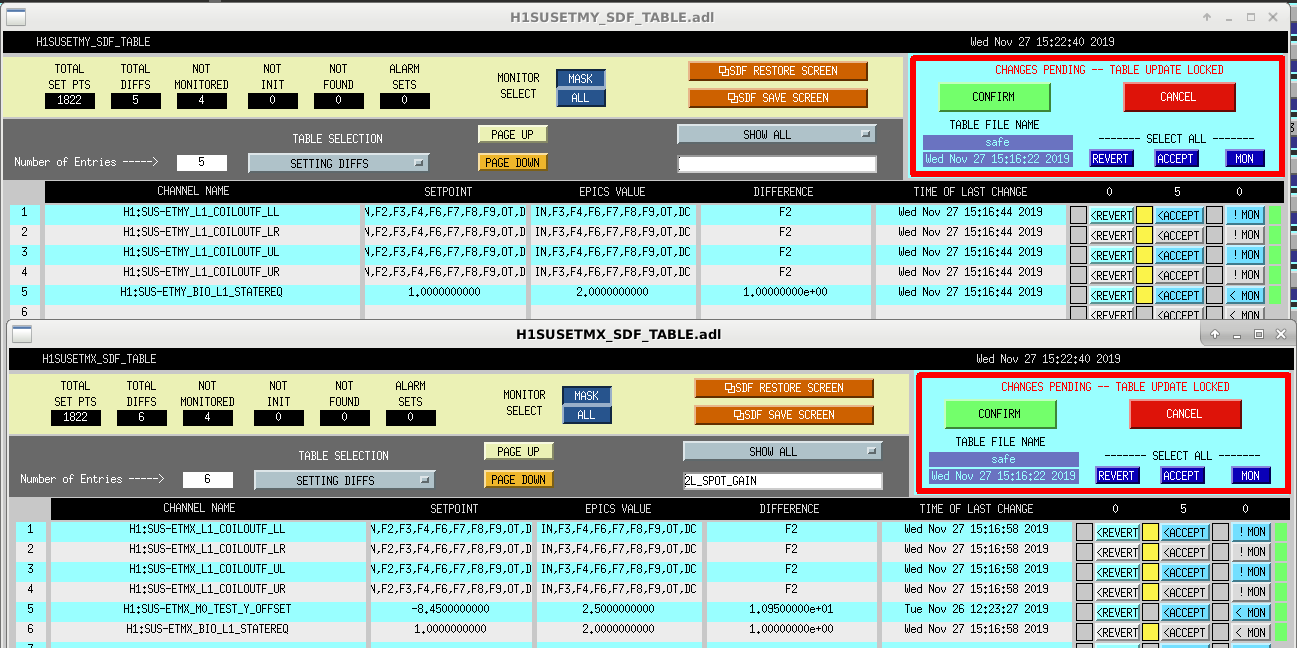
(6) Once you get to nominal low noise, you'll have SDF DIFFs to accept; they'll look like the opposite of the attached screen shot, referencing "FM2" and the above mentioned BIO state request channel.
(7) aLOG that you've reverted the settings.
Images attached to this report
Comments related to this report
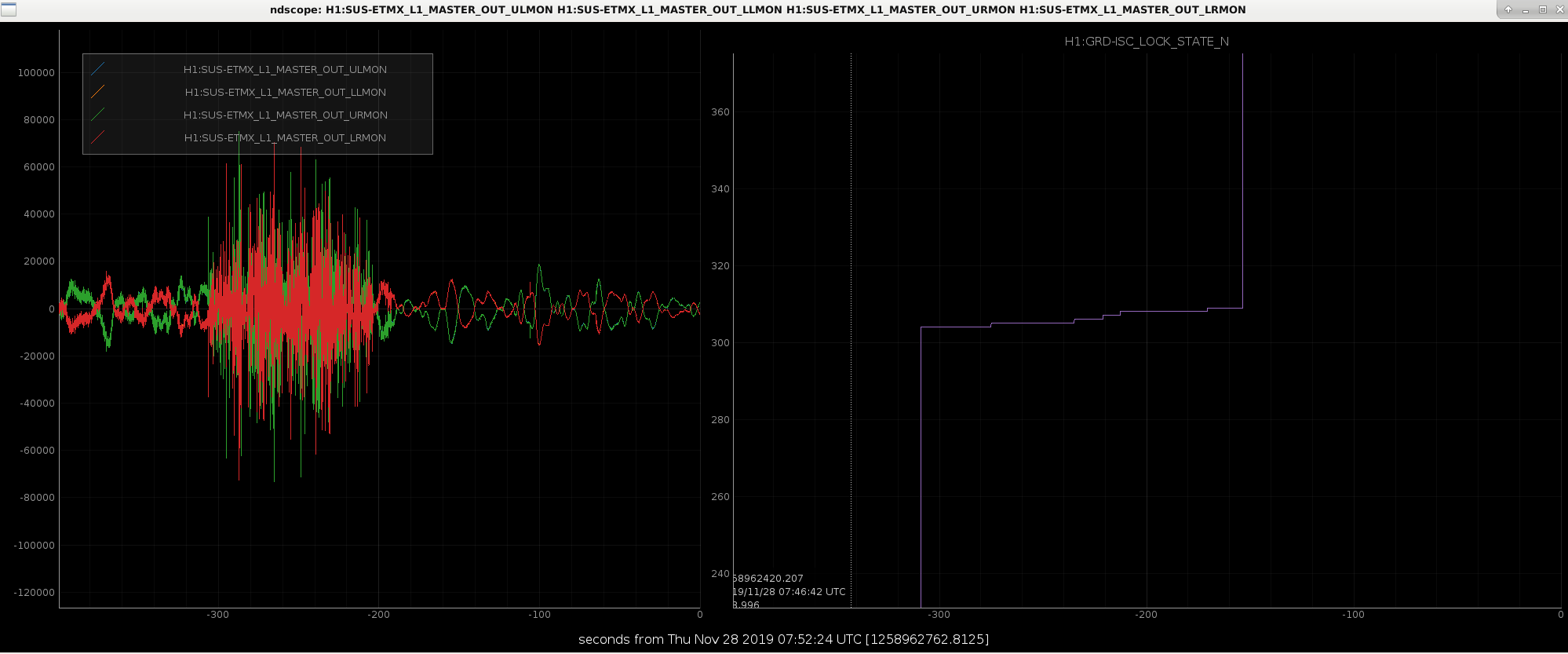
I have attached an image showing that SUS-ETMX_L1 channels get very noisy between ISC_LOCK states 304 DARM_TO_RF and 308 CARM_OFFSET_REDUCTION. But, still a way off 130000. We did have 2 locklosses at SHUTTER_ALS 07:15UTC 07:33UTC.
Images attached to this comment