=== Summary ===
There were numerous tests to investigate whether the NCAL electronics causes glitches and other short duration, transient noise in DARM. The full details are given in LHO alogs 53274, 53396 however, to summarise:
1) On the 12th November 2019, a series of glitches at 30,40,50 and 60 Hz had been observed, most prominently seen on the 13th November 2019 in the Omircon summary plot.
2) The glitches persist until 14th November 2019 21:00 UTC.
3) This time coincides with when the NCAL was fully powered at EX, but not spinning.
The channels that I used to investigate the noise coupling(s) are:
| Channel Name | Description |
|---|---|
| H1:CAL-DELTAL_EXTERNAL_DQ | DARM |
| H1:PEM-EX_ADC_0_11_OUT_DQ | Temporary/Portable PEM Magnetometer at EX |
| H1:PEM-EX_ACC_BSC9_ETMX_X_DQ | Permanent accelerometer in the VEA at EX, measuring X direction. |
| H1:PEM-EX_ACC_BSC9_ETMX_Y_DQ | Permanent accelerometer in the VEA at EX, measuring Y direction. |
| H1:PEM-EX_ACC_BSC9_ETMX_Z_DQ | Permanent accelerometer in the VEA at EX, measuring Z direction. |
| H1:PEM-EX_MAG_VEA_FLOOR_X_DQ | Permanent magnetometer in the VEA at EX, measuring X direction. |
| H1:PEM-EX_MAG_VEA_FLOOR_Y_DQ | Permanent magnetometer in the VEA at EX, measuring Y direction. |
| H1:PEM-EX_MAG_VEA_FLOOR_Z_DQ | Permanent magnetometer in the VEA at EX, measuring Z direction. |
Further information about the permanent PEM sensors can be found under the LHO tab at pem.ligo.org
To understand the wiring set-up of the NCAL, the wiring diagram cartoon in DCC D1900015 or a pin to pin drawing in DCC D1900499.
From the tests I have conducted, using the NCAL electronics, I am unable to reproduce the glitches as seen in the OMICRON or HVETO summary page plots, and there are otherwise no short duration, transient noises. From this I conclude that the NCAL electronics is not the primary source of the glitches and that it is acceptable to leave the NCAL on/powered during observing however, the NCAL will NOT be spinning during observe segments. The NCAL will be spun during either calibration/commissioning times for measurements or during down periods for engineering work (such as Tuesday maintenance).
It would be helpful if the DetChar team could aid in the conclusion I have drawn by using better data analysis techniques to confirm or deny this result.
=== Understanding the Original Glitchy Data ===
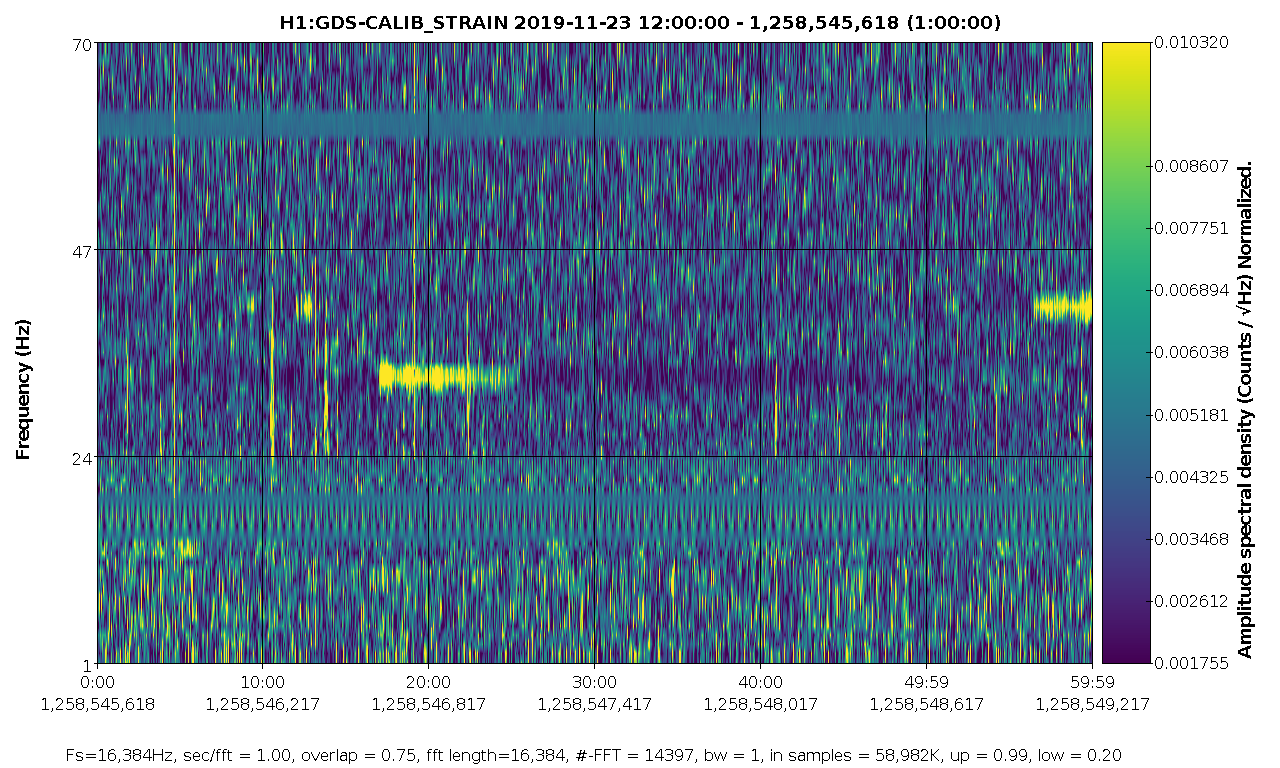
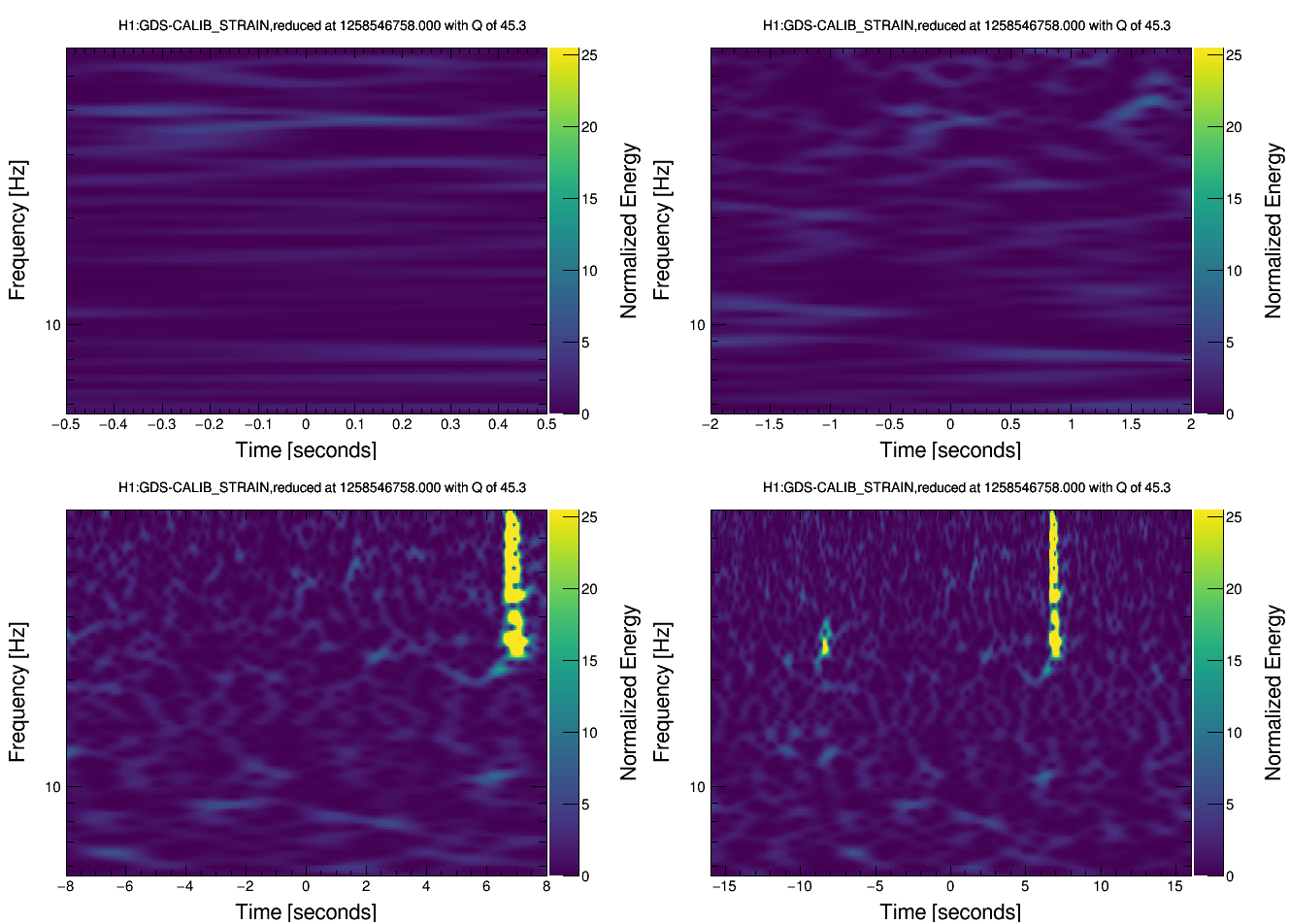
It is hard to pinpoint where the glitches are coming from however, the Hveto tab on the summary pages points to H1:PEM-EX_ADC_0_18_OUT_DQ as the winning channel associated with these glitches. This channel is connected to a voltage monitor at EX for the ESD drive system indicating that the noise is coming fromt the X End station. Currently, I have not used it in my analysis-more as an indication that the noise is coming from EX however, I will add this to my analysis later. I took a four hour period of time, during 13-Nov-2019, starting at 11:00 UTC (just prior to the time period identified as bad) and tried to use LigoDV-web spectrogram and Q-Transform features in order to understand the morphology of the glitches. By inspection of the Omicron plot, although the glitches appear to be constrained to a given frequency band, they do not appear to be periodic. To me, this eliminates clock-like processes such as blinking lights/LEDs etc. As an example, I show an Omicron plot from the 13 November 2019 at 12:00 UTC and the corresponding spectrogram of DARM using the same channel. A Omega scan of the feature seen in the spectrogram between minutes 18-25 shows a loud broadband glitch at around 13-11-2019 at 12:19:07 UTC. A collection of all the plots I made and the settings I used can be found in G1902232 in addition to the results of the investigations given in the sections below.
Below we try to replicate any of these previously seen glitches in spectrogram(s) of further follow-up tests using the NCAL electronics (because we've not figured out how to create omega glitch-grams).
=== On/Off Tests ===
In order to determine if the optical encoder system was causing the issues, we turned the the encoder system off and on in ~20 minute cycles (LHO alogs 53441, 53524). In both cases, I was at the X end whilst the LHO IFO was in Nominal Low Noise, and I would carefully walk over to the BRS Heater/NCAL Motor Controller rack and flip the +/-15V switch. Only the encoder system is connected to this switch therefore, power to other system will not be affected (there are no other systems that require +/-15V however, the power is supplied by the BRS heater +/-18V system). Furthermore, in both cases, the wi-fi at EX was on and the lights were off. It is not easy to turn the power off to the NCAL Beckhoff system because, it is sharing power with the BRS Heater system therefore, turning off the power supply to the NCAL Beckhoff system would also turn off the power to the BRS Heater thus, this test was not conducted. The goal of the on/off tests is to have definitive on and off states of the encoder system within the same lock stretch and statistically, from the original glitches observed during 12th-14th November, a glitch should occur. Forcing the system on and off may force an electronics glitch and it is expected clearly see the on/off points in DARM.
During the first on/off test (LHO alog 53441), the sensor correction was disabled therefore, frequent scattering glitches swamped the spectrum making it hard to draw conclusions from the data. This is because, the magnitude of the scattering shelf glitches are much higher than the noise expected from NCAL electronics. There may be some useful information in the data however, it may be hard to find a quiet time between glitches to obtain reasonable SNR in DARM to see the NCAL electronics glitches.
During the seconds on/off test (LHO alog 53524), the sensor correction remained on, reducing the the scattering shelf glitches in magnitude and occurrences. When taking a spectrogram of this time, there is no indication, that I can see, of the glitches as a results of the On/Off tests either looking at a 0-1000Hz range or zoomed in to 0-70Hz range. in the portable magnetometer channel, the winning channel that illuded to the glitches or in DARM. During the second round of On/Off tests, the portable magntometer was on top of the encoder satellite box therefore, this sensor should show whether the NCAL encoder system glitches with the power.
=== Extended Encoder Off Time ===
To determine if the Beckhoff electronics were the cause of the glitches, we turned off the encoder system for an extended period of time. By eliminating the encoder system, the only electronics contribution would be from the Beckhoff system. The long off time would allow for sufficient integration time in order to investigate if there are any new lines as a result of the NCAL Beckhoff system or correlation with glitches. The difficulty here is that there are no fast voltage/current monitors therefore fast glitches may be missed by these monitors.
During the times when the encoder was off and, the NCAL Beckhoff system is on, the rate of glitches appear to be the same before and after the NCAL systems' installation. From looking at the glitches summary page on the summary page, the same channel (H1:PEM-EX_ADC_0_18_OUT_DQ) remains in the top 10 winners.
=== Extended Encoder On Time ===
With the above investigations completed, we were confident enough to leaving the NCAL electronics (including the encoder system) on during observing segments. The NCAL would not be spinning however the MEDM interface would enable remote operation of the NCAL. The motivation for this was to gather enough days worth of data in order to analyse DARM over long integration times. This was to assess the impact the NCAL electronics would have on long duration searches such as CW. The results of this are currently unknown however, assistance with this would be helpful since, I am unfamiliar with long duration search techniques. Evan Goetz has started an inital investigation (LHO alog 53666) and suggests that the NCAL electronics, not sure which system, is adding more lines into the 10-100Hz band when intergrating over a long period time.
During the times when the encoder was on, the NCAL Beckhoff system is on and, the NCAL is stationary, the rate of glitches appear to be the same before and after the NCAL systems' installation. From looking at the glitches summary page on the summary page, the same channel (H1:PEM-EX_ADC_0_18_OUT_DQ) remains in the top 10 winners (for example 20th Nov 2019).
=== Spin Tests ===
During the Tuesday maintenance on the 26th of November 2019, R.Schofield and R.Schofield and I used the portable magnetometer to investigate magnetic coupling of the NCAL system in various locations around the XVEA (LHO alog 53503). We left the portable magnetometer on top of the satellite box for future so that we have a sensor as close to the NCAL as possible and can trend the channel H1:PEM-EX_ADC_0_11_OUT_DQ for future investigations. The goal of these tests was to determine the how noisy the NCAL system, using the magnetometers and accelerometers as our metric.
When looking at spectrograms of the magnetometers{X,Y,Z} and the accelerometers{X,Y,Z}, there are harmonics that increase in frequency as the NCAL is accelerating or decelerating. When the NCAL is at rest or is at a constant velocity, there does not appear to be loud glitches in the magnetometers however, the accelerometers show glitches throughout the test period. Since I was in th XVEA during the times of these tests as well as R.Schofield undertaking other tasks in the XVEA, these glitches may be associated with out movements rather than the NCAL system.
=== NCAL Electronics Timeline ===
For follow up data analysis, the current electronics timescale of NCAL is as follows:
|
Time (GPS) |
Time (dd-mm-yyyy HH:MM:ss UTC) |
Description |
|---|---|---|
| 1256673618 | 01-11-2019 20:00:00 | Connected the Beckhoff system and powered for the first time, communication to the Beckhoff PC not enabled/connected. Encoder connected to power but not powered as well as not connected to the EE bay chassis (LHO alog 52860). |
| 1256929278 | 04-11-2019 19:01:00 | Connect the communications (ethernet) cables for the NCAL PC and attempt set up of remote access to the PC. Beckhoff restart and IOC restart (LHO alog 52986). |
| 1256948538 | 12-11-2019 00:22:00 | Encoder connected to the EE bay chassis and encoder is powered on. NCAL failed spin attempt (LHO alog 53203) due to incorrectly set up wiring to the motor controller. DC power is currently being supplied by a portable DC power supply and AC power is run from the PEM chassis in the XVEA. |
| 1257716553 | 13-11-2019 21:42:15 | Fixed a incorrect wiring issue on the NCAL Beckhoff Motor Controller and encoder switched on. NCAL spun for the first time. All NCAL system remain powered after leaving EX (LHO alog 53230). |
| 1257787818 | 14-11-2019 17:30:00 | Powered off the Beckhoff Motor controller whilst seeking better options to power thr NCAL in the XVEA(LHO alog 53242). |
| 1257874518 | 15-11-2019 17:35:00 | Encoder system powered down and unplugged. Beckhoff system remains powered and connected (LHO alog 53274). |
| 1258219818 | 19-11-2019 17:30:00 | Power to the motor controller re-routed to correct sockets and all Beckhoff systems powered. The power supply the NCAL Beckhoff system uses has been swapped and the to a power supply that can handle more amps and the voltage is bumped up slightly oer 24V (LHO alog 53358). The encoder system is re-connected and turned off. |
| 1258739058 | 25-11-2019 17:44:00 | Encoder is turned on and off in ~20 mintes intervals and turned off at the end of the tests. (LHO alog 53441). |
| 1258827378 | 26-11-2019 18:16:00 | NCAL Beckhoff system is still on. Encoder system is turned on for magnetometer tests (LHO alog 53503). Encoder is turned off after tests and Beckhoff system is left on. |
| 1258927169 | 27-11-2019 21:58:59 | Encoder is turned on and off in ~20 mintes intervals and this time remains ON. (LHO alog 53524). |
| 1259537958 | 04-12-2019 23:39:00 | All NCAL electronics in the XVEA powered down and unplugged. Encoder connector unplugged for mid bay DAQ (LHO alog 53689). |
=== Other Thoughts ===
If the power supply, that provides power to the NCAL electronics, glitches then this may couple though the NCAL electronics into DARM. To my knowledge, there is not a monitor on the power supplies and there are no fast current/voltage monitors in the NCAL electronics path. If there is a fast current/voltage monitor on the BRS heater electronics then this may be an indicator of the power supply state however it would be hard to draw conclusions without another reference.