
R. Savage, J. Oberling
This morning we tuned up the FSS RefCav beam path in advance of the holiday break. The TPD had been trending down over the last couple of weeks, so we wanted to get things tuned up to hopefully avoid the TPD falling too low in the middle of the break. This work was done with the ISS OFF.
We began by performing a power budget to look for any areas where it was obvious we were losing power.
- WP04 Input: 148 mW
- AOM Input: 145 mW
- AOM Output (measured at face of M25): 100 mW
- EOM Input: 59 mW
- EOM Output: 59 mW
With the above powers we find that the AOM diffraction efficiency is lower than it generally is. On the first pass (AOM Output/AOM Input) we have a 69% diffraction efficiency; on the 2nd pass (EOM Input/AOM Output) we have a diffraction efficiency of 59%. To improve this, the AOM alignment is adjusted to peak up the AOM Output, then M25 adjusted to peak up the EOM input. We were only able to increase the AOM Output by ~1 mW by adjusting the angle of the AOM, but gained ~13 mW by adjusting the vertical position of the AOM higher (~1/4 - 1/2 turn on the vertical adjustment knobs, so not much adjustment needed at all). This was the most we could get with AOM adjustments; the AOM output power increased to 114 mW, therefore increasing our 1st pass diffraction efficiency to 78.6%. We measured this at 75.5% in November, so we're good to go here. We now had 34 mW input into the FSS EOM, which is lower than when we started; this makes sense, as we adjusted the position of the AOM to peak the 1st pass diffraction efficiency but had not yet realigned the 2nd pass. Mirror M25 was adjusted to peak up the power incident into the EOM. When finished we had 85 mW incident on the EOM, which gives a 2nd pass diffraction efficiency of 74.6%.
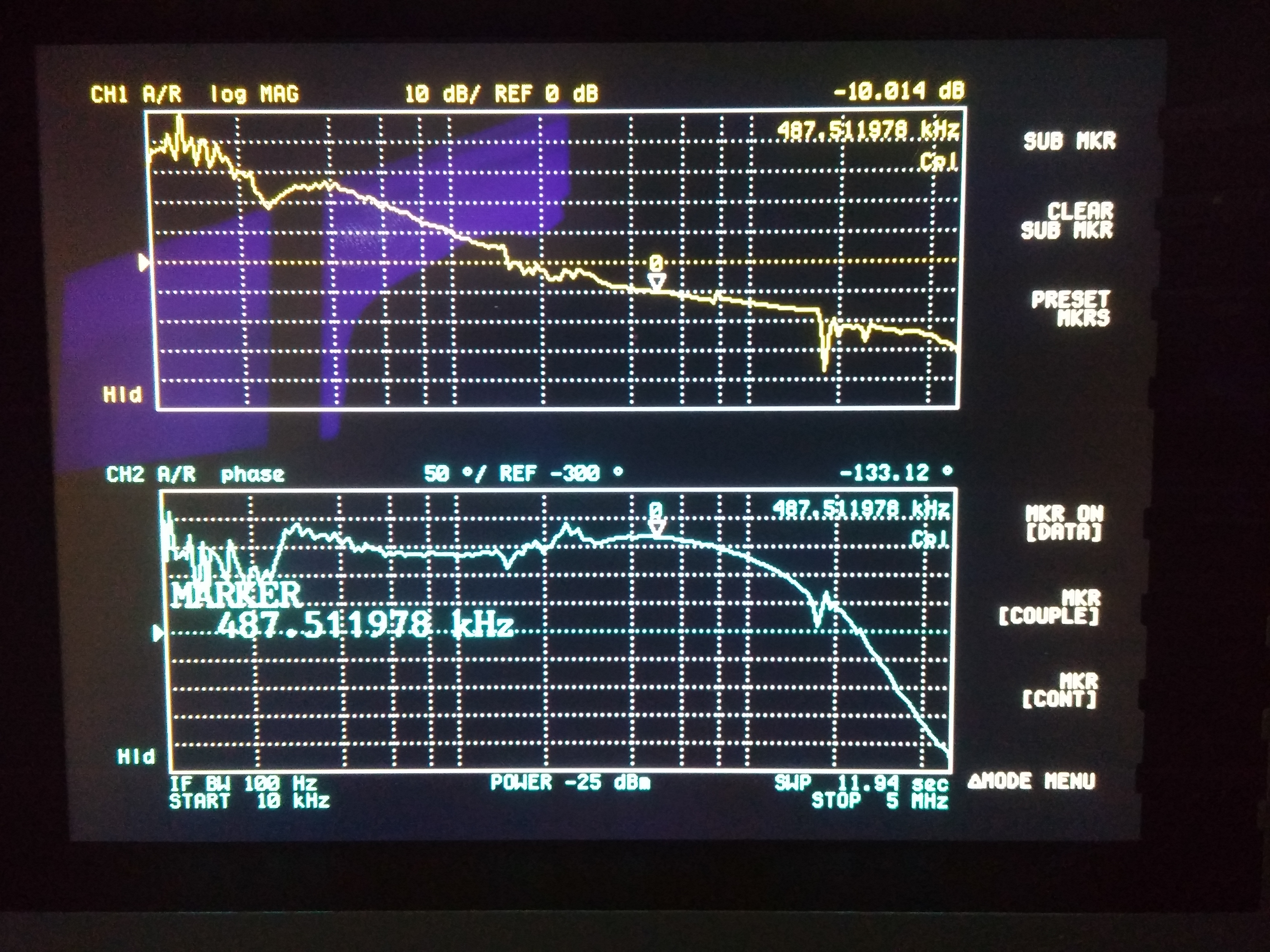
At this point Rick noticed that the beam spot on the viewer card we were using looked odd, almost like a HG01 mode. We traced the beam back through the beam path, looking for dirty optics along the way. We noticed that the 2nd FSS mode matching lens, L10, looked really dirty. We attempted to clean it in situ, but that didn't work out so well so we removed the lens and cleaned it. We also noticed some spots on WP05 and M25, so we cleaned these optics as well (done in situ). This complete, the beam on the card looked a good deal better but still had a bit of HG01 look to it. Pressed for time, we decided to move on and see how the RefCav locked before persuing this more. Before relocking the RefCav, the beam alignment through the EOM was checked and found to be a little off horizontally on the EOM output aperture. An iterative alignment between mirror M26 and the EOM itself was used to fix this; this was done to hold the beam near the center of the RefCav Refl camera, our rough alignment reference. That complete, we used the autolocker to lock the RefCav, which locked with no issues. The picomotor-controlled mirror mounts were used to peak up the TPD; when done, we had a RefCav TPD of 5.58 V. To finish, we measured the TF of the FSS, see attachment (if the phase plot looks weird, that's only because it was unwrapped). With the gains unchanged (common gain at 20, fast gain at 16), we have a UGF of 487 kHz, so no gain adjustment was needed (recall that the UGF of the FSS is measured at a magnitude of -10dB due to the electronics of the 2nd gen TTFSS we currently use). This completed the FSS tune-up. As of right now, the RefCav TPD is reading 5.66 V.
Finally, I turned both power watchdogs ON (we turn them off when working in the enclosure) at 20:30 UTC (12:30 PST), thereby completing FAMIS 10741.
I do want to note one interesting thing. We forgot to turn the ISS 1st loop back ON when we were done. Once I remembered to do this IFO recovery had already started, and Guardian was at the INCREASE POWER stage. This means the locking sequence survived all the way to INCREASE POWER with no 1st loop ISS engaged (the 2nd loop is generally engaged shortly after DRMI acquisition, I did not notice if it was engaged with no 1st loop); DARM did have a fairly ugly, and expected, high-frequency noise hump. The 1st loop engaged with zero issues, didn't even break the lock. The noise hump went away and Guardian continued on its merry way like nothing had happened. Huh. *nods head sagely*
For future reference, the vertical adjustment of the AOM was in the direction of increasing its distance from the table surface.
This is not the first time we have experienced the need to change the AOM height. In fact, adjustment knobs were already installed in both actuators needed to change the AOM height.
When time allows, we want to try swapping out the AOM to see if this FSS alignment issue is related to issues with this particular AOM. We don't recall having these issues with previous incarnations of the LIGO PSLs. We have been using the same AOMs in very similar optical configurations for more than 20 years.