evan.goetz@LIGO.ORG - posted 11:58, Friday 28 February 2020 (55349)
Analysis of second measurement data for start-of-lock sensing function evolution during IFO thermalization
Jeff/Corey/Patrick ran the comb of injections yesterday (see LHO aLOG 55338) similar to what was done previously (see LHO aLOG 53951). This was to follow up and confirm the results we had obtained previously where we observed a significant systematic effect around 20-30 Hz at the very beginning of lock stretches that would be outside of our nominal uncertainty budget (see LHO aLOG 55182).

Jeff and I anticipated getting another complete measurement done yesterday, but due to some mix-up, we don't have the data from the H1:LSC-DARM1_EXC_DQ channel, meaning we have no measurement of the live, real-time loop suppression at our injection frequencies in order for us to compute the sensing function. :( Fortunately, we were able to compute live, real-time response function measurements to compare with modelled values. This is still quite informative and yields a consistent picture as before for the current interferometer configuration: at the beginning of the thermalization, the sensing function is a detuned anti-spring, eventually settling into a thermalized state of pro-spring with very close to zero Hz detuning. (NB: commissioning efforts may change this behaviour in the future.)

I used data from Feb 27 2020 23:14:00 UTC to Feb 28 2020 01:16:00 UTC. The script to run the analysis lives in the calibration SVN here:
^/trunk/Runs/O3/H1/Scripts/FullIFOSensingTFs/process_sensing_20200227_darm_comb.py

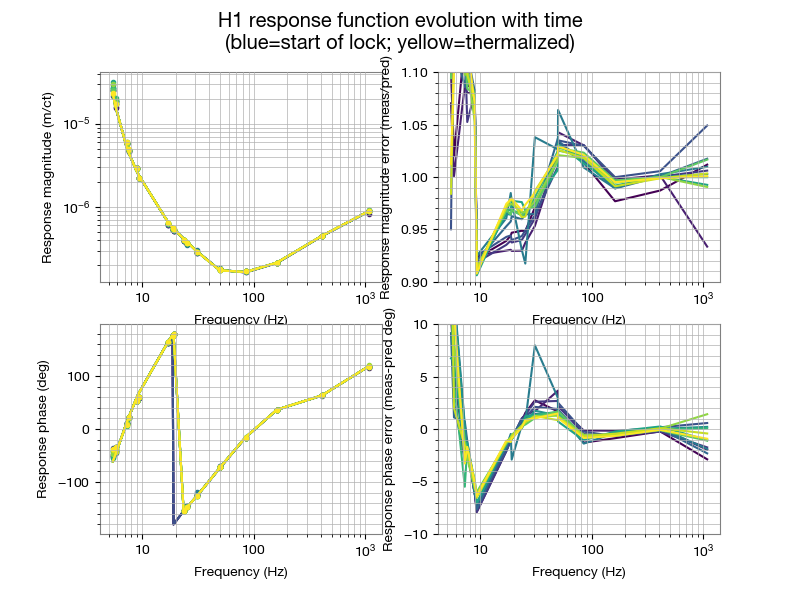
Here, we do not attach as many figures as LHO aLOG 55182 because our sensing function data is meaningless (it's all zeros). Attached are the following figures:

Figure 1: Response function at intervals of 10 minutes to show the evolution as a function of time (BLUE is the start of the lock, YELLOW is the thermalized IFO state)
Figure 2: Response function at intervals of 10 minutes to show the evolution as a function of time if one also applies the f_s value as computed by GDS, assuming a Q value of 20 (BLUE is the start of the lock, YELLOW is the thermalized IFO state)

Our only handle on the thermalization effect is the 17.1 Hz Pcal line where a model assumes a detuned spring for the sensing function and a value for f_s is computed from the line measurement. This is written by the GDS calibration pipeline to H1_HOFT_C00 frames in the channel H1:GDS-CALIB_F_S_SQUARED. A positive f_s^2 value indicates an anti-spring, and a negative value indicates pro-spring. Empirically, applying this correction for these two experiments seems to provide some benefit, but we have not normally been applying this correction since there are also indications that applying it all the time makes things worse (see LHO aLOG 51916).

So, again, bottom line is that there is a ~7% systematic error around 20-30 Hz at the very start of lock stretches (nominal low noise), resulting in a larger systematic error than the budget for a thermalized H1 interferometer state. The hourly budget computed is not wholly adequate for H1 thermalization behavior early in lock stretches.
Images attached to this report