evan.goetz@LIGO.ORG - posted 15:40, Friday 28 February 2020 (55352)
Some evidince of maintenance efforts improvement on spectral lines
There had been some recent activity to see if any electronics configuration changes at EX might have an impact on spectral lines in long coherence spectra of h(t). I've gathered up some tentative evidence that changes implemented from Feb. 12 - 18 had a positive impact on h(t). It appears that whatever changed that period was reverted. I don't know what was done that particular week, the CDS folks like Richard and Fil will have better knowledge than me, but here's what I find:

Figure 1: Ratio of 1 week of averaged 1800 s SFT data (week 46, Feb. 11-17) over the whole O3 cumulative averaged SFT data. What sticks out to me (and is not seen any other week of O3) is the comb of lines that drop below the ratio of 1.0, marked by the red ellipse. The comb spacing is 0.9856 Hz. (link to the data)

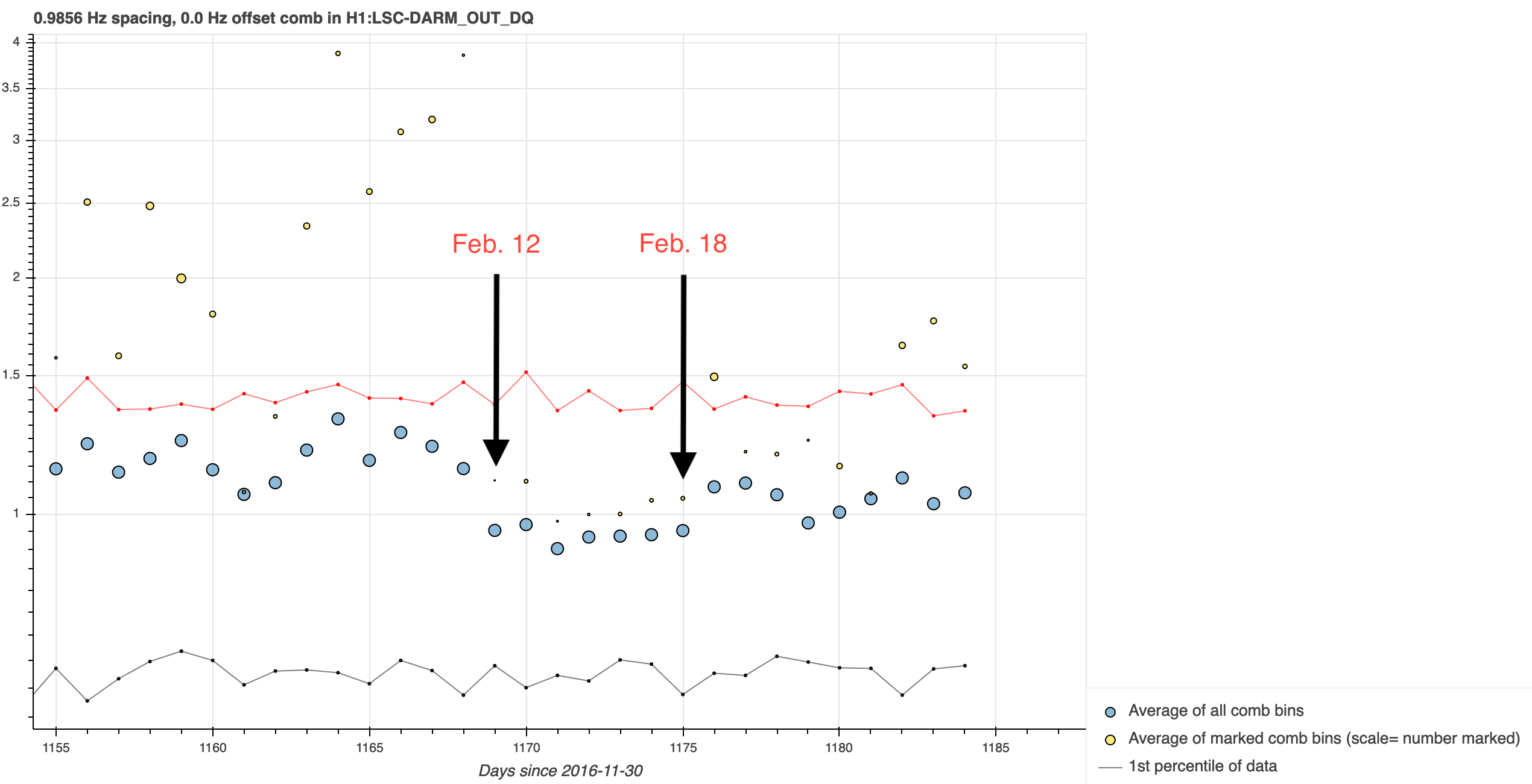
Figure 2: From the comb tracking summary page, a zoom in on the 0.9856 Hz comb that is being tracked in the H1:LSC-DARM_OUT_DQ channel. Here, both yellow and blue data points drop noticibly on Feb. 12 and remain fairly low until Feb. 18. After Feb. 18, there seems to be more variation, although it is still a little lower than before

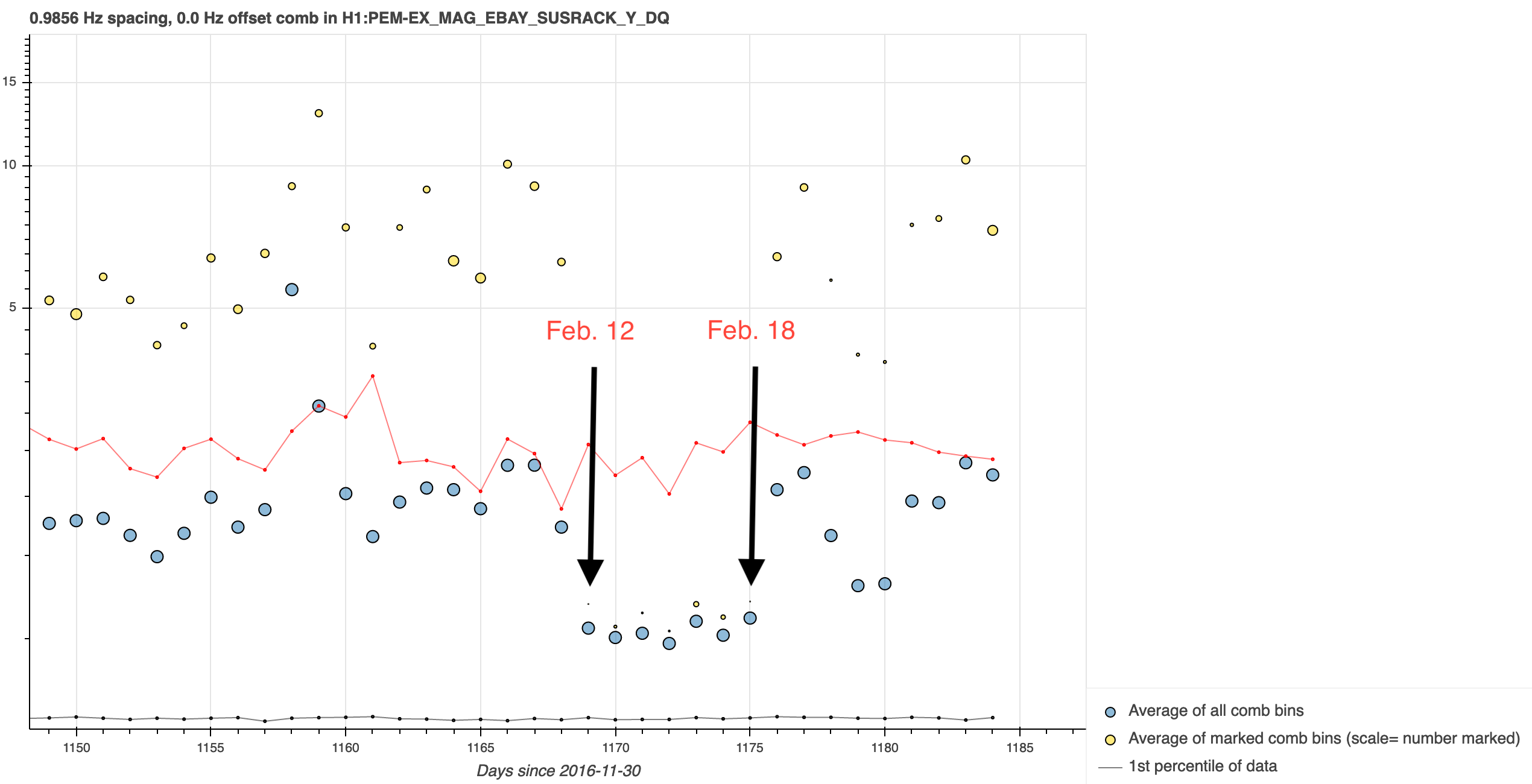
Figure 3: The same comb tracking page also tracks a few auxiliary channels. Here is H1:PEM-EX_MAG_EBAY_SUSRACK_Y_DQ showing the strongest decrease. I wanted to be sure it's not just coupling from the SUS channels feeding back so I look further away on a magnetometer placed in the SEI rack in the next figure

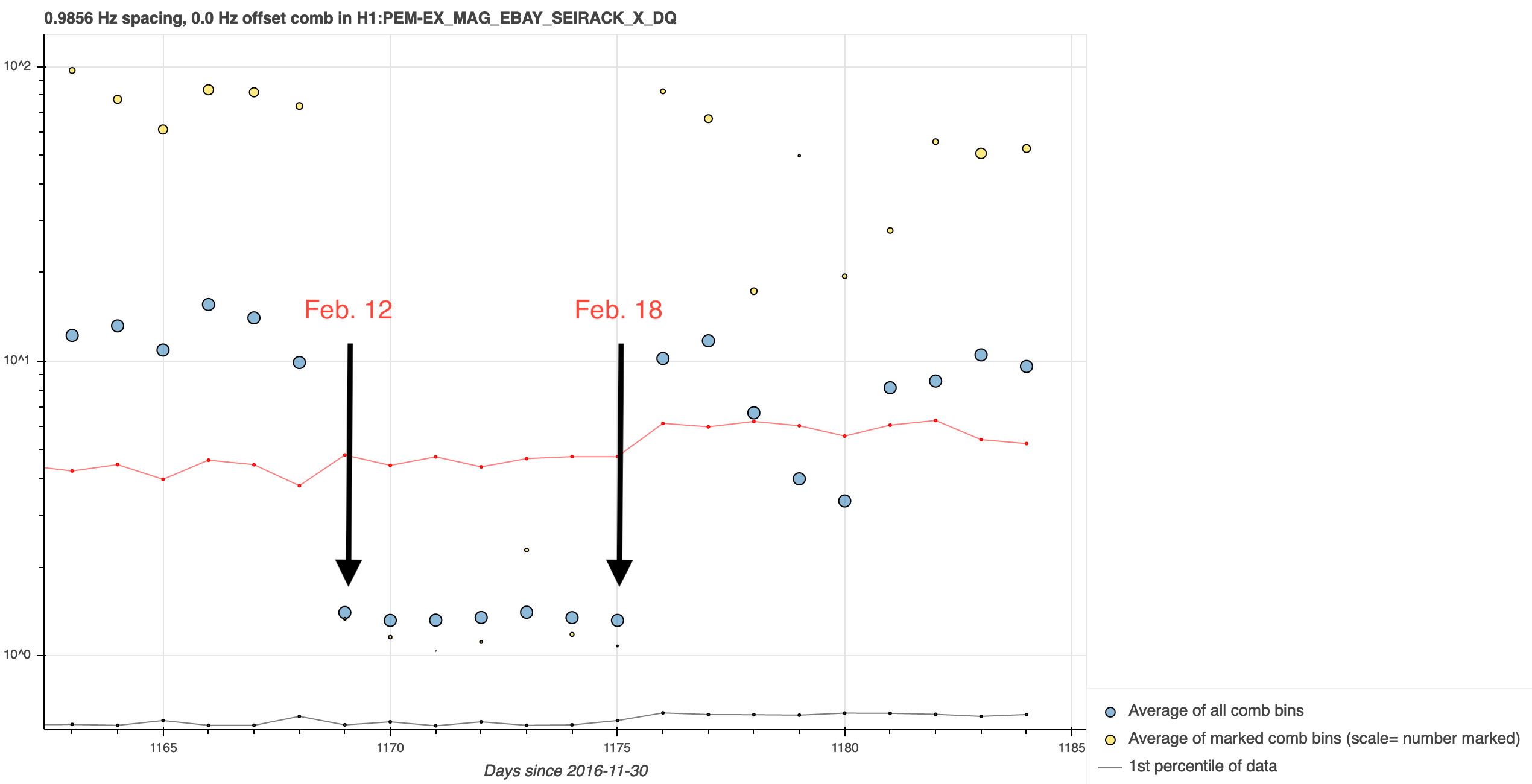
Figure 4: Here is the H1:PEM-EX_MAG_EBAY_SEIRACK_X_DQ channel showing the biggest decrease, larger than in the SUSRACK, nearly an order of magnitude smaller.

Unfortunately, the week 47 ratio plot shows that the improvement did not stick around. I'm not sure if that's because some configuration was reverted.

In summary, the evidence is partial that whatever was done at EX for the electronics configuration did seem to have some partial benefit. Perhaps this work will yield a better and permanent fix in the future.

Images attached to this report