
jeffrey.kissel@LIGO.ORG - posted 14:42, Monday 02 March 2020 - last comment - 18:19, Monday 02 March 2020(55377)
More PCALX vs. PCALY Calibration Line Test at 530 Hz; Lines Installed / Moved, and Now On In Observation Ready for ~4 hours
J. Kissel, S. Karki

Sudarshan / Dripta have analyzed the data from the last test of PCALX vs. PCALY from back in early February (LHO aLOG 54873), and found that -- even with the factor of ~8 increase in SNR they gained from moving the usual 1153 Hz pair of lines down to 530 Hz -- the variation in the data over the 4 hour test was too large to determine the calibration discrepancy between the ends to a satisfactory precision.

Thus, today, we try again, with the PCAL lines back down at 530 Hz, but with an increase in amplitude by a factor of 3 (and a flip-flip of frequency assignment).

These lines will be in the data for ~4 hours, and have been installed in the observation ready segment starting at Mar 02 2020 22:13:35 UTC (1267222433).
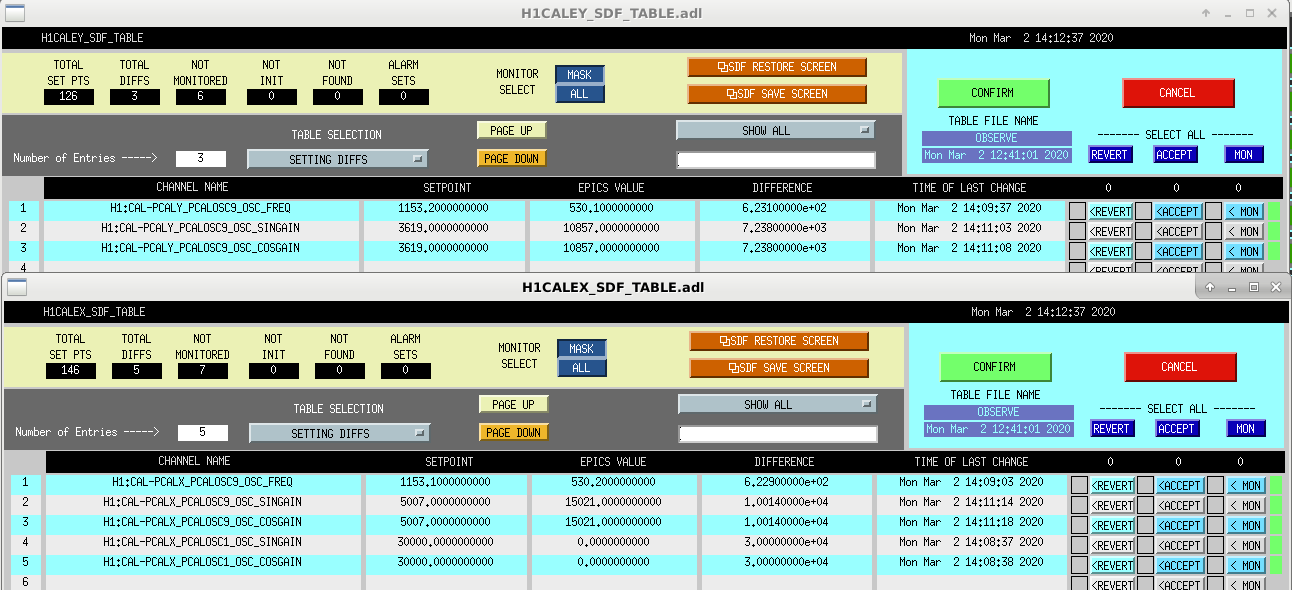
PCALX has been placed at 530.20 Hz, with amplitude 3.0*5007.0 = 15021.0 ct_pk.
PCALY has been placed at 530.10 Hz, with amplitude 3.0*3619.0 = 10857.0 ct_pk.

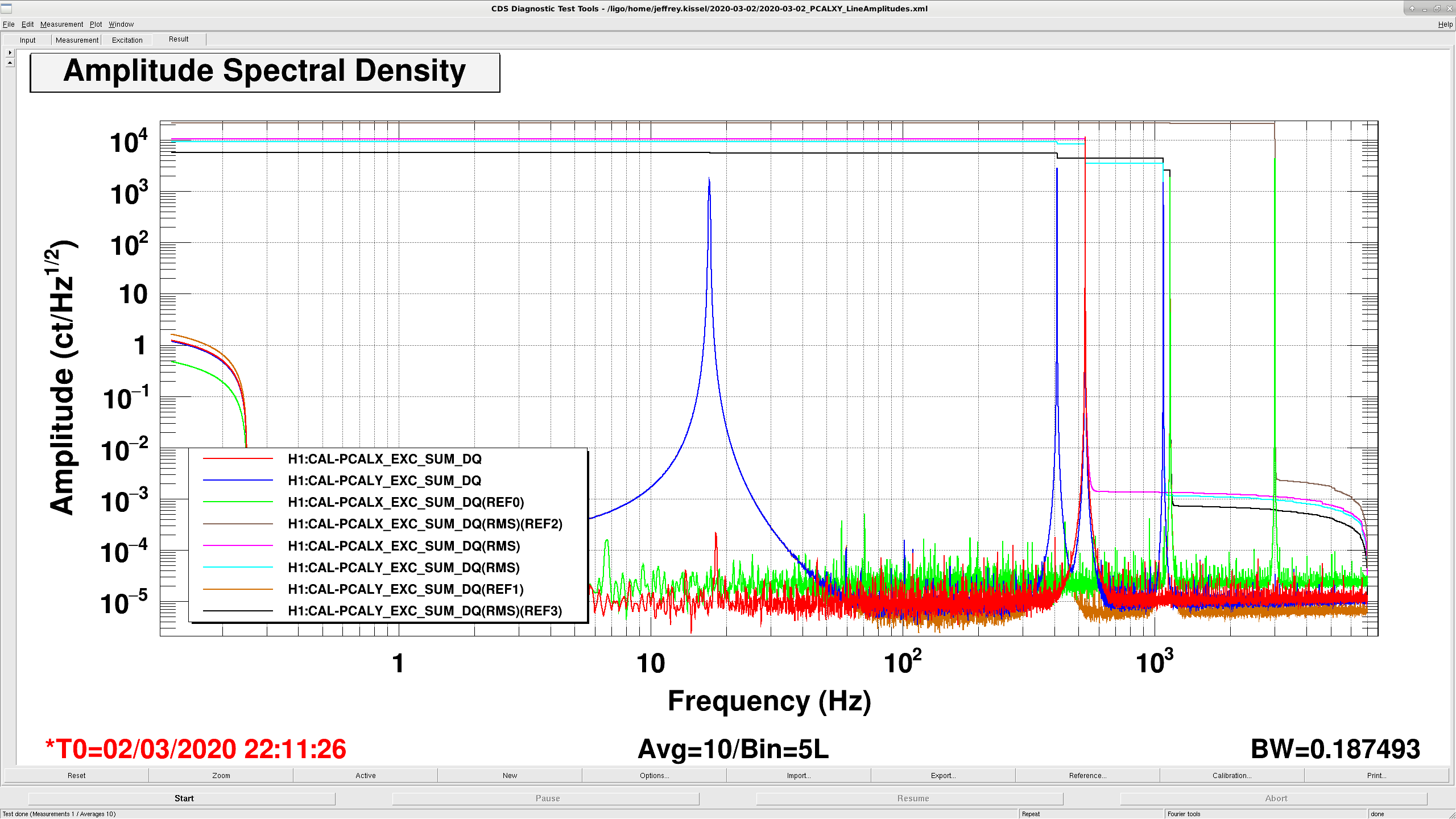
With these excitation amplitudes -- and the other "normal" PCALY calibration lines running at 17.1, 410.3, and 1083.7 as well as pulsar injections -- the RMS excitation value is 16021.6 ct_RMS for PCALX and 9189.13 ct_RMS for PCALY. The RMS for PCALX when high frequency roaming line is at 3001.3 Hz, is 21507 ct_RMS, so theoretically there is more head room to increase the amplitude more, if need be, but at the time we don't find it necessary, and we do quite enjoy this kind of head room we have before saturation.


Attached are screenshots of the SDF differences that were accepted to make this temporary change, and an ASD and RMS of the total requested excitation signal coming out of each PCAL.
Note -- in order to obtain this increase, we had to completely turn OFF the high frequency roaming PCALX line (which is currently at 3001.3 Hz -- but given that we've had a beautiful 70+ hour lock stretch, we won't miss these 4 hours).
Images attached to this report
Comments related to this report
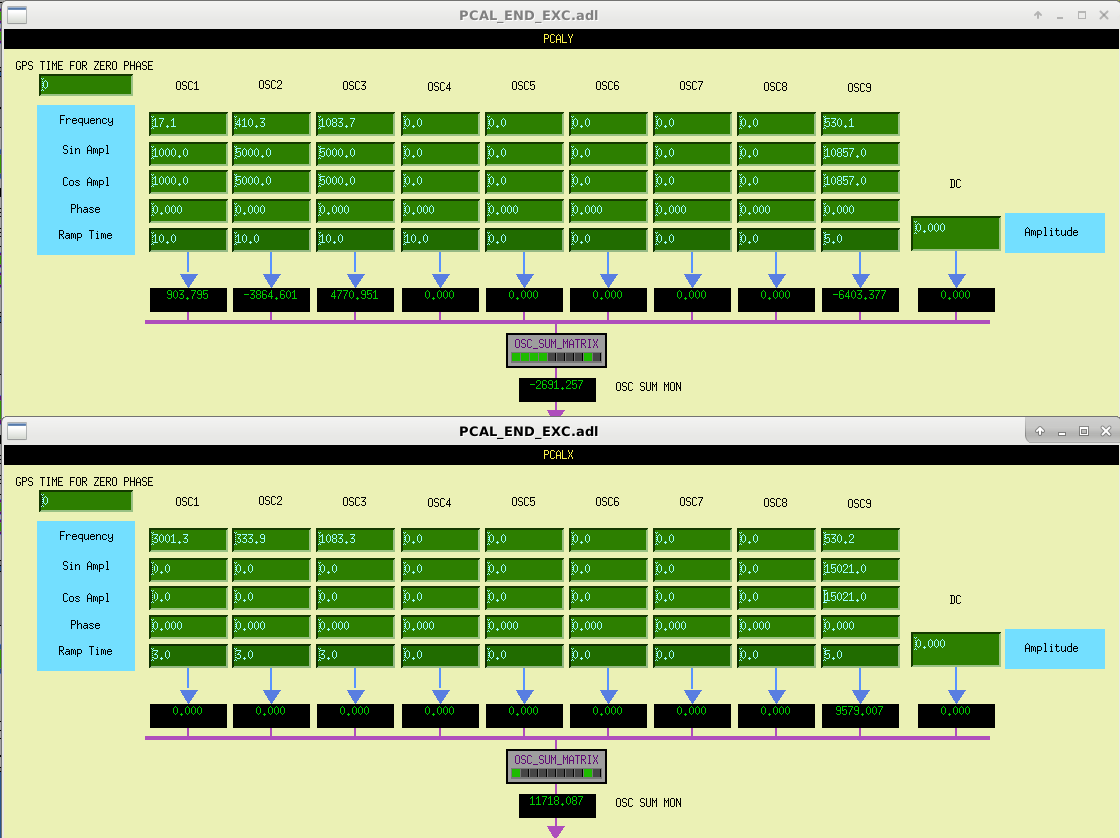
Attached is a screenshot of the PCAL oscillator MEDM screens during this test.
Images attached to this comment
These lines have been switched back to X=1153.1 and Y=1153.2 Hz at 2020-03-03 02:14:25 UTC, and we're back in observing by 2020-03-03 02:17:26 UTC. We have data at 530.1 and 530.2 for approx for 4 hours.