
jeffrey.kissel@LIGO.ORG - posted 17:49, Friday 08 January 2021 (57621)
Medium-level Success on Measuring H1 SUS ITMY New Violin Modes In-air Chamber-side
J. Kissel, T. Sadecki, B. Weaver

%%% Summary %%%
Betsy and Travis took the morning to open up the fiber guard windows on cage of the freely suspended H1 SUS ITMY, in order to setup and create a viewport for the shadow sensor system we typically use to measure the monolithic fiber's violin modes. They then installed the shelves that mount to the QUAD's cage and hold the HeNe laser on one side, and a steering mirror and QPD on the other.

From there, we set up the shadow sensor (HeNe + QPD) to be first aligned on the -X / +Y, S1800721, Front Left (FL) fiber whose fundamental violin mode is roughly calculated from first principles to be 494.0 Hz (see S1800721 and explanation of calculation in T2000688), and the Glasgow Team predicts a fundamental of 495.25 Hz with FEA (see T2000707).

I've quit for the day, having *only* measured the -X / +Y, S1800721, FL fiber, and key'd OFF the HeNe's laser interlock. Travis has set up the shadow sensor to measure the next fiber, +X / +Y, S1800751, FR, Rough 496.9 Hz, FEA 497.31 Hz, so on Monday I can just key on the laser and resume measurements.

%%% More detailed thoughts, defining "Medium-level Success" of the Measurement %%%

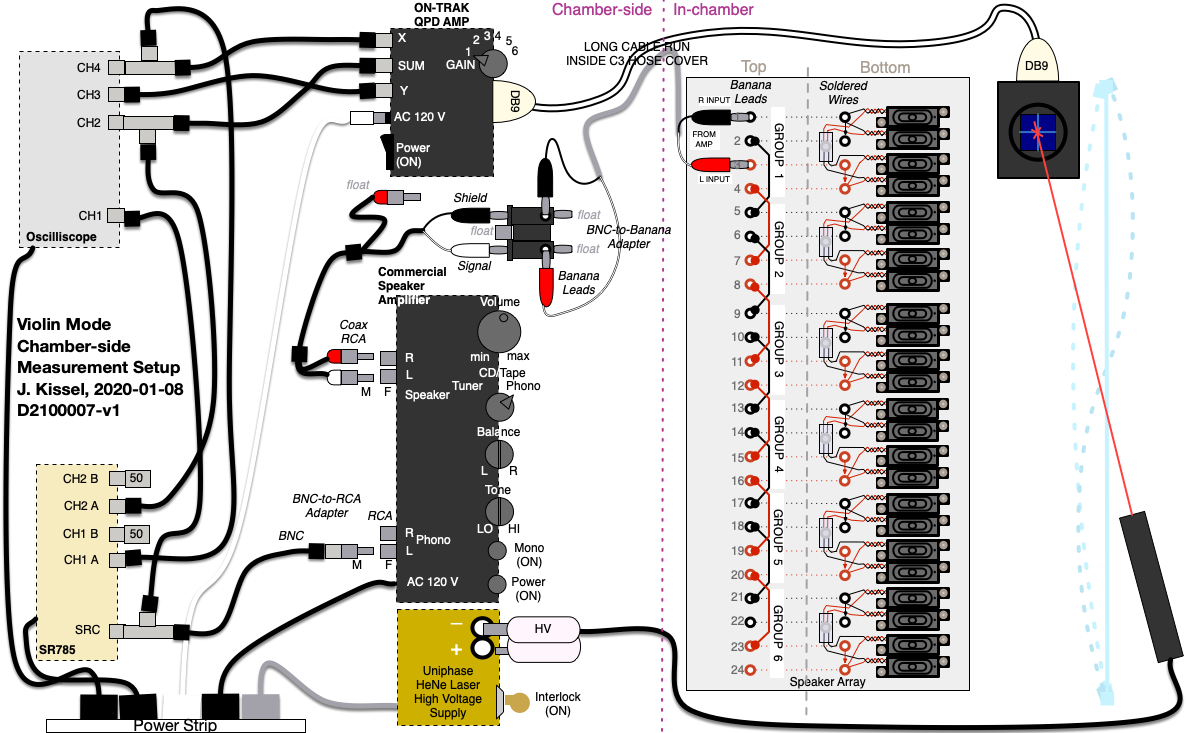
It took a few hours yesterday and more again this morning for me to re-remember how to setup the mess that is the sensor / actuator electronics and data acquisition system for the shadow sensor. It's just barely documented in T1700430 and T1700414, and otherwise composed of cobbled together spare parts around site when the system first arrived on site in 2017. I attach a .png of a new diagram I've made of the system as it stands now (and posted a .pdf and the graffle source to the DCC as well, under D2100007). I had to make a last-minute repair to the speaker array yesterday because a critical but subtle solder joint became loose, hence me needing to understand the system in such great miserable detail. But, indeed, the diagram may help a future systems' designer by encompassing everything needed.

Then, once set up and functional, I spent more hours re-learning all the gotchas within the measurement excitations and data, and playing the same slow mode-search game we've played before -- most recently in 2018 with ETMY, see LHO aLOG 40509; and in 2017 with H1SUSITMX, see LHO aLOG 39163. I had about as much success as I did with H1SUSETMY in 2018 -- the Qs of the mode and its harmonics (if I even find them), are quite low, and given the limited capabilities of my sensor, actuator, and data acquisition system, I'm left searching and fumbling for quite some time.

It's been too long since 2017's H1SUSITMX measurements, but I really do wonder how we had so much success. My guess is that I was duped by what I now know are artifacts of the data, all of which I was not-so-kindly reminded of today. They include but are not limited to:
    - sharp harmonics of AC / 60 Hz power used throughout the setup,
    - sharp excess power features at exactly the central frequency of the frequency band (and artifact of windowing? the 785? dunno),
    - saturations of the QPD,
    - up-conversion/sidebands from the rigid-body modes of the free undamped SUS broadening the modes, or
    - direct coupling between the speakers and the QPD (confirmed this time, for the first time, by sending in a manual "swept sine," and seeing the excitation happily sweep along the in sensor ASD).

Through the re-read of T2000707, I was reminded that the original intent of the array was to be mounted right next to the fiber, and for the user to mix-and-match the speakers in a operator-switch-board in order to better excite the mode shape. While doing so would be far too dirty and cumbersome in chamber, instead, we the array is sheathed in a C3 hose cover, and all of the speakers are tied in and all excite simultaneously, using a 50 Hz wide band-limited white noise excitation. However, the *capability* to use speakers in a way tailored to the mode shape of the harmonic, reminds me that the shadow sensor is measuring just one cross-section at roughly the middle of the fiber in one direction. So it may very well be that some of the harmonics physical motion just won't manifest above the sensor noise because there's a node in the motion for that harmonic where the shadow sensor "slices" the fiber. I've begun dreaming of a collection of shadow sensors along the length of the fiber guard...

... but in short the system design could use a *major* upgrade if we plan to keep making these measurements throughout the future (as I think we do). Of course, too late for this round, so I'll keep fighting the good fight.

I attach my notes from today. Although I've exported the ASD data in support of the notes from the SR785, I haven't yet processed the data in as nice a form as I'd done for 2018 H1SUSETMY or 2017 H1SUSITMX. In due time. For now, the best we can say from today is that the fundamental of this mode appears to be 501.375 Hz measured with a crude binwidth of 0.125 Hz. Even with the crude binwidth, though, we can say that the measurement is different from both the first-principles and FEA prediction.
Images attached to this report
Non-image files attached to this report
